How Vacuum-Assisted Biopsy Needles Achieve Micron-Level Precision
Jun 12, 2026
https://pmc.ncbi.nlm.nih.gov/articles/PMC4115763/
The clinical performance of vacuum-assisted breast biopsy needles is highly dependent on manufacturing precision. The sharpness of the needle tip, the smoothness of the sample slot, and the concentricity of the cutting sleeve-every micrometer-level deviation can affect the success rate of sampling and patient safety. Taking the manufacturing process of Manners Company as an example, this article analyzes the precise process chain of VABB needles from raw materials to finished products.
I. Material Selection and Pre-treatment
The three main components of the VABB needle-the needle tip, the sample notch cannula, and the cutting cannula-are all made of SUS 316 stainless steel. This material contains 2%–3% molybdenum, has strong resistance to pitting corrosion, and has a hardness controlled at HRC 30–40 (equivalent to Vickers 300–400 HV), balancing puncture force and flexibility. All incoming materials must be accompanied by an ASTM F899 certificate and undergo RoHS and REACH compliance testing. Manners provides material certification to ensure batch traceability.
II. Precision Machining of the Heart-shaped Lathe
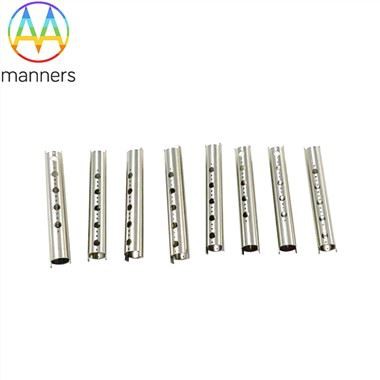
The core processing equipment is a Citizen L12-1M7 centerless automatic lathe with a positioning accuracy of ±0.005 mm and a repeat positioning accuracy of ±0.002 mm. The processing of the needle tip is the most complex: it requires milling three curved surfaces on a stainless steel rod with a diameter of approximately 1.5 mm to form a razor-sharp edge. This process takes about 30 minutes and is carried out using a ∅0.4531-inch flat-bottomed end mill for normal cutting along the normal direction to ensure symmetrical cutting edges. The sample slot sleeve needs to be milled to create a long strip-shaped window (slot), with a width tolerance of ±0.01 mm and an inner wall roughness of Ra ≤ 0.4 μm to reduce tissue friction. The cutting sleeve needs to complete flaring, end face processing, inner chamfering, and marking slot processing. Each step is completed on the same machine through multi-axis linkage to ensure that the clearance between each component is less than 0.02 mm.
III. Laser Marking and Sandblasting
Depth scale lines need to be marked on the sample slot sleeve so that doctors can determine the puncture depth under ultrasound or X-ray. Manners uses a JPT fiber laser marking machine, which precisely controls the beam energy density and forms a permanent black mark on the tube wall without damaging the substrate. Subsequently, sandblasting is carried out to create a uniform matte texture on the surface. This not only reduces the interference of mirror reflection on the ultrasound image but also enhances the uniformity of the current distribution during electrolytic polishing.
IV. Passivation and Electrolytic Polishing
All components are immersed in a citric acid solution for passivation to remove free iron ions and form a chromium-rich oxide film with a thickness of approximately 2–5 nm. The corrosion resistance is enhanced by more than 10 times. Then, electrolytic polishing is carried out: the workpiece is used as the anode, and direct current is passed through the phosphoric acid-sulfuric acid electrolyte. The anode dissolution first removes the microscopic peaks, reducing the surface roughness to Ra ≤ 0.1 μm. This step not only reduces tissue damage but also eliminates the microcracks remaining from machining, thereby extending the fatigue life.
V. Ultrasonic Cleaning and Sterile Packaging
After electrolytic polishing, the components are placed in an ultrasonic cleaning machine (with a frequency of 28–40 kHz), and deionized water and neutral cleaning agents are used to remove residual electrolyte and particles. Subsequently, they are dried in a Class 10000 clean room and vacuum-sealed in double-layer PP bags. Samples from each batch are taken for size re-measurement (using pin gauges and calipers), puncture force testing (simulating tissue), and appearance inspection. The final product is accompanied by a COC certificate and is transported via TNT/DHL/FedEx cold chain.
Conclusion
Behind each VABB needle lies the micron-level milling of the precision turning machine, the precise positioning of laser marking, the mirror-like finish of electrolytic polishing, and the thorough purification of ultrasonic cleaning. It is this ultimate pursuit of manufacturing processes that enables vacuum-assisted biopsy to achieve the clinical goals of "one puncture, multiple samplings, low trauma, and high diagnostic rate." As an OEM/ODM supplier, Manners is promoting the continuous advancement of breast biopsy technology with its precise manufacturing capabilities.