Decoding Micron-Scale Machining For Vacuum-Assisted Breast Biopsy Needles
Jun 12, 2026
1. Needle Tip Milling: 30 Minutes of Meticulous Craftsmanship
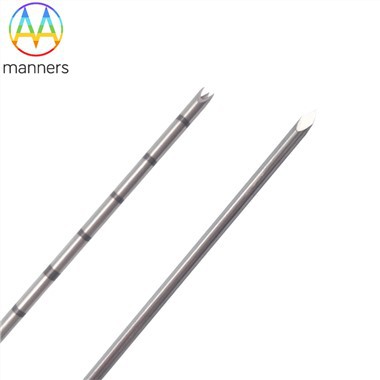
The needle tip is the most vital component of a VABB needle, engineered with sharp triple-curve cutting edges to slice tissue efficiently during rotary or reciprocating motion. Production relies on the Citizen L12-1M7 sliding headstock lathe, boasting positioning accuracy of ±0.005 mm and repeat positioning accuracy of ±0.002 mm.
For tip milling, a 0.4531-inch flat-end square mill cuts perpendicularly to the feed path to machine three curved surfaces sequentially. The full cycle takes roughly 30 minutes, as the angle, depth and transition zone of every curved surface demand stringent precision control to guarantee edge sharpness and symmetry. Post-machining, the tip undergoes profile projector inspection; only those with cutting edge radii under 5 μm proceed to subsequent processes.
2. Sample Notch Cannula Grooving and Laser Marking
The sample notch cannula acts as the critical channel to hold harvested tissue specimens. Its fabrication comprises two core stages: notch grooving and laser marking. Grooving is also performed on the Citizen L12-1M7, where precision cutting creates a rectangular or oval lateral opening (sample notch) on the tube wall. Notch edges must be burr-free and ultra-smooth to prevent laceration of tissue samples.
Subsequently, a JPT laser marker etches depth scales, model codes or QR codes onto the cannula's outer surface. Laser marking is a non-contact process: high-energy-density laser beams vaporize or discolor surface material to form permanent markings. These marks resist abrasion and repeated sterilization without compromising the tube's mechanical properties, perfectly satisfying traceability requirements for medical devices.
3. Cutting Cannula Flaring and Chamfering
The cutting cannula reciprocates inside the sample notch to sever tissue, involving a more intricate manufacturing sequence. First, the tube end is flared into a bell-shaped inlet for seamless assembly with the needle tip assembly. Next, face and internal chamfers are machined to deliver smooth cutting edges and tight fitting against the sample notch. Marking and secondary grooving (for sealing or guide structure installation) are completed on the same lathe in one setup.
Dimensional tolerances for every step are held within ±0.01 mm. Excessively large or tiny gaps between the cutting cannula and sample notch would degrade cutting efficiency and compromise specimen integrity.
4. Technical Advantages of the Precision Lathe
The Citizen L12-1M7 is a Swiss-type sliding headstock lathe. Its defining feature is an axially slidable main spindle paired with a guide bushing that rigidly supports bar stock, enabling fabrication of slender parts with extreme length-to-diameter ratios.
Conventional lathes suffer vibration and tool deflection when machining thin tubing like VABB needles (only a few millimeters in diameter and over 10 centimeters long), whereas sliding headstock lathes maintain stable cutting throughout the process. Equipped with a C-axis and live tooling, this machine accomplishes turning, milling, drilling, tapping and other operations in a single clamping setup, eliminating cumulative alignment errors from repeated re-fixturing.
Conclusion