Multi-Process Precision Manufacturing And Electropolishing Technology
Jul 27, 2026
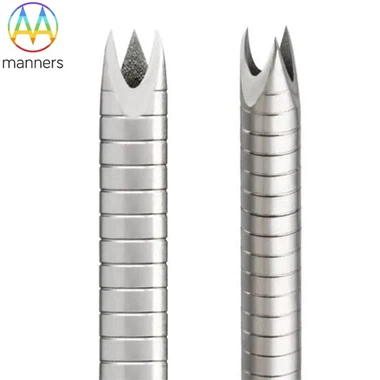
Diamond tip bone marrow biopsy needles fall into the category of high-precision Class III invasive medical devices. Product performance, safety and stability rely entirely on standardised precision manufacturing workflows implemented by manufacturers. Premium industry products undergo six core sequential processes: necking, swaging, precision grinding, laser cutting, laser marking and electropolishing. These procedures distinguish high-quality products from low-end alternatives manufactured via simplified processing. Quality defects including burrs, deformation, corrosion and dimensional deviation are eliminated at the production source to meet international medical device manufacturing norms and domestic quality control criteria.
Primary forming processes guarantee structural stability of needle shafts. Necking precisely controls tube diameter and wall thickness gradients across all gauges 8G–18G. Uniform shaft thickness prevents unbalanced stress distribution and bending risks during puncture. Swaging conducts integrated reinforcement shaping at shaft-handle joints and tip transition zones to remove assembly gaps and stress weak points. Shaft resistance against bending and fracture is significantly enhanced for high-intensity puncture into hard bone, eliminating medical hazards of intra-operative shaft breakage. These two foundational procedures establish dimensional accuracy and structural strength for finished products.
Precision grinding and laser processing enable functional upgrades. Precision fine grinding treats multi-faceted diamond cutting edges, five lateral hole openings and internal/external shaft surfaces. Sharp uniform tips and burr-free apertures avoid tissue tearing and squeezed specimens during sampling to maximise specimen integrity and improve minimally invasive patient experience. Laser cutting accurately forms front lateral holes and functional structures with micron-level dimensional tolerance for smooth multi-hole sampling and even negative pressure distribution. Laser marking imprints specification labels and traceability scales resistant to abrasion to satisfy full lifecycle traceability requirements for medical devices.
Electropolishing represents a landmark finishing process for high-end medical devices and forms a critical quality control barrier for manufacturers. Low-end products only receive basic mechanical polishing. Tiny pores, metal particles and burrs remain on shaft surfaces, facilitating bacterial colonisation, tissue adhesion and inflammatory reactions. Manufacturers apply medical-grade electropolishing to achieve mirror finishing over the entire needle shaft. Surface impurities and micro burrs are removed while metal surfaces are passivated. Stainless steel corrosion resistance and biocompatibility are greatly improved to prevent tissue adhesion, cell retention and bacterial attachment, meeting stringent requirements for single-use sterile minimally invasive treatment.
Supported by the complete processing workflow, manufacturers deliver products characterised by high precision, safety and wide adaptability. All items pass biocompatibility, sterility and mechanical performance testing without cytotoxicity, sensitisation risks or metal residue. Compared with low-end industry alternatives produced through simplified processing, these products achieve comprehensive upgrades in processing precision, stability and clinical safety, catering to advanced diagnostic scenarios of medical institutions worldwide and demonstrating professional manufacturing strength and rigorous quality standards of leading manufacturers.