Breaking The Zero-Center Deadlock: Innovation And Simplified Strategies Of Brachytherapy Needles For Low- And Middle-Income Countries
Apr 29, 2026
Breaking the Zero-Center Deadlock: Innovation and Simplified Strategies of Brachytherapy Needles for Low- and Middle-Income Countries
Lancet Oncology research has outlined a grim global landscape: 58 countries worldwide lack any brachytherapy facilities, with a 0% treatment coverage rate in low-income nations. Demand in these marginalized regions is projected to surge by 169% by 2050. Filling this critical gap cannot rely on duplicating the costly, hyper-complex center models of high-income countries. The fundamental solution lies in developing and popularizing innovatively simplified brachytherapy needles and workflows tailored to resource-limited environments, guided by the core principles of accessibility, affordability and sustainability. Traditional needle hardware and clinical protocols require targeted, practical optimization to adapt to local constraints.
I. Core Barriers of Conventional Needle Systems in Resource-Limited Settings
1. Prohibitive Per-Treatment Costs: Most high-end interstitial needles are designed for single use, placing an unaffordable financial burden on underfunded public health systems and individual patients.
2. Overreliance on Advanced Imaging: MRI-guided 3D interstitial brachytherapy remains the clinical gold standard, yet MRI scanners are extremely scarce and costly to maintain in LMICs. The lack of MRI access is widely misperceived as an insurmountable barrier to safe interstitial implantation.
3. Complex Sterilization and Quality Control: Reusable needle systems demand fully equipped central sterilization departments and regular integrity testing (for bending, tip burrs and structural damage), which are difficult to sustain in regions with weak infrastructure.
4. Prolonged Learning Curves: Mastery of complex multi-needle implantation and 3D plan optimization requires years of specialized training for physicians and medical physicists, creating a severe global talent shortage.
II. Innovation and Simplification Pathways for Needle Hardware and Clinical Workflows
Systematic breakthroughs must start with the iterative design of end-use needle devices and standardized clinical procedures.
1. Needle Hardware Innovation: Durability, Cleanability and Ultrasonic Visibility
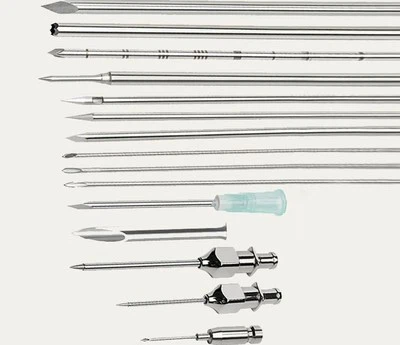
- Ultra-Durable Reusable Needles: Develop specialized alloy needles with high-performance coating treatments, expanding safe reusable cycles from 10 times to 50 or even 100 times. Large-scale localized manufacturing drastically reduces average single-use costs.
- Integrated Scales and Depth Stops: Wear-resistant engraved depth markings and mechanical locking stoppers reduce absolute reliance on intraoperative ultrasonic depth measurement, minimizing perforation risks caused by operational errors.
- Low-Cost Echogenic Enhancement: Replace expensive specialized coatings with micro-textured tip processing technology to ensure clear visualization on basic universal ultrasound devices, enabling safe real-time guidance without premium imaging hardware.
2. Clinical Workflow Simplification: From 3D Conformity to Standardized 2D Optimization
- Standardized Midpoint-Dosage Interstitial Protocols: Establish tumor size–matched interstitial implantation guidelines for cervical cancer. For example, fixed needle quantity (3 needles), symmetrical layout and standardized depth parameters for 4–5 cm bulky tumors. Rapid dosage calculation based on classic Manchester system principles replaces complex inverse optimization, delivering safe, validated dose distribution without high-end planning systems.
- Pragmatic CT-Ultrasound Fusion Pathways: Adopt CT as the primary postoperative verification modality. Real-time ultrasound guides vascular avoidance and puncture depth during implantation, while post-procedural CT validates needle positioning and supports final dose calculation. This model bypasses MRI dependence, leveraging the far wider accessibility of CT equipment.
- Pre-Assembled Integrated Applicator Kits: Disposable sterile all-in-one sets combining uterine tandems, vaginal applicators and 2–3 pre-angled interstitial needles. Clinicians select size-matched kits based on tumor volume for rapid integral placement and fixation, drastically streamlining operative time and procedural complexity.
3. Service Model Innovation: Mobile Units and Task Shifting
- Simplified Needle Kits for Mobile Brachytherapy: Rugged, portable and easily inventoried applicator and needle sets customized for mobile treatment units, resistant to vibration and harsh field environments.
- Task Shifting with Standardized Training: Under strict standardized protocols and remote expert supervision, authorize trained gynecologists and general practitioners to perform routine template-based interstitial insertion. Specialized radiation oncologists at regional hubs provide remote imaging guidance and quality audits, alleviating the global oncology workforce shortage.
III. Practical Case: Needle Configuration for a Basic Cervical Cancer Brachytherapy Center
A primary center serving a population of 5 million can operate effectively with a streamlined, cost-efficient instrument portfolio:
- Applicators: 3 sets of reusable, size-variable uterine tandems and vaginal applicators.
- Interstitial Needles: 20 ultra-durable high-cycle reusable interstitial needles.
- Guidance Tools: 1 portable ultrasound device for real-time puncture guidance.
- Imaging Hardware: 1 CT scanner for post-implant verification and dose calculation.
- Planning System: 2D/basic 3D planning software equipped with standardized rapid dosage calculation modules.
- Sterilization Equipment: High-pressure steam autoclave for reusable instrument disinfection.
This low-investment configuration delivers curative combined intracavitary-interstitial radiotherapy for locally advanced cervical cancer, with significantly superior clinical outcomes compared to exclusive external beam radiotherapy or conventional intracavitary treatment.
IV. International Collaboration and Policy Support
1. Appropriate Technology Certification Frameworks: Lead by IAEA, WHO and authoritative global organizations to validate and promote simplified, cost-effective needle systems, workflows and planning software that meet unified safety and efficacy benchmarks.
2. Targeted R&D Funding: Launch special grants to support industrial and academic research focusing on low-resource adapted innovative needle designs and streamlined clinical protocols.
3. Open-Source Planning Algorithms: Develop and release open-source standardized dosage calculation software for template-based interstitial protocols, eliminating expensive proprietary software barriers for primary centers.
Conclusion
Expanding brachytherapy access to zero-center nations requires not technological downgrade, but targeted technological redefinition-shifting from pursuing optimal high-resource solutions to developing feasible, cost-effective alternatives. Innovations in brachytherapy needles serve as the strategic cornerstone of this global health initiative. Through durable, user-friendly, imaging-adaptable needle design, paired with simplified standardized workflows and pragmatic technical pathways, sustainable, high-quality brachytherapy services can be established in underserved regions. This challenge demands not only engineering breakthroughs but also collective global ingenuity and commitment. Every rationally simplified, affordable interstitial needle deployed in primary care settings dismantles the technological barriers that deprive millions of women with cervical cancer of curative treatment opportunities.