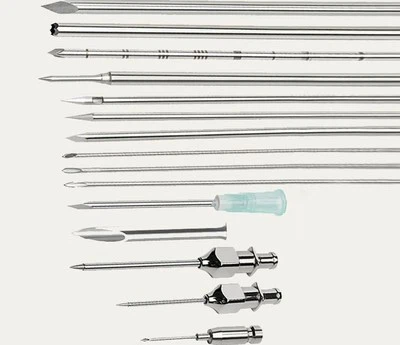
Biopsy Needles: The Unsung Hero Of Precision Medicine And The Path To Domestic Substitution
Apr 18, 2026
Biopsy Needles: The "Unsung Hero" of Precision Medicine and the Path to Domestic Substitution
Core Product Terms: Biopsy Needle, Core Needle Biopsy (CNB), Fine Needle Aspiration (FNA)
Representative Manufacturers: Medtronic, Argon Medical Devices, Cook Medical, Shanghai Inter Medical
The biopsy needle is the "gold standard" tool for tumor diagnosis, and its precision directly impacts the accuracy of pathological results. In the nearly $10 billion global biopsy needle market, high-end products are still dominated by European and American giants, but domestic manufacturers are breaking through via cost-effectiveness and customization services.
I. Product Matrix and Technological Evolution
Based on sampling mechanisms, biopsy needles are mainly divided into three categories:
* Fine Needle Aspiration (FNA) Needles: Small caliber (typically 22G-25G), used for cytological sampling (e.g., thyroid nodules). Represented by manufacturers like BD, known for their echo-enhanced needle tip design for better ultrasound guidance.
* Core Needle Biopsy (CNB) Needles: Larger caliber (14G-18G) with an inner notch, capable of obtaining complete tissue cores for pathological diagnosis (e.g., breast cancer). Medtronic's Tru-Cut type products are mainstream.
* Vacuum-Assisted Biopsy (VAB) Needles: Use vacuum to continuously obtain multiple samples. Representative devices include Hologic's Mammotome, widely used in minimally invasive breast surgeries.
The evolution trend is towards "greater precision and safety." For example, Argon Medical's coaxial biopsy needle allows multiple samples through the same puncture tract, reducing tissue damage; Cook Medical's Chiba needle improves success rates for deep-seated lesions by modifying the needle tip bevel angle.
II. Competitive Landscape: Global Dominance and Domestic Rise
The global market is dominated by multinationals like Medtronic, BD, and Boston Scientific, collectively holding over 60% market share. They have built formidable barriers in high-end tertiary hospital markets through decades of accumulated clinical data and global distribution networks.
Domestic manufacturers (e.g., Shanghai Inter Medical, EikoMed) compete with strategies of "differentiation and cost advantage." Shanghai Inter Medical focuses on orthopedics and anesthesia puncture devices (e.g., bone marrow biopsy needles), leveraging local supply chain costs to enter primary care markets. EikoMed offers flexible OEM/ODM services, providing customized needle solutions for small/medium device companies and exporting to emerging markets.
III. Challenges and Paths for Domestic Substitution
Domestic biopsy needles still lag in materials science (e.g., toughness of medical-grade stainless steel), needle tip geometric precision (affecting puncture resistance and tissue damage), and reliability of single-use systems (e.g., anti-stick safety). The substitution path typically starts in lower-risk areas (e.g., superficial lymph node biopsy) and gradually moves towards more challenging fields (e.g., percutaneous lung biopsy, prostate-targeted biopsy).
IV. Future Trends: Intelligence and Visualization
Future biopsy needles will deeply integrate with image navigation (e.g., MRI real-time guidance) and robotic assistance systems. "Smart biopsy needles" with micro-sensors can provide real-time tissue impedance feedback during puncture, helping physicians avoid blood vessels and nerves. Domestic manufacturers that invest early in such interdisciplinary areas may achieve a technological leap forward.