Manufacturing Processes Of Puncture And Microneedles: Precision Machining, Material Innovation, And Supply Chain Resilience
Apr 18, 2026
Manufacturing Processes of Puncture and Microneedles: Precision Machining, Material Innovation, and Supply Chain Resilience
Core Product Terms: Medical Needle Manufacturing, Microneedle Molding, OEM/ODM
Representative Manufacturers: EikoMed, YOUWE Biotech, Yuanxu Biology (元旭生物)
Although puncture needles and microneedles serve different functions, their manufacturing shares an ultimate pursuit of "precision." The former tests the limits of metalworking, while the latter challenges micron-scale mold technology.
I. Traditional Puncture Needle Manufacturing: The Pinnacle of Metalworking
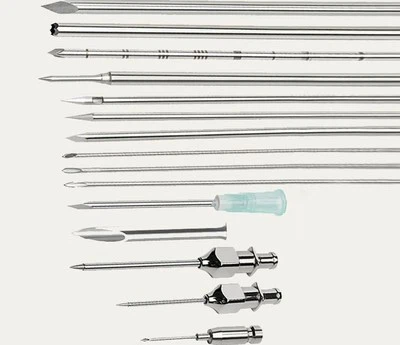
Manufacturing traditional puncture needles (exemplified by EikoMed, Shanghai Inter Medical) centers on the deep processing of medical-grade stainless steel tubing.
1. Tube Drawing and Annealing: Stainless steel tubes are drawn to target outer diameters (e.g., 22G, ~0.7mm) and annealed multiple times to relieve internal stress, preventing cannula bending.
2. Tip Forming: The highest technical barrier. Multi-station precision stamping or grinding creates beveled, pencil-point, or other geometries. EikoMed's proprietary needle tip designs enhance sharpness and reduce tissue drag.
3. Hub Attachment and Polishing: The cannula and hub are joined via laser welding or adhesive, followed by electropolishing to remove burrs, ensuring smooth puncture.
4. Cleaning and Sterilization: As invasive devices, validated cleaning processes remove metal debris and machining oils, followed by EO or gamma radiation sterilization.
Supply Chain Key: The supply of high-precision medical stainless steel strip (e.g., 304/316L) heavily relies on Japan and Germany. Domestic materials still lag in grain size uniformity, a potential cause of yield fluctuation for domestic needles.
II. Microneedle Manufacturing: Micro-Nano Processing and Drug-Device Combination
Microneedle manufacturing (exemplified by YOUWE Biotech, Yuanxu Biology) is closer to a cross between "semiconductor + pharmaceutical" processes.
1. Master Mold Fabrication: The "master" for microneedles, typically made via silicon etching or laser direct writing, is extremely costly. Yuanxu Biology, leveraging its micro-nano processing expertise, develops high-aspect-ratio silicon microneedle masters in-house, reducing outsourcing costs.
2. Replication Molding: Polymers (e.g., hyaluronic acid, PVA) are micro-injection molded or centrifugally cast. YOUWE Biotech's low-temperature, high-pressure injection molding process (MNDF® technology) effectively protects bioactive ingredients (e.g., PDRN) from degradation.
3. Drug Loading: For dissolvable microneedles, drugs are mixed into the polymer matrix before casting; coating microneedles require high-precision inkjet or dip-coating after molding.
4. Drying and Cutting: Microneedles are freeze-dried in ultra-low humidity to maintain hardness, then laser-cut into patches.
III. The Rise of OEM/ODM Manufacturers
The interdisciplinary nature of microneedles has fostered specialized CDMOs. EikoMed provides customized puncture needle services (e.g., special-length spinal needles) for global hospitals; YOUWE Biotech offers full-process ODM services for cosmetic brands, from formulation to production. This "flexible manufacturing" capability is their core competency.
IV. Future Manufacturing Trends: Intelligence and Sustainability
Future factories will introduce machine vision for 100% online inspection of needle tip defects and AI algorithms to optimize molding parameters. Material-wise, biodegradable polymers (e.g., PLGA) will gradually replace traditional plastics, enabling "zero-residue" microneedles and environmental sustainability.