The Diagnostic Precision Revolution: How Breast Biopsy Needles Achieve Millimeter-Level Transition From Imaging Suspicion To Pathological Diagnosis Q&A Appr
Apr 14, 2026
The Diagnostic Precision Revolution: How Breast Biopsy Needles Achieve Millimeter-Level Transition from Imaging Suspicion to Pathological Diagnosis
Q&A Approach
When a suspicious lesion is detected on breast ultrasound or mammography, how can physicians extract the potentially tiny "suspect tissue"-which may be only 5 mm in size-for precise analysis without resorting to surgery? Core needle biopsy (CNB) technology is the key to resolving this clinical dilemma. However, it is worth noting that these biopsy needles, with a diameter of less than 2 mm, achieve sub-millimeter precision under image guidance. How do they ensure the retrieved tissue core is both representative of the lesion and obtained without causing excessive trauma?
Historical Evolution
The development of breast biopsy techniques is an evolutionary history from "radical surgery" to "precision minimally invasive procedures." Before the 1970s, all suspicious breast lesions required surgical excisional biopsy, which resulted in significant trauma and conspicuous scarring. In 1975, Fine Needle Aspiration (FNA) cytology began to be applied, but it could only obtain cells, making histological assessment and molecular subtyping impossible.
The true revolution occurred in the 1980s-with the invention of automated spring-loaded biopsy guns, physicians were able for the first time to acquire intact tissue cores using 14–16 Gauge (G) needles. In the 1990s, the advent of Vacuum-Assisted Biopsy (VAB) technology enabled continuous sampling with larger specimen volumes. Entering the 21st century, the deep integration of image guidance technology with biopsy needles has pushed puncture accuracy to new heights.
Technical Standard Definitions
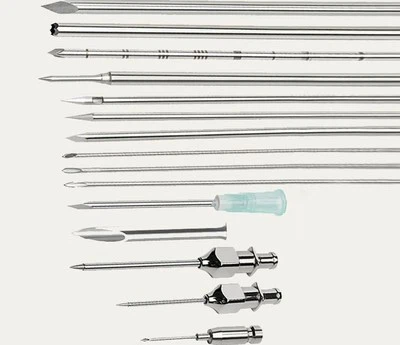
Modern breast core biopsy needles constitute a sophisticated multi-parameter system:
|
Parameter Dimension |
Technical Standard |
Clinical Significance |
|---|---|---|
|
Needle Gauge |
14G (≈2.1mm) standard; 9–12G for vacuum-assisted |
14G balances sample volume and trauma; VAB needles acquire more contiguous samples |
|
Cutting Mechanism |
Spring firing speed 3–5 m/s; Cutting stroke 15–25 mm |
Ensures rapid cutting, reducing tissue crush artifact |
|
Sample Notch |
Notch length 15–22 mm; Depth determines sample diameter |
Standard notch acquires 1.5–2.0 cm tissue core |
|
Imaging Compatibility |
Echogenic needle tip visible on US; High-contrast markers on Mammo |
Enables real-time precise guidance |
|
Sampling Mode |
Single-stroke firing; Vacuum-assisted continuous rotation |
Adapts to different lesion characteristics |
Clinical Application Essentials
Precision application of breast biopsy needles across different scenarios:
Ultrasound-Guided Biopsy: For palpable or sonographically visible masses, accuracy exceeds 95%. Using a 14G needle for standard sampling allows for histological grading, hormone receptor status, and HER2 testing. For nodules smaller than 1 cm, high-frequency probes (12–18 MHz) combined with dedicated biopsy guides can control needle tip positioning error within 1 mm.
Stereotactic Mammographic Biopsy: For microcalcifications visible only on mammography. Three-dimensional coordinates are calculated via two angled X-rays, and 9–11G vacuum-assisted needles can completely excise the calcified area. Immediate post-sampling mammography confirms removal of calcifications, achieving a diagnostic accuracy of 98%.
MRI-Guided Biopsy: For lesions visible only on contrast-enhanced MRI. Non-magnetic titanium alloy biopsy needles are used with dedicated breast coils and biopsy grids. Real-time enhanced scanning confirms needle tip location, making it particularly suitable for assessing multifocal and multicentric lesions.
Re-evaluating Diagnostic Value
The "Information Density" Revolution of Biopsy Specimens:
Basic Pathology: A single 2 cm tissue core allows H&E staining to distinguish types like invasive carcinoma or DCIS.
Immunohistochemistry (IHC): The same sample enables testing for ER, PR, HER2, and Ki67 to complete molecular subtyping.
Genetic Testing: Residual tissue can undergo assays like Oncotype DX (21-gene) or MammaPrint (70-gene) to guide chemotherapy decisions.
Translational Research: Fresh tissue can be used for PD-L1 testing, organoid culture, and drug sensitivity testing.
Data from Fudan University Shanghai Cancer Center indicates that under ultrasound-guided 14G CNB, the diagnostic accuracy reached 97.3%, with a concordance rate of 99.1% compared to postoperative pathology. Specifically, the sensitivity for diagnosing invasive cancer was 99.2%, and specificity was 99.8%.
Safety and Quality Control
Evidence-based medical safety assurance:
Needle Tract Seeding Risk: Large-scale Meta-analyses show the risk of needle tract metastasis following standardized CNB is 0.003%, with no difference in 5-year survival rates.
Hemorrhage Complications: Hematoma incidence is 1–2%; severe bleeding requiring intervention is <0.1%.
Infection Risk: Under strict aseptic technique, infection rates are <0.05%.
Pneumothorax Risk: Rare, mostly occurring in extremely thin breasts or with overly deep punctures.
Future Technological Integration
The intelligent evolution of breast biopsy needles:
Real-time Pathological Feedback: Integration of Optical Coherence Tomography (OCT) within the needle to obtain preliminary pathological information during puncture.
AI Navigation: Artificial intelligence automatically identifies lesion boundaries and plans optimal puncture paths.
Robotic Assistance: Robotic arms eliminate hand tremors, achieving sub-millimeter repeatability.
Therapeutic Biopsy: Immediate local ablation post-sampling, integrating diagnosis and treatment.
As Laura Esserman, Past President of the International Society of Breast Diseases, stated: "Breast core needle biopsy is not just a diagnostic tool, but the starting point of precision medicine." From the millimeter-level needle tip to the centimeter-level tissue core, this seemingly simple biopsy needle is redefining the diagnostic paradigm for breast diseases.