The Symphony Of Materials And Mechanics: How Breast Biopsy Needles Acquire High-Quality Samples Under Minimally Invasive Premises Q&A Approach
Apr 14, 2026
The Symphony of Materials and Mechanics: How Breast Biopsy Needles Acquire High-Quality Samples Under Minimally Invasive Premises
Q&A Approach
When a biopsy needle fires into breast tissue at a velocity of 4 meters per second, how is stress distributed across the needle tip? How do the microscopic structures of the tissue respond at the instant of cutting? How can the geometry and material properties of the needle tip be optimized to obtain an intact tissue core while minimizing cellular crush artifacts? This is not merely a clinical question but an interdisciplinary challenge involving biomechanics, materials science, and precision engineering.
Historical Evolution
The mechanical optimization of breast biopsy needles began in the 1980s with the application of Finite Element Analysis (FEA). In 1992, American engineers first recorded the dynamic process of needle-tissue interaction via high-speed photography. By 2000, nanoindentation technology made it possible to measure the micromechanical properties of breast tissue. In 2010, computer simulations based on authentic tissue parameters became the standard workflow for biopsy needle design. Today, the convergence of 3D printing technology and Computational Fluid Dynamics (CFD) is propelling biopsy needle design into the era of "personalized optimization."
Materials Science Matrix
Material selection for modern breast biopsy needles is based on multiple requirements:
|
Material Category |
Typical Application |
Young's Modulus |
Key Advantages |
Clinical Considerations |
|---|---|---|---|---|
|
Medical Stainless Steel 316L |
Needle shaft body |
193 GPa |
High stiffness, easy to machine, low cost |
Suitable for standard biopsy, sterilizable |
|
Martensitic Stainless Steel |
Needle core cutter |
210 GPa |
High hardness (HRC 50-55), maintains sharpness |
Ensures cutting efficiency, reduces blunting |
|
Titanium Alloy Ti-6Al-4V |
MRI-compatible needle |
110 GPa |
Non-magnetic, excellent biocompatibility |
Essential for MRI-guided biopsy |
|
Nitinol (Ni-Ti SMA) |
Steerable needle tip |
28-41 GPa (post-transformation) |
Superelasticity, recoverable bending up to 30° |
Suitable for deep or angulated punctures |
|
Polymer Composites |
Disposable needle hub |
2-5 GPa |
Lightweight, low cost, easy grip |
Improves handling, anti-slip design |
Tip Geometry and Mechanics
Personalized needle tip designs for different lesions:
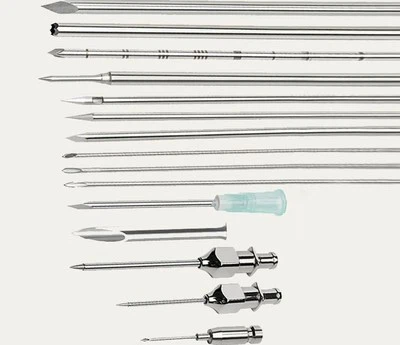
Standard Bevel Tip: 20–30 degree single bevel, suitable for most solid masses; penetration force 8–12 N.
Tri-cut (Three-facet) Tip: Three-blade design reduces tissue compression by 30%, ideal for scirrhous carcinomas.
Blunt Dissection Tip: Blunt tip with sharp cutting notch, preventing perforation of cyst walls.
Rotary Cutter Array: Rotating blade of vacuum-assisted needles enabling continuous, uninterrupted cutting.
Tissue Response Mechanics
Multi-scale tissue response during the puncture process:
Macroscopic Scale: A hemorrhagic and edematous zone approximately 1–3 mm wide forms around the puncture channel.
Tissue Scale: A crush artifact zone of 50–200 μm occurs at the cut edge, potentially affecting pathological interpretation.
Cellular Scale: Mechanical force induces immediate early gene expression lasting 2–4 hours.
Molecular Scale: Local cytokine release may influence the microenvironment.
Cutting Dynamics Optimization
Precision calibration of automated biopsy guns:
Firing Velocity: Optimal at 3–5 m/s; too slow pushes tissue aside, too fast increases damage.
Cutting Stroke: Standard stroke of 15–22 mm ensures complete capture of the lesion.
Spring Stiffness: 1.5–2.5 N/mm provides sufficient energy without excessive impact.
Braking Mechanism: Mechanical or hydraulic braking ensures the needle stops at the preset position.
Vacuum-Assisted Fluid Mechanics
Fluid control in rotational biopsy:
Negative Pressure Gradient: -500 to -700 mmHg ensures tissue aspiration into the cutting notch.
Flow Channel Design: Laminar flow design avoids turbulence that causes tissue fragmentation.
Real-time Monitoring: Pressure sensors monitor tissue aspiration status.
Sample Transport: Helical feed rods continuously deliver tissue specimens.
Breakthrough in Computer Simulation
A breast biopsy simulation platform developed by the MIT Biomechanics Laboratory integrates mechanical parameters from 200 cases of real breast tissue. Simulations indicate that optimizing the needle tip bevel angle from the traditional 30 degrees to 25 degrees reduces tissue compression by 22% while simultaneously decreasing penetration force by 15%.
Surface Engineering Innovation
Evolution of needle tip surface treatments:
Diamond-like Carbon (DLC) Coating: Thickness 2–5 μm, friction coefficient reduced from 0.6 to 0.1.
Hydrophilic Polymer Coating: PEG coating reduces tissue adhesion for smoother sampling.
Antimicrobial Silver Coating: Lowers infection risk, especially beneficial for prolonged vacuum-assisted procedures.
Fluorescent Marking: Fluorescent coating on the tip enhances visibility under fluorescence imaging guidance.
Manufacturing Upgrade in China
Domestic material and process innovations:
Domestic Medical Stainless Steel: Specialty steel developed by Taiyuan Iron & Steel (TISCO) achieves cleanliness levels meeting ASTM F138 standards.
Precision Machining: Shenzhen enterprises have mastered needle tubing drawing technology for 0.1 mm inner diameters.
Coating Breakthrough: DLC coatings from the Lanzhou Institute of Chemical Physics (CAS) have reached international standards.
Intelligent Inspection: Machine vision systems automatically inspect needle sharpness with 0.01 mm precision.
Future Frontiers in Mechanics
The mechanical future of breast biopsy needles:
Personalized Tips: Customizing needle tip parameters based on preoperative elastography.
Adaptive Control: Piezoelectric sensors adjusting puncture parameters in real-time.
Non-invasive Sampling: Ultrasound-focused "virtual cutting" with no physical puncture.
Robotic Haptics: Force-feedback robots sensing changes in tissue stiffness.
4D Printed Needles: Smart materials with time-dependent mechanical properties.
As Nobel Prize-winning physicist Richard Feynman once said: "What I want to understand is the world on the tip of a needle." In the field of breast biopsy, this is more than a metaphor-it is precisely at the millimeter scale of the needle tip where materials science, biomechanics, and clinical medicine perform a perfect symphony.