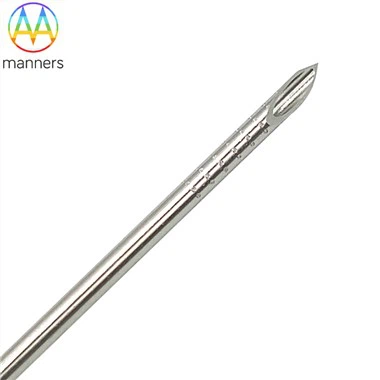
The Art Of Precise Control—Working Strategies Of The Veress Needle In Patients Of Different Body Types
Jun 18, 2026
https://en.wikipedia.org/wiki/Veress_needle
Core Perspective: Anatomical Variations and Operational Adaptation
The effectiveness of the Veress needle highly depends on individual patient factors, particularly abdominal wall thickness, muscle tone, and the presence of adhesions. A successful laparoscopic procedure often begins with a precise understanding of the "feel" of the Veress needle. This "feel" refers to the subtle balance between resistance sensed by the physician's fingers, spring vibration, and the depth of penetration. This article will discuss adjustments in using the Veress needle across three typical clinical scenarios.
Patients with normal body weight (BMI 18.5–24.9)
This is the ideal scenario. The layers of the abdominal wall (skin, subcutaneous fat, anterior sheath of rectus abdominis, muscle, posterior sheath, and peritoneum) are clearly defined, with a total thickness of approximately 2–4 cm. During standard procedure, the physician punctures at an angle of 45–60 degrees toward the pelvis. The spring in the Veress needle typically produces the first resistance fluctuation when passing through the posterior sheath of the rectus abdominis, followed by a distinct "pop" sensation and a second click upon penetrating the peritoneum. At this point, the needle tip has entered the peritoneal cavity to a depth of about 1–2 cm, and the blunt end fully expands. This type of patient presents the smoothest workflow, with almost no occurrence of false tracks or emphysema.
Obese patients (BMI ≥ 30)
Obese patients have significantly thickened abdominal wall fat layers (up to 8–15 cm) and relaxed fascia, resulting in increased puncture distance and indistinct resistance. The standard Veress needle length (120 mm) may be insufficient to penetrate the entire abdominal wall, necessitating the use of an extended version (150 mm). During the procedure, physicians must apply greater force when lifting the abdominal wall to move the peritoneum away from major blood vessels, while using a more perpendicular angle (approximately 90 degrees) to minimize lateral displacement. Due to the cushioning effect of fatty tissue, the spring's "click" sound may become faint or even absent, requiring reliance on pressure monitoring and the hanging drop test for confirmation. Studies show that the failure rate of Veress needle insertion in obese patients is approximately 5%, higher than the 1% observed in normal-weight individuals. For this reason, some clinicians make a small incision directly through the umbilical skin into the fascia prior to puncture, thereby improving success rates.
Patients with prior surgical history (adhesion risk)
Adhesions formed after abdominal surgery can cause the peritoneum to adhere tightly to the bowel, potentially rendering the blunt tip protection mechanism of the Veress needle ineffective-since adhesions fix the bowel in place, preventing the blunt tip from displacing it. In such cases, using a standard Veress needle carries a high risk. Expert consensus recommends selecting a puncture site at least 5 cm away from the original incision or directly switching to an open Hasson technique. However, for mild adhesions, experienced surgeons may still use the Veress needle with a "gradual puncture" approach: slowly advance until resistance from the peritoneum is felt, then pause briefly to allow the spring to fully reset, followed by a rapid breakthrough. This technique takes advantage of the peritoneum's elastic recoil, reducing the risk of tearing adhesions.
Additionally, the abdominal wall characteristics of children and elderly patients require special consideration: infants have extremely thin abdominal walls, necessitating the use of short Veress needles (80 mm) with puncture depth strictly limited to less than 1 cm. In elderly patients, due to muscle atrophy and fragile fascia, force during insertion should be minimized to avoid excessive penetration. It can be said that using a Veress needle is never a rigidly standardized procedure, but rather a delicate skill requiring integration of anatomical knowledge and tactile experience. Only by mastering these adaptive techniques can the full safety potential of the Veress needle be realized.