How The Veress Needle Prevents Visceral Injury Through Dual Mechanisms
Jun 18, 2026
https://en.wikipedia.org/wiki/Veress_needle
Core Perspective: Patient Safety and Risk Control
Establishing pneumoperitoneum is the first critical step in laparoscopic surgery, and the Veress needle serves as the central safety device in this phase. Its mode of operation is fundamentally a "passive safety system": it requires no electronic sensors or complex algorithms, relying solely on pure mechanical structure to respond to environmental changes within milliseconds, thereby minimizing accidental injury to the greatest extent possible. This safety derives from two levels of design: the blunt-tip protection mechanism and the pressure-feedback mechanism.
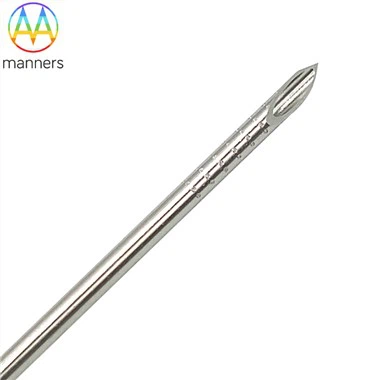
The first layer of protection is the aforementioned spring-loaded blunt stylet. When the needle tip is in a free space (such as the abdominal cavity), the blunt tip remains extended. Even if the needle shaft moves, the blunt tip makes contact with visceral surfaces first, pushing them aside rather than incising them directly. Experimental studies have shown that, at equivalent insertion velocities, the perforation rate of a Veress needle with a blunt tip is only one-tenth that of an exposed needle tip when applied to porcine small intestine. More importantly, this protection is "unconditional"-as long as no external force is applied, the spring automatically resets. Even during multiple attempts necessitated by patient obesity or adhesions, the blunt tip functions reliably.
The second layer of protection comes from the gas channel within the needle shaft. The Veress needle is typically equipped with a side port or a central lumen connected to an insufflator. When the needle tip is correctly positioned within the abdominal cavity, the CO₂ insufflation pressure remains low (initially around 4–6 mmHg), and the gas diffuses freely. However, if the tip inadvertently enters the preperitoneal space, omentum, or bowel lumen, the pressure rises sharply (>12 mmHg) while the flow rate drops. Modern insufflators can monitor these parameters in real time and trigger alarms. Additionally, surgeons perform the "drop test" (or hanging drop test): placing a drop of saline at the hub of the needle. If negative pressure draws the fluid inward, it indicates that the needle tip is in the peritoneal cavity-as intra-abdominal pressure is lower than atmospheric pressure. This simple test, combined with mechanical feedback, forms a dual verification system.
It is worth noting that the safety of the Veress needle depends on correct usage technique. For instance, during umbilical puncture, the abdominal wall should be elevated to increase the distance between the peritoneum and underlying viscera. For patients with a history of prior abdominal surgery, the original incision should be avoided, or an open entry technique (Hasson technique) should be adopted instead. Despite the maturity of its design, major vascular or bowel injuries still occur in approximately 0.05%–0.2% of cases. Consequently, many institutions employ "visual entry" as a supplement, equipping the needle tip with a micro-camera to allow the surgeon to observe tissue planes in real time. However, this adds cost and technical complexity. In contrast, the traditional Veress needle remains the preferred choice in global primary care hospitals due to its simplicity, reliability, and affordability.
In summary, the function of the Veress needle extends beyond merely creating an access point; it minimizes the risks of blind puncture through the dual safeguards of mechanical and pressure-based mechanisms. It embodies the "fault-tolerant priority" philosophy in medical device design-rather than relying on perfect operator technique, the instrument itself possesses error-correction capabilities. This is precisely why the Veress needle has endured for nearly a century without becoming obsolete.