What Is The Veress Needle Used For? — From Novice To Expert: How To Master The “One‑Shot” Veress Insertion
Jun 18, 2026
https://en.wikipedia.org/wiki/Veress_needle
For the beginning laparoscopic surgeon, handling the Veress needle is often one of the first-and most daunting-challenges. This seemingly simple steel needle actually tests an integrated skill set: tactile feedback, anatomical knowledge, and risk awareness.
So how should a trainee systematically learnthe purpose and proper use of the Veress needle?
1. Theoretical Learning: Understanding "Why We Do It This Way"
Trainees must first grasp what the Veress needle is for:
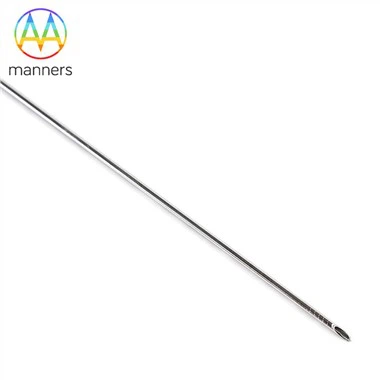
It is nota conventional injection needle, but a spring‑protected, puncture‑and‑insufflation device with a built‑in safety mechanism.
Core topics to master:
Spring‑stylet working principle (retraction on resistance / deployment on loss of resistance)
Standard anatomical layers traversed:
Skin → Subcutis → Fascia (anterior rectus sheath) → Rectus muscle → Pre‑peritoneal fat → Peritoneum
Adjustment of insertion angle and depth according to patient BMI and abdominal wall thickness
Only with this conceptual foundation can the learner make correct decisions when encountering intraoperative anomalies.
2. Simulation Training: Developing Tactile Memory in a Safe Environment
Many training centers now provide laparoscopic trainers using silicone pads or animal tissue (porcine/cadaveric abdominal wall) to simulate the abdominal layers.
Trainees repeatedly practice Veress needle insertion to feelthe double‑click / two‑pop sensation.
Advanced simulators can model obesity or adhesions to build experience with atypical resistance patterns.
📌 Studies show that ≥20 supervised simulation attempts significantly improve first‑attempt success rates in the OR.
3. Clinical Supervision: Gradual Transition from Observation to Performance
In live surgery, the typical teaching progression is:
- Observe: Watch the attending perform the full sequence, with step‑by‑step commentary.
- Assist: Perform subordinate tasks-connect insufflator tubing, execute aspiration & drop tests under supervision.
- Perform: Under direct guidance, attempt the actual puncture.
Key teaching points emphasized at the bedside:
- Grip: Hold the hub like a dart-fingers on the knurled handle, wrist stable, elbow supported.
- Advancement: Smooth, controlled forward pressure-avoid stabbing motions.
- Success cues: Audible/tactile "clicks," loss of resistance, positive saline drop test, low initial insufflation pressure.
4. Common Errors & Correction Strategies
|
Common Mistake |
Why It Happens |
Correction |
|---|---|---|
|
Incorrect insertion angle – too steep in thin patients (risks aortic bifurcation injury); too shallow in obese patients (causes pre‑peritoneal insufflation) |
Poor pre‑op planning |
Estimate angle from BMI pre‑op; fine‑tune based on resistance felt |
|
Skipping confirmation tests – rushing to insufflate |
Anxiety / eagerness |
Drill the triad (aspiration → drop test → initial pressure) as non‑negotiable muscle memory |
|
Failing to check spring function pre‑insertion |
Overlooking equipment prep |
Alwaysdepress the stylet manually before insertion to confirm smooth retraction & crisp deployment |
5. From Competent to Expert: The "One‑Shot" Insertion
Senior surgeons often achieve first‑attempt, uncomplicated entry with calm efficiency. Their habits include:
- Precise pre‑operative planning: Selection of optimal entry site (umbilicus vs. Palmer's point) and angle based on BMI, prior surgery, positioning.
- Refined haptic discrimination: Ability to distinguish fascia yield, peritoneal give, and abnormal resistance(adhesion, scar).
- Disciplined abort‑early mindset: At the slightestdoubt about position-stop, reassess, re‑puncture or convert. Never "push through."
Closing Perspective
What is the Veress needle used for?
To the novice, it is the first gate to be passed-demanding respect, study, and repetition.
To the expert, it is a familiar, trusted partner in every laparoscopic case.
Mastering the Veress needle-from theory to simulator, from supervised assist to independent performance-is a rite of passagefor every laparoscopic surgeon.