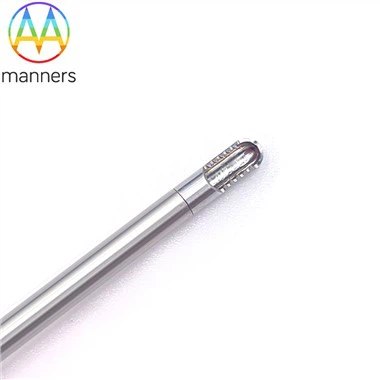
Spiral Hypotube
Sep 20, 2026
Pain point
In the realm of catheter design, one of the most persistent challenges is achieving the perfect balance between pushability and trackability. Traditional solid shafts either push well but cannot navigate tight bends, or they are flexible but buckle under the force required to advance through the body. This dichotomy forces device makers into a compromise that often results in suboptimal clinical performance. Physicians frequently complain about "sluggish" catheters that require excessive force to advance, or "floppy" ones that whip uncontrollably during rotation. The pain is amplified in complex procedures like percutaneous transluminal coronary angioplasty (PTCA), where the ability to precisely position a balloon or stent is paramount. Without a shaft that can transmit torque efficiently while bending smoothly, procedures become longer, riskier, and more physically demanding for both the physician and the patient.
Principle
The spiral cut hypotube is a brilliant engineering solution to this challenge. By removing material in a helical pattern along the length of the tube, the bending stiffness is significantly reduced, allowing the catheter to navigate curved anatomies with ease. However, the uncut helical bridges maintain a continuous path for torsional force, enabling the physician to rotate the proximal end and have that motion faithfully replicated at the distal tip. The pitch of the spiral-the distance between cuts-can be varied to create zones of different flexibility. A tight pitch offers greater flexibility for the distal tip, while a wider pitch provides more pushability in the proximal section. This graduated flexibility is what makes spiral hypotubes the preferred choice for a wide range of endoscopic devices, from cardiovascular to urinary applications. The principle is one of selective compliance: the tube yields to bends but resists twisting, providing the physician with a sense of direct control.
Equipment classification
Manufacturing spiral hypotubes requires precision laser cutting systems capable of synchronized rotation and translation. Five-axis CNC laser machines are the standard, allowing for the creation of complex helical geometries with high repeatability. The laser source is typically a fiber laser for stainless steel and other alloys, with power and focus carefully controlled to achieve the desired kerf width. Vision guidance systems ensure that the cut starts and ends precisely, maintaining pattern integrity. Post-cutting, electropolishing equipment is used to smooth the cut edges and enhance the surface finish, reducing friction during device advancement. Additionally, torque testing rigs are employed to quantify the torsional stiffness and hysteresis of the finished hypotube, ensuring it meets the design specifications.
Practical guide
To design an effective spiral hypotube, engineers should first map the anatomical path the device will take. Identify the points of maximum curvature and the lengths where pushability is critical. Use computer-aided design (CAD) software to simulate the spiral pattern, varying the pitch and cut width to achieve the desired mechanical properties. Consider the use of interrupted spiral patterns, where solid sections are left at intervals, to further enhance torque transmission without sacrificing too much flexibility. Always prototype and test under conditions that mimic the clinical environment, including the presence of a guidewire. Validate the design with both bench-top tests and, if possible, cadaver or animal studies. Document all parameters and results to support regulatory submissions.
Real-world experience
A leading manufacturer of PTCA catheters faced issues with their delivery system not tracking smoothly around the aortic arch. By switching to a spiral cut hypotube with a variable pitch-tight proximally for push and wider distally for trackability-they achieved a 25% improvement in crossing success rates. In another instance, a urology device company used a continuous spiral pattern to enhance the flexibility of their stone retrieval basket, allowing it to navigate the sharp angles of the renal calyxes with unprecedented ease. These successes highlight the transformative impact of spiral cutting on device performance.
Conclusion
The spiral hypotube is a testament to the power of intelligent design in medical engineering. By harnessing the principles of selective material removal, it overcomes the inherent limitations of solid shafts, providing a versatile platform for minimally invasive interventions. For any medical needle manufacturer, mastering the spiral cut is essential for creating devices that offer both the physician's control and the patient's safety.
Outlook
Future developments in spiral hypotubes will likely involve the integration of smart materials that can change their stiffness in response to external stimuli, such as temperature or electrical current. This could enable "active" spiral shafts that adjust their flexibility in real-time during a procedure. Additionally, advances in laser technology may allow for even more complex spiral geometries, such as nested or overlapping spirals, opening new possibilities for device functionality.