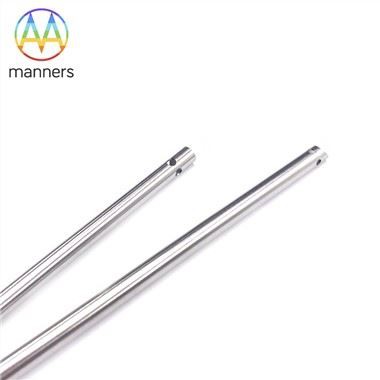
Material And Craft Standardization Of Trocar Stylet Cannula
Sep 30, 2026
1. Industry Material and Process Pain Points
The domestic trocar needle industry has long faced prominent problems of uneven material quality and non-standard processing technology. Many low-end products adopt inferior non-medical stainless steel materials, which have poor corrosion resistance and biocompatibility, and are prone to rust, deformation and tissue irritation after high-temperature disinfection and clinical use. In terms of processing technology, most backward products only adopt simple rough polishing, with residual micro burrs and uneven surface on the cannula and stylet, which easily scratch internal tissues and blood vessels during operation, increasing intraoperative bleeding and postoperative infection risks. The lack of standardized CNC precision machining and fine electropolishing process leads to inconsistent product dimensional accuracy and unstable tip sharpness. In addition, the industry has incomplete certification systems, many products lack complete medical safety certification, and the customized processing capacity is insufficient, unable to meet the high-precision production needs of modern medical devices.
2. Core Material and Process Principle
High-quality Trocar Needle Stylet Cannula takes medical-grade 304 and 316 stainless steel as core raw materials, with ultra-high biocompatibility, corrosion resistance and mechanical stability, fully complying with international medical device safety standards. 316 stainless steel has excellent anti-oxidation performance, adapting to repeated medical disinfection and long-term tissue contact without adverse reactions; 304 stainless steel provides stable structural hardness, ensuring that the stylet tip maintains long-term sharpness and the cannula does not deform under pressure. The product adopts standardized full-process precision manufacturing technology: CNC intelligent machining realizes accurate shaping of stylet and cannula dimensions, professional fine sharpening ensures uniform tip sharpness, and secondary medical electropolishing removes surface micro defects to form a mirror-level smooth surface. The standardized process ensures that each product has consistent performance, zero burrs and zero tissue irritation, meeting high-standard clinical use requirements.
3. Process Classification and Product Grading
According to processing precision and quality standards, trocar stylet cannula products are divided into standard polished grade and high-precision electropolished grade. The standard polished grade adopts conventional fine polishing technology, with stable basic performance and high cost performance, suitable for routine basic minimally invasive surgery in primary medical institutions. The high-precision electropolished grade adopts CNC precision machining + medical electropolishing dual process, with ultra-high dimensional accuracy, smoother surface and better biocompatibility, passing ISO13485, ISO9001, SGS and RoSH full certification, suitable for high-precision complex surgery in tertiary hospitals and professional medical centers. Both grades support personalized customization of dimensions and tip types according to 2D/3D drawings or samples, and can provide standard carton packaging or customer-specified customized packaging services.
4. Process Production and Clinical Operation Guidelines
Production process guidelines: Strictly screen medical-grade 304/316 stainless steel raw materials to eliminate unqualified alloy materials. Adopt CNC intelligent equipment for one-time precise cutting and shaping of stylet and cannula to ensure accurate dimensional parameters. Complete professional tip sharpening treatment to form standardized sharp puncture structure. Conduct layered polishing and electropolishing to remove surface burrs and impurities. Finally, conduct multi-index quality inspection and safety certification to ensure product compliance. Clinical operation guidelines: Select matching grade products according to surgical precision requirements. Inspect product surface smoothness and tip integrity before use. Operate gently during puncture to avoid violent extrusion damaging the product structure. After channel establishment, fix the cannula stably to ensure surgical safety, and standardize postoperative instrument recycling and wound care.
5. Practical Production and Clinical Experience
Long-term production practice and clinical verification prove that standardized material selection and precision processing technology are the core guarantees of product performance. Medical-grade stainless steel materials ensure the long-term stability and safety of trocar stylet cannula, avoiding quality problems such as rust and deformation of inferior products. CNC precision machining ensures consistent product size and structural accuracy, eliminating operation errors caused by dimensional deviation. Electropolishing technology greatly reduces tissue friction damage, making intraoperative operation smoother and postoperative patient recovery faster. Products with complete international certification have passed strict clinical safety tests, with extremely low complication rate and stable and reliable performance. Customized processing services can accurately meet the personalized needs of special surgical scenarios, which has been widely recognized by domestic and foreign medical customers.
6. Summary and Sublimation
The standardized material system and precision processing technology of Trocar Needle Stylet Cannula solve the industry pain points of uneven quality, rough processing and insufficient safety certification of traditional puncture instruments. High-quality medical stainless steel materials and full-process CNC + electropolishing technology realize comprehensive upgrading of product precision, safety and biocompatibility. Graded product design and flexible customized services cover the differentiated needs of primary and high-end medical institutions, effectively improving the overall quality standard of the domestic trocar needle industry and providing reliable technical support for standardized clinical minimally invasive surgery.
7. Industry Process Upgrading Suggestions
The industry should comprehensively promote the standardized application of medical-grade 304/316 stainless steel materials and eliminate inferior alloy raw materials. Popularize CNC intelligent precision machining and medical electropolishing technology to replace traditional rough processing techniques. Unify product certification standards, require all qualified products to pass complete international safety certification. Enterprises should enrich product grading systems and customized service capabilities to meet multi-scene clinical needs. Continuously optimize production processes, improve batch product consistency, and promote the high-quality and standardized development of the trocar needle manufacturing industry.