Precision Manufacturing Process System Of 18G Biopsy Trocar Needles
Sep 30, 2026
1. Industry Process and Quality Pain Points
The domestic medical biopsy needle manufacturing industry has long faced prominent process homogenization and unstable quality problems. Most low-end biopsy products adopt single simple grinding process without fine necking and swaging treatment, resulting in uneven needle body wall thickness and poor structural rigidity, which is easy to deform and shake during deep tissue puncture and affects sampling accuracy. Traditional manual polishing technology leaves micro burrs and uneven surface roughness on the needle body, causing continuous tissue friction damage and intraoperative bleeding during biopsy. Ordinary laser marking has unclear scale and poor wear resistance, unable to support precise depth control in stereotactic positioning surgery. In addition, most manufacturers lack complete electropolishing processes, leading to poor product biocompatibility, easy tissue irritation and inflammatory reaction after puncture. The absence of standardized full-process quality control results in large batch quality differences, seriously restricting the high-end development of domestic biopsy needle products.
2. Core Precision Manufacturing Principle
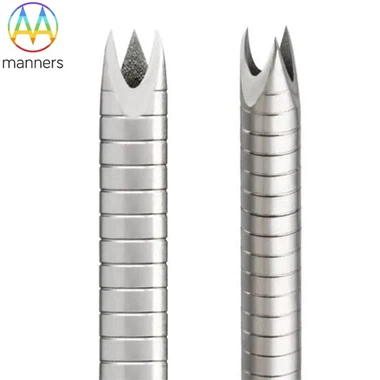
18G Biopsy Trocar Needles adopt a full-chain integrated precision manufacturing system covering necking, swaging, grinding, laser cutting, laser marking and medical electropolishing, completely subverting the traditional single-process production mode. The necking and swaging processes realize integrated integral molding of the stainless steel needle body, ensuring uniform wall thickness and stable mechanical rigidity to resist extrusion deformation during puncture. Fine mechanical grinding and high-precision laser cutting shape symmetrical and sharp needle tip cutting edges, realizing uniform stress and regular tissue cutting without tearing. Intelligent laser marking technology forms high-precision wear-resistant scale calibration on the needle body, supporting real-time accurate depth monitoring under image guidance. The final medical electropolishing removes all surface micro-defects, forming a mirror-level smooth surface, optimizing biocompatibility, reducing tissue friction and artifact interference, and realizing high-precision and high-stability industrial manufacturing of biopsy needles.
3. Process Grade Product Classification
According to manufacturing process precision and quality grade, 18G Biopsy Trocar Needles are divided into standard process grade and high-end full-precision process grade. The standard process grade adopts basic grinding, laser marking and conventional polishing processes, with stable basic performance, high cost performance, suitable for routine clinical screening and primary medical market mass supply. The high-end full-precision process grade adopts full-process fine processing including precise necking, constant-pressure swaging, ultra-fine laser cutting and secondary electropolishing, with ultra-high structural consistency, surface smoothness and scale accuracy, suitable for tertiary hospital high-precision lesion biopsy and scientific research sampling scenarios. Both grades support personalized customization of size, structure and needle tip type according to customer 2D/3D drawings or physical samples, with flexible packaging options.
4. Process Production and Clinical Matching Guidelines
Production process guidelines: Strictly screen medical-grade stainless steel raw materials to ensure compliance with medical biocompatibility standards. Implement one-time precise necking and swaging molding according to 18G standard parameters to avoid structural deviation. Adopt numerical control grinding and laser cutting equipment for needle tip finishing to ensure consistent sharpness of each product. Complete high-precision laser scale marking and secondary deburring treatment, and finally conduct medical electropolishing and sterile cleaning. Conduct full-dimensional inspection and performance testing before delivery to ensure 100% product qualification rate. Clinical matching guidelines: Select standard process products for routine superficial lesion biopsy and high-end full-precision products for deep tiny and complex lesions. Check needle body scale and surface smoothness before operation, match process performance with surgical precision requirements, and give full play to process advantages to ensure sampling accuracy and safety.
5. Practical Process Application Experience
Long-term factory production verification and multi-center clinical application show that the full-process precision manufacturing system greatly improves the comprehensive quality of 18G biopsy trocar needles. The integrated molding process solves the deformation and shaking problems of traditional products during puncture, improving the stability of intraoperative sampling posture. The laser precision cutting needle tip realizes flat and complete lesion tissue cutting, effectively avoiding sample fragmentation and incomplete acquisition. The mirror electropolished surface reduces intraoperative bleeding and postoperative inflammatory reaction, significantly improving patient comfort. The high-precision scale marking provides accurate data support for stereotactic precise positioning, reducing manual operation errors. Standardized batch production ensures consistent product quality, and personalized customized processes can accurately meet the differentiated needs of special clinical operations, forming good market reputation and clinical recognition.
6. Summary and Sublimation
The multi-process integrated precision manufacturing technology of 18G Biopsy Trocar Needles effectively solves the industry pain points of rough processing, unstable quality and single performance of traditional biopsy needles. Through the organic integration of mechanical precision processing and laser intelligent technology, it realizes comprehensive upgrading of product structural stability, puncture precision, sampling quality and biocompatibility. It breaks the homogenization competition dilemma of low-end biopsy needle market, establishes high-standard manufacturing benchmarks for domestic medium-gauge biopsy needles, and provides high-quality instrument support for the standardized development of clinical precise biopsy diagnosis.
7. Industry Process Upgrading Suggestions
The domestic biopsy needle manufacturing industry should comprehensively popularize full-process precision processing technology, eliminate backward single-process production modes. Enterprises should increase investment in intelligent processing equipment, realize automated and standardized production of necking, swaging and laser cutting processes. Industry associations should formulate unified process precision standards and product quality evaluation systems to standardize industry production specifications. Continuously optimize electropolishing and surface treatment processes, improve product biocompatibility and imaging adaptability, and promote the overall high-quality upgrading of the biopsy needle manufacturing industry.