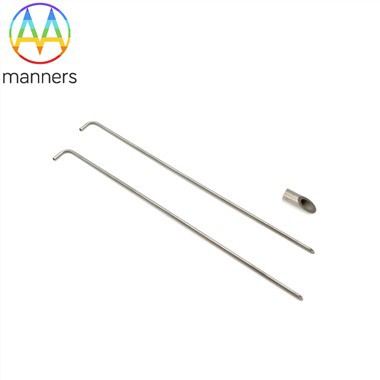
Clinical Minimally Invasive Advantages Of Trocar Needle Stylet Cannula
Sep 30, 2026
1. Industry Clinical Pain Points
Traditional surgical puncture instruments have long restricted the development of modern minimally invasive surgery due to structural and performance defects. Conventional single-piece puncture needles lack separated stylet and cannula design, requiring repeated puncture and instrument replacement during laparoscopic, thoracoscopic and endoscopic operations, which greatly increases intraoperative tissue trauma and operation duration. Most ordinary puncture tools have rough surface finish and inconsistent tip sharpness, easily causing irregular skin and fascia tearing, massive bleeding and postoperative tissue adhesion. In addition, traditional instruments cannot maintain stable surgical channels after puncture, resulting in frequent gas leakage during laparoscopic pneumoperitoneum establishment, blurred surgical vision and reduced operation accuracy. The lack of standardized separable structure design also leads to low reuse efficiency and poor intraoperative flexibility, bringing high complication risks and poor patient recovery effects, which cannot meet the high-standard minimally invasive treatment needs of modern clinical surgery.
2. Core Working Principle of Stylet Cannula Structure
Trocar Needle Stylet Cannula adopts a scientific separated dual-structure design composed of a sharp stylet and a hollow cannula, which completely solves the structural defects of traditional integrated puncture needles. The inner sharp stylet is responsible for low-resistance precise penetration of skin, muscle and fascia tissues, forming a tiny and regular puncture incision with minimal trauma. After completing tissue penetration, the inner stylet can be safely withdrawn, while the outer hollow cannula remains stably fixed in the human tissue, forming a closed and stable surgical working channel. Made of medical-grade 304 and 316 stainless steel, the whole device undergoes professional polishing and electropolishing treatment to ensure ultra-smooth surface, effectively reducing tissue friction and secondary damage. The stable cannula channel can support the insertion of various surgical instruments and drainage tubes, and maintain intra-cavity pressure stability, realizing continuous, efficient and low-trauma minimally invasive surgical operation.
3. Equipment Classification and Structural Features
According to clinical application scenarios and structural specifications, Trocar Needle Stylet Cannula is divided into three core types: laparoscopic universal type, thoracoscopic specialized type and endoscopic auxiliary type. The laparoscopic universal type features moderate outer diameter and stable channel sealing performance, suitable for routine abdominal minimally invasive operations such as cholecystectomy, hernia repair and appendectomy. The thoracoscopic specialized type adopts optimized length and pressure-resistant structure, adapting to chest cavity puncture and lung and pleural lesion surgery. The endoscopic auxiliary type has fine and compact structure, specially designed for gastrointestinal endoscopy and fine lesion sampling operations. All products support personalized customization of dimensions, tip types and structures according to customer 2D/3D drawings or samples. They pass ISO13485, ISO9001, SGS and RoSH certification, with reliable biocompatibility and safety, and can adopt standard carton or customized packaging according to demand.
4. Standard Clinical Operation Guidelines
Preoperative preparation: Select matching trocar stylet cannula models according to surgical type and lesion position. Inspect the sharpness of the inner stylet, the smoothness of the outer cannula and the integrity of the overall structure to ensure no deformation, burrs or damage. Complete preoperative sterile disinfection of the surgical area and instruments, and formulate a targeted puncture path plan combined with imaging data. Intraoperative operation: Hold the device stably, aim the sharp stylet tip at the preset puncture point, penetrate the tissue vertically and slowly with uniform force to form a regular tiny incision. After confirming that the cannula completely enters the body cavity, steadily withdraw the inner stylet, retain the hollow cannula to build a stable surgical channel, and complete instrument implantation, lesion operation or drainage work. Keep the cannula fixed to avoid displacement and gas leakage during the operation. Postoperative management: Slowly extract the cannula after the operation, perform precise hemostasis and sterile dressing on the puncture wound, and monitor wound recovery to prevent infection and adhesion.
5. Practical Clinical Application Experience
Multi-department clinical practice verifies that trocar needle stylet cannula has irreplaceable advantages in minimally invasive surgery. The separated stylet and cannula structure realizes one-time puncture and long-term channel retention, avoiding repeated tissue damage caused by traditional instrument replacement. The electropolished smooth surface greatly reduces intraoperative friction trauma and bleeding volume, with clear surgical vision and improved operation precision. In laparoscopic and thoracoscopic surgery, the stable cannula channel effectively maintains pneumoperitoneum and intrathoracic pressure, ensuring continuous and stable surgical operation. Compared with traditional puncture instruments, the postoperative wound of this product is smaller, the inflammatory reaction is lighter, and the patient's recovery cycle is shortened significantly. Supported by strict factory quality control and multi-national certification, the product has stable clinical performance, low complication rate and high patient satisfaction, and has become a mainstream basic instrument for clinical minimally invasive surgery.
6. Summary and Sublimation
Trocar Needle Stylet Cannula effectively solves the industry pain points of large trauma, unstable channel, low efficiency and high complication rate of traditional integrated puncture instruments. With innovative separated dual-structure design, high-quality medical stainless steel materials and precision surface processing technology, it realizes standardized, low-trauma and high-precision channel establishment for minimally invasive surgery. It not only improves the efficiency and safety of laparoscopic, thoracoscopic and endoscopic operations, but also optimizes patient postoperative rehabilitation effect, laying a solid foundation for the standardized and popularized development of clinical minimally invasive medical technology.
7. Industry Prospect and Development Suggestions
With the continuous popularization of precise minimally invasive surgery, the market demand for high-performance trocar stylet cannula will continue to expand. It is suggested that medical device enterprises continuously optimize product tip structure and cannula sealing performance, develop multi-type tip designs to adapt to more complex surgical scenarios. Enrich personalized customized specifications to meet the differentiated needs of special operations and atypical anatomical structures. The industry should unify product production precision standards and clinical operation specifications, strengthen quality supervision of certified products. Medical institutions should strengthen standardized operation training for clinicians, give full play to the minimally invasive advantages of stylet cannula products, and promote the overall upgrading of domestic minimally invasive surgical operation level.