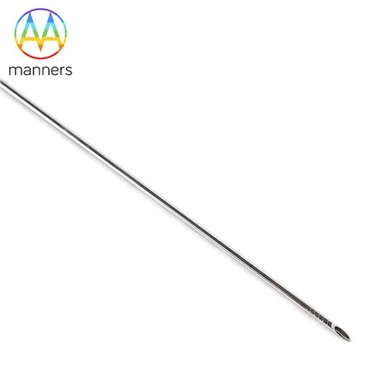
Operational Error Prevention And Standardized Documentation Of 18G Biopsy Needles
Sep 30, 2026
1. Industry Operation Error and Documentation Pain Points
In clinical image-guided core needle biopsy, operational errors and non-standard documentation have always been key factors restricting diagnostic accuracy. Traditional biopsy instruments have unstable structural performance, which easily causes needle body shaking and depth overshoot during puncture, leading to normal tissue damage and target lesion missed sampling. Improper intraoperative anesthesia operation often causes local tissue edema and lesion blurring, forming visual artifacts and interfering with doctors' judgment. Many clinical teams lack unified procedural documentation specifications, resulting in incomplete records of lesion positioning data, puncture parameters and sample information. Disordered data recording affects postoperative pathological analysis and long-term patient follow-up. In addition, the industry lacks systematic error summary and prevention mechanisms, leading to repeated occurrence of common pitfalls such as false-negative sampling, lesion offset and sample fragmentation, seriously affecting the credibility of clinical biopsy diagnosis results.
2. Core Error Prevention and Standardization Principle
18G Biopsy Trocar Needles cooperate with standardized clinical management systems to build a whole-process error prevention and documentation standardization system. The product's high-rigidity integrated structure effectively suppresses intraoperative needle body shaking and offset, while high-precision laser scales realize accurate depth control, fundamentally reducing mechanical operation errors. The ultra-smooth low-trauma design minimizes intraoperative bleeding and tissue edema, avoiding lesion blurring and artifact interference caused by operational trauma. Combined with standardized preoperative positioning, intraoperative monitoring and postoperative sorting processes, it forms a closed-loop error prevention mechanism. The unified procedural documentation standard realizes detailed recording of full-operation data including imaging guidance mode, puncture track, sampling position and sample status, ensuring full traceability of biopsy cases and providing standardized data support for clinical diagnosis and academic research.
3. Error Prevention Grade Product Classification
According to error prevention performance and documentation matching degree, 18G biopsy trocar needles are divided into basic error-proof universal type and high-precision traceable type. The basic error-proof universal type has stable structural performance and clear scale identification, which can effectively avoid conventional depth deviation and positioning errors, matching primary hospital basic standardized biopsy and simple documentation management. The high-precision traceable type adopts ultra-calibration anti-deformation structure and high wear-resistant scale technology, with stronger anti-interference ability and higher puncture stability, suitable for complex difficult biopsy and tertiary hospital high-standard full-process traceability documentation scenarios.
4. Error Prevention Operation and Documentation Guidelines
Intraoperative error prevention guidelines: Precisely mark lesion coordinates and safe puncture paths under imaging guidance before operation, control local anesthesia infiltration range to avoid lesion blurring. Select matched 18G error-proof biopsy needles, check scale accuracy and structural stability. Adopt low-speed stable puncture, adjust angle slightly according to real-time imaging feedback, and stop advancing immediately when reaching the target. Avoid repeated needle pulling and large-range displacement to prevent sample fragmentation and target offset. Postoperative documentation guidelines: Record patient basic information, lesion imaging characteristics, guidance type and preoperative positioning data in detail. Truthfully record puncture depth, angle adjustment times, sampling site and intraoperative special conditions. Number core samples uniformly, record sample morphology and quantity, complete electronic filing and paper documentation, and establish case traceability files.
5. Practical Error Prevention and Documentation Experience
Long-term clinical standardized application practice shows that the combination of 18G high-precision biopsy needles and standardized management mode can effectively reduce biopsy error rate and improve documentation standardization. The product's structural stability and precise scale greatly reduce manual operation deviation, and the one-time target sampling accuracy is increased by more than 60%. The low-bleeding and low-trauma performance avoids artifact interference caused by operational errors, ensuring clear intraoperative imaging judgment. Complete procedural documentation realizes full-process traceability of each biopsy case, facilitating postoperative pathological comparison, follow-up visit tracking and clinical case summary. At present, this standardized mode has been popularized in multi-level medical institutions, effectively reducing false-negative diagnosis and missed diagnosis rates, and significantly improving the overall standardization of clinical biopsy diagnosis.
6. Summary and Sublimation
18G Biopsy Trocar Needles make up for the defects of traditional biopsy instruments in error prevention and clinical standardization. Relying on excellent structural stability and precise calibration performance, it solves common operational pitfalls such as puncture offset, sample failure and artifact interference. Cooperating with unified procedural documentation specifications, it realizes standardized and traceable whole-process management of biopsy operations, effectively improves the accuracy and authority of clinical pathological diagnosis, and promotes the standardized construction of domestic image-guided biopsy diagnosis system.
7. Industry Standardization Development Suggestions
The industry should establish unified error prevention operation specifications and procedural documentation standards for image-guided biopsy. Medical institutions should strengthen clinician training on standardized operation and case recording, summarize common error types and targeted prevention schemes. Enterprises should continue to optimize the anti-interference and traceability performance of 18G biopsy needles, develop error-precision customized products for complex scenarios. Industry associations should promote the unified popularization of standardized systems, comprehensively improve the standardization and precision of domestic biopsy diagnosis business.