Intraosseous Vascular Access Needles: Operating Mechanism And Manual Drive System
Nov 22, 2026
The manual drive system is the defining functional feature that differentiates this range of intraosseous vascular access needles from other bone access devices. Instead of spring-powered impact or electric drivers, the design relies on controlled manual rotation to advance the catheter through soft tissue and cortical bone into the bone marrow. This mechanism gives emergency providers direct tactile feedback throughout insertion, allowing real-time judgement of tissue resistance and preventing uncontrolled deep penetration.
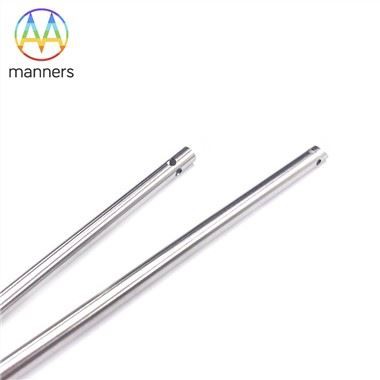
The full assembly consists of the hollow catheter with a cutting groove, a removable internal probe and an actuator handle. The probe runs inside the catheter during insertion to block bone debris from entering the lumen and preserve the sharp cutting profile. The handle transfers rotational force from the operator's hand to the needle assembly. After skin puncture, the tip contacts hard cortical bone; the operator rotates the handle steadily, and the cutting groove engages the bone surface, carving a cylindrical channel. The clinician feels a distinct loss of resistance once the tip crosses the cortex and enters the less dense medullary cavity. At this point, rotation stops, and the actuator and probe are withdrawn, leaving the hollow catheter positioned for infusion.
This rotation-controlled operating principle delivers multiple clinical benefits. First, it reduces the risk of overshooting through the far cortex, a common complication of impact-style intraosseous devices. Second, tactile feedback helps inexperienced users recognise correct placement without relying solely on imaging or pressure tests. Third, the multi-purpose driver handle can be compatible with the full range of available needle sizes, simplifying inventory in emergency departments and ambulance kits. Staff only need to familiarise themselves with one operating motion across standard 15G needles and custom-sized variants.
The cutting groove geometry is optimised for balanced cutting performance. It is engineered to cut cleanly through compact cortical bone rather than crush or splinter it. Clean cutting preserves local bone integrity, lowers the chance of subsequent fracture and reduces pain for awake patients. The stainless steel material maintains edge sharpness after repeated sterilisation during manufacturing validation. Electropolishing further reduces friction between the needle and bone, making rotation smoother and requiring less operator force.
The operating sequence is intentionally simplified for high-pressure emergency environments. The steps are landmark identification, skin antisepsis, needle advancement to bone contact, controlled rotary insertion, confirmation of marrow entry, removal of probe and actuator, catheter securement and connection to infusion tubing. The intuitive workflow minimises cognitive load when multiple resuscitation tasks are happening simultaneously, such as chest compressions, airway management and drug preparation. This user-friendly design aligns with the product positioning as a rapid, reliable vascular access option when IV access is unobtainable.
Limitations of the manual drive design must also be understood. Operators with limited hand strength may find insertion more difficult on thick cortical bone, such as adult proximal tibia. Proper training teaches users to maintain steady perpendicular alignment while rotating, because angled insertion increases the risk of slipping off the bone surface. Manufacturers compensate for this by optimising the cutting groove and shaft geometry to keep required insertion torque within a manageable range for most adult clinicians.
Comparative evaluation shows that manual rotary intraosseous vascular access needles offer an attractive balance of cost and performance. They avoid the higher expense of disposable battery-powered drivers and eliminate the risk of driver failure due to dead batteries in the field. This makes them suitable for resource-limited medical settings, mass casualty incidents, rural pre-hospital services and large public health emergency programmes, while still meeting the reliability requirements of tertiary hospital emergency departments.
Ongoing refinement of the manual drive system focuses on ergonomic handle shaping to improve grip in wet or gloved hands, clearer tactile transition at bone penetration and easier probe separation after placement. The goal is to preserve the core advantage of direct operator control while making the device even more forgiving for occasional users. For emergency medical professionals, the combination of simple rotation control, consistent cutting behaviour and multi-purpose driver compatibility establishes intraosseous vascular access needles as a practical, dependable tool for rescue vascular access.