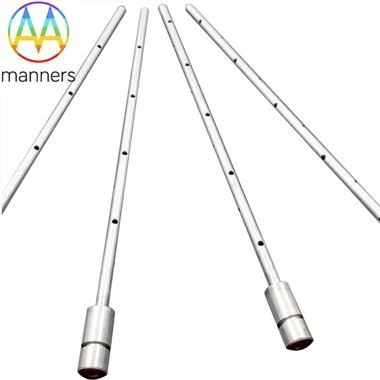
Intraosseous Vascular Access Needles: Manufacturing Technology And Quality Assurance
Nov 22, 2026
Intraosseous vascular access needles fall under the category of injection and puncture instruments, requiring extremely high precision throughout the full production workflow. The core raw material is medical-grade stainless steel, which meets strict standards for corrosion resistance, mechanical strength and low biological reactivity. Any material defect such as internal inclusions or uneven hardness may lead to needle bending, tip breakage or excessive bone trauma during emergency insertion, so incoming material inspection forms the first barrier of quality assurance.
A sequence of specialised metalworking processes shapes the final functional needle assembly. Necking modifies the cross-section of the needle shaft to create a defined transition zone between the cutting tip and the catheter body, improving structural resilience under rotational force. Swaging compresses and aligns component joints to eliminate gaps that could trap bone debris or separate during insertion. Precision grinding creates a sharp, uniform cutting edge for controlled cortical bone penetration. Laser cutting fabricates the proprietary cutting groove that enables the catheter to carve a stable channel through bone without shattering large bone fragments. Laser marking etches permanent alphanumeric identifiers, gauge specifications and lot numbers on the needle surface without compromising material integrity. Finally, electropolishing removes surface burrs, creates a passive smooth surface and reduces the risk of thrombus formation and tissue adhesion.
Customisation capability is a key service feature for global buyers. Manufacturers can produce non-standard needle lengths, gauges and tip geometries according to customers' 2D engineering drawings, 3D models or physical sample submissions. This customisation serves diverse market demands: paediatric care may require thinner gauges, while military and pre-hospital trauma programmes may need reinforced needle bodies for harsh field conditions. Every custom design undergoes functional verification, including penetration testing on bone simulant models, flow testing and assembly safety validation before mass production. The default 15G size remains the most widely used standard specification for adult emergency resuscitation.
Quality assurance covers functional performance, sterility and labelling compliance. Functional testing assesses insertion torque, cutting performance, catheter patency and resistance to bending. Sterilisation processes are validated to guarantee elimination of microbial contamination, with shelf-life studies confirming sterility retention within the labelled expiry window. Visual inspection checks for surface scratches, burrs and marking defects, while dimensional inspection verifies that all critical dimensions match the approved drawing tolerance. Batch records trace every finished needle back to raw material batches, processing stations and inspection reports to support medical device recall procedures if required.
Regulatory compliance is integrated into production management systems. Facilities manufacturing intraosseous vascular access needles commonly maintain ISO 13485 certification, the global quality management standard for medical devices. For sales into the European market, products must satisfy MDR requirements with technical documentation covering risk analysis, clinical evaluation and post-market surveillance. Other markets enforce their own medical device registration rules, and manufacturers work with distributors to prepare test reports and certification files for local submission.
Packaging design is also subject to quality validation. Standard bulk cartons suit central hospital supply storage, while custom packaging options can include procedure trays, sterile peel pouches and multilingual instruction inserts tailored to the end-user region. Packaging must withstand vibration during shipping, temperature fluctuation and routine handling without compromising the sterile barrier. Labelling must clearly state product name, gauge, batch number, expiry date, sterility status and intended use.
Consistency in mass production is one of the biggest technical challenges for intraosseous vascular access needle manufacturers. Even minor variation in cutting groove geometry can change insertion force and increase complication rates. Automated optical inspection and torque testing stations reduce human error and stabilise output quality. Research and development teams continuously refine process parameters to lower insertion force while maintaining enough structural strength to avoid tip fracture.
The technical maturity of intraosseous vascular access needles directly translates to clinical reliability. Emergency clinicians depend on predictable device behaviour under high-stress circumstances. A needle that inserts smoothly, maintains patency and avoids unexpected failure helps providers focus on patient resuscitation rather than device troubleshooting. By combining precision machining, rigorous testing and regulatory-aligned quality systems, manufacturers deliver the reliable, cost-conscious intraosseous vascular access needles required by modern trauma and emergency care systems worldwide.