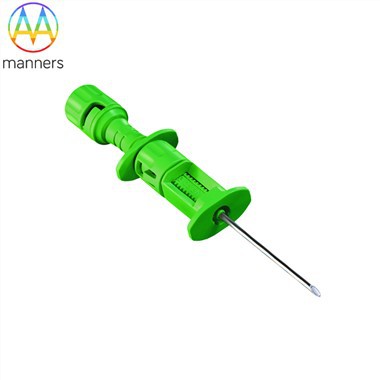
Trainer Power Driver Needle — The Future Of Competency-Based Emergency Training
Nov 22, 2026
Meta description: Trainer Power Driver Needle sits at the centre of emerging competency-based training, spaced practice and data-driven credentialing for emergency care.
From Hours to Outcomes
Emergency training is shifting its unit of measurement. Traditional programmes counted course hours and certificates issued; contemporary frameworks count demonstrated competence and measured patient outcomes. This shift is driven by accreditation expectations, by evidence that attendance does not predict performance, and by recognition that rarely used high-risk procedures decay quickly. Intraosseous access sits squarely in this category: endorsed by Paediatric Advanced Life Support, Advanced Cardiac Life Support and Advanced Trauma Life Support as the standard alternative to failed peripheral access, yet practised by most clinicians only occasionally. Trainer Power Driver Needle belongs to the emerging infrastructure that keeps such skills alive between events.
Competency Frameworks and Their Demands
Competency-based education asks three questions: what must the provider be able to do, how will that be observed, and how will it be maintained. Applied to intraosseous access, the answers require realistic hardware, standardised observation and scheduled maintenance. Hardware matters because the skill is partly tactile, and tactile judgement cannot be assessed on a diagram. The trainer platform supplies the first requirement; structured checklists and refresher cycles supply the other two. Frameworks that ignore any of the three tend to produce paperwork rather than capability.
Spaced Practice and Skill Retention
Retention research consistently favours distributed practice over massed practice. A single intensive course produces rapid gains and equally rapid decay, while brief sessions spread over months preserve performance at far higher levels. Intraosseous skills follow this pattern: the sequence is short enough to rehearse in fifteen minutes, but long enough to forget in six. Programmes adopting quarterly micro-sessions on trainer hardware report markedly better retention than annual recertification, and the low consumable cost of a short session makes the model financially practical for most services.
Data-Informed Curriculum Adjustment
Digital capture of training performance is becoming standard. When every attempt records site, needle size, model type, time to placement, stopping accuracy and instructor judgement, programmes can analyse patterns rather than rely on impressions. Recurrent difficulty with the proximal humerus, systematic over-advancement after marrow entry, or frequent sizing errors in paediatric drills each point to a specific curriculum fix. This feedback loop is the operational meaning of competency-based training: the curriculum changes because the data says it should.
Hardware Evolution and Training Implications
Device design continues to emphasise controlled advancement, immediate cessation on cue and consistent cutting behaviour, achieved through precision processes including necking, swaging, grinding, laser cutting, laser marking and electropolishing in medical-grade stainless steel. Each refinement has a training consequence. Smoother cutting geometry shortens the familiarisation phase; clearer tactile transitions improve cue recognition; broader custom sizing ranges extend the patient groups a single curriculum can cover. Training programmes should update their drills when hardware changes, because cue structures that learners memorise can shift subtly with design revisions.
Team Performance and Non-Technical Skills
Future curricula will weight non-technical skills more heavily. Intraosseous placement during resuscitation competes with airway management, compressions, monitoring and drug preparation for attention and hands. Training must therefore rehearse communication, role clarity and prioritisation, not only needle handling. Scenarios that force a team to decide when to abandon peripheral attempts, who secures the catheter, and who monitors the site reveal coordination weaknesses that isolated skills drills conceal. Assessment frameworks increasingly score these behaviours alongside technical execution.
Equity of Access Across Settings
Competency-based training also has an equity dimension. Pre-hospital services, rural facilities, paediatric units and military medical teams all need intraosseous capability, but they operate under very different resource constraints. A trainer platform that is cost-conscious, reusable at the driver level and customisable in needle configuration allows smaller services to build credible programmes rather than outsourcing training entirely. Packaging flexibility supports this: standard cartons for central storage, custom sterile presentation for mobile units and remote sites.
Regulatory and Quality System Convergence
Quality management expectations are converging internationally. Manufacturers maintaining ISO 13485 systems and preparing technical documentation aligned with frameworks such as MDR provide buyers with the traceability that institutional procurement and accreditation reviews require. Training device purchases increasingly sit inside these same documentation expectations, since auditors now ask not only whether staff were trained, but whether the equipment used for training was appropriate and traceable.
A Realistic Trajectory
The likely path forward is incremental rather than revolutionary: more frequent short refreshers, wider use of objective checklists, routine capture of performance data, and gradual integration into credentialing frameworks at regional level. Along that path, the Trainer Power Driver Needle functions as a practical constant, providing the physical realism that every competency framework ultimately depends on. Programmes that invest in that realism early will find the transition to outcome-based credentialing far less disruptive than those that treat training as an administrative formality. The measure of success is simple: when the rare emergency arrives, the provider's hands already know the sequence.