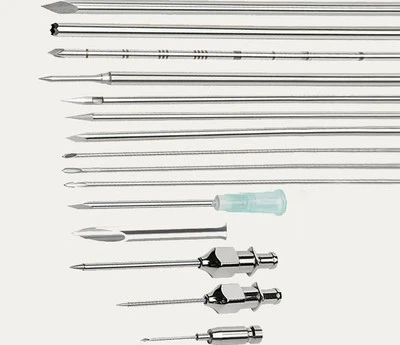
Intraosseous Access Needles: The Lifeline in Emergency Care
Apr 09, 2026
Intraosseous Access Needles: The Lifeline in Emergency Care
Intraosseous access needles (IO needles) are medical devices specifically designed to rapidly establish access to the bone marrow cavity. In critical situations where venous access cannot be quickly obtained, they serve as a "lifeline" for treating critically ill patients, allowing medical personnel to directly infuse fluids, medications, blood products, and other life-saving substances through the bone marrow cavity.
I. Core Product Specifications and Manufacturing Processes
|
Item |
Content |
|---|---|
|
Product Name |
Intraosseous Access Needles |
|
Core Materials |
Medical-grade stainless steel, etc. |
|
Product Category |
Injection and Puncture Instrument |
|
Key Processing Techniques |
Necking, swaging, grinding, laser cutting, laser marking, electropolishing, etc. |
|
Customization Capability |
Customizable based on customer-provided 2D/3D drawings or samples |
|
Packaging |
Standard carton or as per customer requirements |
Manufacturing Process Analysis:
Laser Cutting and Marking: Ensures precise needle dimensions and enables clear, permanent labeling for clinical identification and traceability.
Electropolishing: Provides surface refinement of the needle, removing burrs and microcracks to achieve mirror-like smoothness. This significantly reduces puncture resistance and tissue trauma while enhancing corrosion resistance.
Swaging and Necking: Used to form the needle tip's specific geometric shape (e.g., diamond, bevel) to optimize puncture efficiency.
II. Core Product Advantages
The design and material selection of intraosseous access needles aim to achieve rapid, reliable, and low-trauma establishment of bone marrow cavity access.
Reliable Material, Minimally Invasive Design
Made from medical-grade stainless steel, offering excellent strength and biocompatibility. The needle design prioritizes minimal invasiveness, reducing discomfort and tissue damage as much as possible during puncture.
Rapid Establishment, Nearly Painless
In emergency situations, an effective infusion pathway can be established within 30-60 seconds. Compared to repeated attempts at difficult venous access, this procedure significantly reduces patient waiting time and distress.
Precise Medication Delivery, Direct to Core
The bone marrow cavity contains a rich, non-collapsible network of sinusoidal veins. Medications and fluids can rapidly enter the central circulation through this network, with effects comparable to central venous administration. This avoids potential issues with peripheral venous administration, such as slow flow rates and drug extravasation.
Rapid Recovery, Few Complications
Due to the small puncture aperture and the bone marrow cavity's strong healing and anti-infection capabilities, the puncture site heals quickly with a low risk of infection, far lower than invasive central venous catheterization.
Excellent Permeability, Stable Flow Rate
The bone marrow cavity acts as a "rigid conduit," remaining patent even in patients with severe shock or collapsed peripheral vessels. This ensures stable and reliable infusion flow rates, buying valuable time for resuscitation.
III. Core Clinical Application Scenarios
Intraosseous access needles are indispensable equipment in emergency medicine, intensive care, pre-hospital emergency care, and military medicine. They are primarily applicable in the following five key scenarios:
Rapid Vascular Access in Emergencies
During life-threatening moments such as cardiopulmonary resuscitation, severe trauma, or major hemorrhage, when venous puncture cannot be completed within 90 seconds, establishing IO access should be prioritized.
Alternative Solution When Venous Access is Difficult
Suitable for all situations causing peripheral venous collapse or difficult localization, such as severe burns, obesity, dehydration, shock, or poor vascular conditions in infants.
Lifeline in Pediatric Emergency Care
Children, especially infants, have delicate veins that are extremely difficult to puncture in emergencies. Intraosseous access needles are the standard recommendation in Pediatric Advanced Life Support (PALS) for quickly establishing reliable access.
Resuscitation in Severe Blood Loss or Hypovolemic Shock
When a patient's blood pressure is extremely low due to major hemorrhage, making peripheral venous access difficult, IO access provides a rapid intravascular infusion option, creating conditions for blood transfusion, fluid resuscitation, and vasopressor use.
Solution to Specific Clinical Challenges
Addresses situations where traditional IV establishment is time-consuming and difficult, such as the need for rapid sedative administration in status epilepticus or the requirement for rapid, high-volume fluid resuscitation and antibiotic use in severe septic shock.
IV. Operational Key Points and Future Outlook
Operational Core: Typically, sites with thin cortical bone and rich marrow cavities, such as the proximal tibia, humeral head, and sternum, are selected. A dedicated driver device is used to quickly insert the needle at a specific angle and force. The sensation of a "loss of resistance" indicates entry into the bone marrow cavity. After confirming by aspirating marrow or a saline flush test, the needle is secured and connected to the infusion device.
Industry Outlook: With advances in materials science and design engineering, future intraosseous access needles will develop towards greater intelligence and integration. Examples include integrating pressure sensors to automatically confirm needle tip position, combining with absorbable materials to avoid secondary removal, and integrating with portable infusion pumps to achieve comprehensive care on the battlefield or at disaster sites. Intraosseous access needles have transitioned from a "last resort" to an "active priority" in emergency medicine, serving as a vital technological safeguard for protecting the baseline of life.