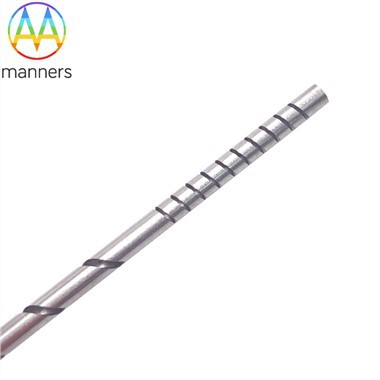
Needle Tip Options At A Disposable Stainless Steel Spinal Needles Manufacturer
Nov 25, 2026
Two Tips, Two Different Products
A spinal needle catalogue usually lists tip style as a single attribute: Quincke Point or Pencil Point. Buyers treat the choice as a clinical preference to be settled by the anaesthetist, and place the order with both options at a few popular gauges. The result is a range that is nominally complete and practically not, because tip geometry changes the manufacturing process, the inspection criteria, and the flow behaviour at the hub, and a supplier who offers both at two sizes is not offering a genuine choice.
The clinical difference is well described. A Quincke Point cuts a clean bevel through the dura. A Pencil Point separates fibres around a closed cone and admits fluid through a lateral eye. The first gives a crisp endpoint and rapid flow; the second reduces the size of the dural defect and is associated with fewer postural headaches. Both are used for anesthesia at the third or fourth lumbar interspace, and the choice depends on the patient, the indication, and the operator's training.
What the buyer has to establish is whether the supplier can produce both geometries with equal competence across the full gauge span, and whether the specification describes each with enough precision that a repeat order is the same product.
How the Two Geometries Differ in Production
A Quincke Point is produced by grinding a bevel at a defined angle, which creates a cutting edge and a heel. The variables are the bevel angle, the edge sharpness, the heel radius, and the deburring that removes grinding residue without rounding the edge. A bevel that is sharp but burred cuts badly; a bevel that has been over-polished feels blunt. Both are invisible in a photograph and both change the operator's experience.
A Pencil Point is formed by closing the tube into a cone and cutting a lateral eye near the tip. The variables are the cone angle, the concentricity of the closure, the size of the eye, and its distance from the apex. A cone that is not concentric tracks off-axis; an eye placed too far back delays the appearance of cerebrospinal fluid, and an operator waiting for flow may advance further than intended, which is exactly the situation in which a needle is pushed against bone rather than redirected.
Both processes are stable when controlled and both drift when they are not.
Classifying the Options for a Purchase Specification
A specification should treat the two geometries as separate items with separate critical dimensions, rather than as one item with a variant.
For the cutting tip, the critical dimensions are bevel angle, heel radius, edge condition, and the finished outside diameter at the bevel. For the separating tip, they are cone angle, concentricity, eye size, and eye position measured from the apex.
Both need a stated tip protrusion relative to the stylet, because the stylet determines the effective tip in use, and a stylet that seats short leaves a cavity that can collect tissue.
Both need a stated colour code, held identically across gauges and across tip styles, so that a Purple is a Purple whether the tip cuts or separates.
Both need packaging defined, standard carton or customer requirement, with the tip style marked on the label, because a Pencil Point and a Quincke Point of the same gauge are indistinguishable until the tip is examined.
Choosing and Communicating
Decide the clinical intent first. Where headache risk dominates, as in obstetric anesthesia or in young patients with elastic dura, the separating tip is usually preferred. Where a crisp endpoint and prompt flow matter, as in a diagnostic tap where the operator wants unambiguous confirmation of dural penetration, the cutting tip is often chosen.
Then decide the gauge distribution for each tip. Supplying a Pencil Point only at 25G and 27G while offering Quincke Points across the range is a common pattern and often adequate, but it should be a deliberate decision rather than an artefact of the catalogue.
Write the specification with the two geometries as separate line items, and ask the supplier to confirm that both are produced on the same site. A Disposable Stainless Steel Spinal Needles Manufacturer that grinds and closes tips in-house will control both processes; one that buys finished cannulae cannot.
Ask for the inspection method on each geometry, and ask whether the first article report will include the tip dimensions or only the shaft. A report that covers length and colour but not the bevel angle is reporting the easy half of the product.
Ask too how the stylet is matched to each geometry. The stylet of a cutting tip is ground to complement the bevel; the stylet of a separating tip is shaped to fill the cone. Neither is interchangeable, and a factory that assembles both from one stylet stock is producing one product properly and the other approximately. This is testable: seat the stylet, hold the needle to a light, and look at the tip. Any visible step or cavity indicates a mismatch that will change the feel of the puncture and may trap tissue on withdrawal.
In anesthesia use at the third or fourth lumbar interspace, the geometry also interacts with patient positioning. Where the back is held in flexion and the operator is working through a dense ligament, the cutting tip gives a clearer resistance change and a quicker endpoint; where the patient is thin, elderly, or at higher risk of postural headache, the separating tip is often preferred despite the softer signal. A Disposable Stainless Steel Spinal Needles Manufacturer who can supply both geometries across 16G to 27G lets the choice follow the patient rather than the catalogue, and that is the practical test of whether a tip range is real.
What Experience Shows
Three observations recur among buyers who have managed both tip styles.
The first is that Pencil Point quality varies more between suppliers than Quincke quality, because the closure process has more degrees of freedom. A buyer who accepts a sample Pencil Point without measuring concentricity and eye position has accepted very little.
The second is that the lateral eye produces a specific complaint: a dry hub despite a correct position. It is a technique issue as well as a product issue, resolved by rotating the shaft, but a consistent eye placement makes the technique reliable.
The third is that the labels matter. Two needles of identical gauge and length but different tips look identical in a tray, and a mislabelled carton converts a clinical choice into an error.
Summary
Tip options are a manufacturing commitment rather than a catalogue attribute. Specify both geometries with their own critical dimensions, require them across the gauge range, hold the colour map constant across both, and label the packaging so the choice is visible before the needle is opened. The clinical difference between cutting and separating is real, and it can only be delivered if both products are made to the same standard.
What to Ask at the Next Review
Ask for the tip dimensions on the first article report, not only the shaft and colour. Ask how concentricity is verified on a Pencil Point and how edge condition is verified on a Quincke Point. Ask which gauges carry which tip, and whether that distribution is a production constraint or a choice. Ask for both tip styles in a 90mm shaft and, where depth requires it, in a custom length. Then hold one sealed unit of each geometry as a reference, and compare every subsequent delivery against it, because a tip that has drifted by a few degrees will pass every visual check that is not a measurement.