Gauge Range Sourcing With A Disposable Stainless Steel Spinal Needles Manufacturer
Nov 25, 2026
The Problem With Buying Only the Popular Sizes
Purchasing data tells a misleading story about spinal needles. The bulk of any order sits in three or four gauges, because most adult lumbar punctures are performed with a mid-range needle in a mid-range patient. A buyer working from consumption alone will therefore restrict the order to those gauges, negotiate a better unit price on volume, and consider the exercise complete.
The gap appears in the patients who are not mid-range. A slim elderly woman at the third or fourth lumbar interspace may need a fine 27G needle to reduce the risk of postural headache and to make the puncture less traumatic. A therapeutic drainage may call for a 16G or 18G to allow faster flow. A patient with a dense ligament and a deep soft tissue envelope may need a heavier gauge simply to transmit enough feel to the operator's hand. When the store room holds only the popular sizes, the operator substitutes, and the substitution is where variability enters a procedure that depends on repeatability.
Gauge range is therefore a sourcing decision that affects clinical outcomes, not a stock-keeping convenience.
Why Gauge Changes What the Operator Feels
Wall thickness and bore diameter determine how a needle behaves in tissue, and both scale with gauge. A fine needle has a thinner wall and a smaller outside diameter, which reduces the force required to advance it but also reduces the resistance signal transmitted to the hand. That trade-off is the whole clinical point of gauge selection.
At 16G or 18G the needle is stiff, transmits resistance crisply, and produces a large dural defect with a correspondingly higher headache risk; it is chosen when flow matters more than headache risk. At 25G or 27G the needle is flexible, the resistance signal is softer, and the dural defect is small; it is chosen when the patient's risk profile argues for the finest instrument that will still reach the space.
A well-made needle holds this relationship consistently. A poorly made one does not: if the wall thins toward the tip, a 25G may feel heavier than its nominal gauge, and the operator's interpretation of depth becomes unreliable. Asked to redirect around bone, an operator working with an inconsistent needle may push instead of redirecting, because the feel no longer distinguishes ligament from bone with confidence.
What Full-Range Supply Actually Means
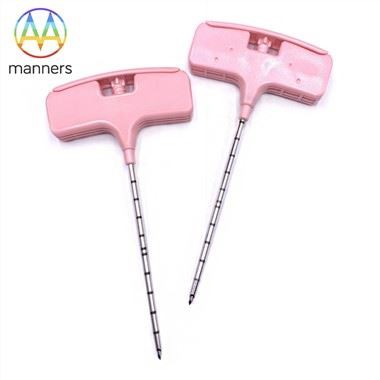
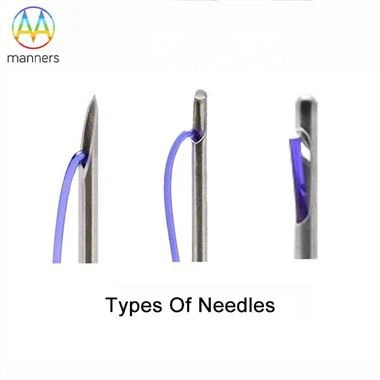
Full-range supply means one production route covering 16G through 27G, with the same tip geometries available at every gauge, and one colour map applied across the whole span.
It means both Quincke Point and Pencil Point versions at the gauges where each is clinically used, rather than a token version at one or two sizes.
It means a 90mm shaft as the default adult length, with custom length available where the measured depth requires it.
It means the twelve-colour code held consistently, so that White at 16G and Grey at 27G are recognisable in the same way as the intermediate shades.
It means standard carton packaging, or packaging built to customer requirement where a service needs a specific pack count or label.
A supplier who covers all of this from one line removes the most common sourcing failure: a store room holding needles from two sources whose colour maps disagree, and an operator who trusts the colour because it was right last year.
Selecting and Communicating the Range
Start with a usage audit rather than a price enquiry. Count the procedures by type, and identify the gauges actually required for each. A unit performing obstetric anesthesia, a neurology ward performing diagnostic taps, and a pain service performing therapeutic drainage will not need the same distribution, but all three benefit from access to the whole span.
Then define the range explicitly in the contract: every gauge from 16G to 27G, both tip geometries, the default 90mm shaft, custom length as an option, the colour map, and the packaging format. Name the colours in sequence so that the mapping is unambiguous.
Ask the supplier to confirm which gauges are held in stock and which are made to order, and ask for the lead time on each. A Disposable Stainless Steel Spinal Needles Manufacturer that makes the entire range on one site will usually answer this question in a single table, and the table itself is a useful diagnostic: a supplier who cannot produce it is unlikely to hold a consistent map across the range.
Ask, finally, how a new gauge is introduced. Adding a size should be a defined change with a defined colour, not an improvisation that displaces an existing colour and breaks the map.
Ask also how gauge and length interact. A 27G needle in a 90mm shaft is a slender instrument and behaves differently in tissue from the same gauge in a custom length built for a deep envelope, because the unsupported span changes what the operator feels. Confirm that every gauge in the range is available in both the standard 90mm shaft and in a custom length, and that the tip geometries remain available at the extremes of the range rather than only in the middle. A range that quietly stops at 22G for Pencil Point versions is a partial capability presented as a full one.
Stock policy is the other half of the question. Decide which gauges are held on the shelf, which are made to order, and what the acceptable lead time is for each, because the store room's depth is a clinical resource. A Disposable Stainless Steel Spinal Needles Manufacturer holding every gauge from 16G to 27G in standard carton packaging allows a department to buy twice a year; one that makes most sizes to order forces a monthly ordering rhythm and a thin shelf. Ask for the stock position in writing at the point of tender, and re-confirm it at each contract review rather than assuming it has remained.
What Buyers Discover in Service
Two lessons come back from departments that have run a full range for a year.
The first is that range availability reduces improvisation. When the right gauge is in the drawer, the operator uses it; when it is not, the operator makes the procedure work with what is there, and the resulting variability is invisible in the notes but visible in the complication data.
The second is that a single source improves colour reliability. Departments that bought part of the range elsewhere report exactly the problem that a unified map is meant to prevent: a Purple from one supplier sitting beside a Dark Blue from another, with no one certain which is which after a rotation of staff.
Summary
Gauge range is clinical capability. Sourcing 16G through 27G from one manufacturer, with both tip geometries, a 90mm default and custom length, one twelve-colour map, and packaging that matches the store room's needs, converts a drawer of assorted needles into a controlled range. The operator's ability to feel depth, and therefore to decide whether to advance or redirect, depends on that control.
Planning the Next Contract
Build the next tender around the range rather than the volume discount. Specify every gauge, both tips, both length routes, the colour map by name, and the packaging format. Request stock and lead-time data per gauge, and request written confirmation that the map will not change. Then pilot the full range in one department for a quarter and review the substitution rate, because the number of times an operator wanted a gauge that was not there is the most honest measure of whether a gauge range programme has worked.