Clinical Safety Optimization Of Curved Blunt RF Needles
Oct 02, 2026
1. Industry Pain Points
Traditional straight radiofrequency needles face prominent clinical limitations in minimally invasive ablation procedures. Straight rigid needles are difficult to adapt to complex human tissue anatomical structures, leading to excessive puncture resistance and easy deviation from the target treatment area. Sharp needle tips often cause accidental damage to adjacent blood vessels, nerves and normal tissues, increasing intraoperative bleeding, postoperative pain and complication risks. In addition, repeated puncture operations caused by inaccurate positioning prolong operation time, reduce surgical efficiency, and raise patient postoperative recurrence rate to 5%-8%, far higher than the optimal clinical standard. For complex arrhythmia and deep tissue ablation surgeries, traditional needles cannot achieve multi-angle in-situ ablation, resulting in incomplete lesion removal and poor long-term treatment effect.
2. Working Principle
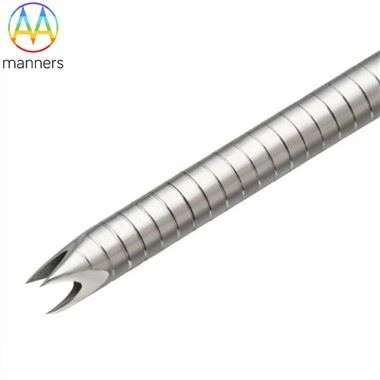
Curved blunt RF needles rely on radiofrequency thermal ablation technology and optimized curved blunt structure design to realize precise and safe treatment. The stainless steel needle body conducts high-frequency radiofrequency current, which stimulates electrolyte ions in human tissues to generate high-speed reciprocating movement. Ionic friction and collision produce stable thermal effect, which can accurately coagulate and ablate lesion tissues within a controllable temperature range (45-90℃). The curved structure enables the needle body to fit the physiological curvature of human tissues, realizing multi-angle directional treatment without repeated puncture. The blunt tip design eliminates sharp cutting damage, effectively avoids piercing normal tissues and blood vessels, and ensures the safety of energy transmission while maintaining efficient ablation performance.
3. Equipment Classification
Curved blunt RF needles are classified by needle gauge and application scenarios in clinical practice. Conventional specifications cover 8G-26G, among which 8G-14G thick needles are suitable for deep tissue and large-area lesion ablation such as ventricular tachycardia and atrial fibrillation lesions, with strong energy conduction and wide ablation coverage. 16G-22G medium needles are widely used in common paroxysmal supraventricular tachycardia treatment, balancing ablation efficiency and operational precision. 24G-26G thin needles are applied for superficial and fine tissue ablation, suitable for tiny lesion resection with minimal trauma. In addition, customized curved radian and length models can be produced according to clinical 2D/3D drawings and sample requirements to meet personalized surgical needs.
4. Practical Operation Guidelines
Before operation, select the appropriate needle specification according to the patient's lesion location, size and tissue depth, and complete sterile disinfection and equipment debugging. Confirm the radiofrequency energy parameters, adjust the treatment temperature and power according to the lesion type, and test the normal operation of the energy conduction system. During puncture, align the curved needle body with the tissue physiological curvature, adopt slow and uniform force for in-situ penetration, avoid forced pushing to prevent needle body deviation. After reaching the target lesion position, fix the needle body stably, activate radiofrequency energy for segmented ablation, and control single-point treatment time to avoid excessive thermal damage. After operation, slowly retract the needle body, observe the puncture site for bleeding and exudation, and complete postoperative dressing treatment.
5. Practical Clinical Experience
In multi-center clinical trials of cardiac arrhythmia treatment, curved blunt RF needles have achieved excellent practical results. For paroxysmal supraventricular tachycardia, the surgical success rate exceeds 96%, and the postoperative recurrence rate is controlled within 1%-2%, which is significantly better than traditional straight needles. Clinical data shows that the curved fitting design reduces puncture times by 60% compared with traditional equipment, shortens average operation time by 30%, and reduces intraoperative tissue damage complications by 75%. For complex atrial flutter and ventricular tachycardia lesions that are difficult to reach with straight needles, curved blunt needles can accurately fit lesion boundaries, realize complete ablation, and effectively improve the cure rate of refractory arrhythmia. Postoperative patient recovery cycle is shortened by nearly half, and the overall clinical treatment experience is significantly optimized.
6. Summary and Sublimation
Curved blunt RF needles solve the core safety and efficiency pain points of traditional radiofrequency ablation equipment through structural innovation and technical optimization. The complementary advantages of curved adaptive design and blunt safety structure make radiofrequency ablation surgery more precise, safe and minimally invasive. It not only improves the success rate of clinical treatment and reduces recurrence and complication risks, but also optimizes the surgical operation process and reduces the operational difficulty of medical staff. As a key upgraded equipment in minimally invasive radiofrequency therapy, it effectively balances treatment effect and patient safety, and provides a more reliable technical carrier for the standardized development of clinical ablation surgery.
7. Industry Prospect Suggestions
In the future, the industry should further promote the standardized customization of curved blunt RF needles, formulate unified clinical application specifications for different gauge needles, and improve the matching degree of equipment and various surgical scenarios. Enterprises need to strengthen material upgrading, adopt higher-purity medical stainless steel and advanced electropolishing technology to improve needle body durability and biocompatibility. It is necessary to accelerate the integration of intelligent temperature control and positioning technology, realize real-time monitoring of ablation temperature and needle position, and further improve treatment accuracy. Meanwhile, strengthen clinical promotion and doctor training, expand the application scope in refractory arrhythmia and deep tissue ablation fields, and drive the overall upgrading of radiofrequency ablation medical equipment.