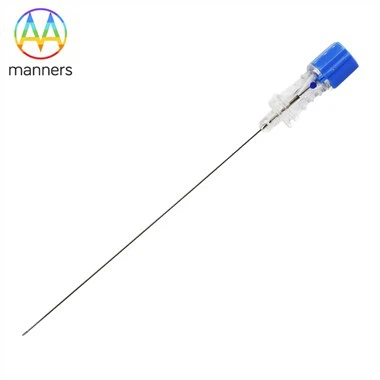
Vascular Access Accuracy Of Curved Tip RF Puncture Needle
Oct 02, 2026
1. Industry Pain Points
Traditional straight radiofrequency puncture needles face prominent accuracy defects in cardiac radiofrequency ablation vascular access procedures. Clinically, surgeons need to implant 3 to 4 electrode catheters through the femoral vein and subclavian vein to reach target areas including the coronary sinus, high right atrium, bundle branch and right ventricle. Straight rigid needles are unable to fit the natural bending angle of human superficial and deep veins, leading to frequent catheter deviation and vascular wall friction during puncture. For complex venous access paths with multi-angle turns, straight needles often require repeated adjustment and multiple puncture attempts, which easily cause vascular intimal damage, local hematoma and intraoperative bleeding. In addition, inaccurate in-vascular positioning will lead to deviation of subsequent electrode catheter placement, affect the induction of atrial and ventricular tachycardia, reduce the accuracy of lesion origin positioning, and indirectly increase surgical failure rate and postoperative recurrence risk.
2. Working Principle
The core advantage of curved tip RF puncture needles lies in the bionic curved tip structure and stable radiofrequency conduction performance, which solves the vascular access pain points of traditional straight needles. Made of high-quality medical stainless steel, the needle body has uniform hardness and excellent flexibility, which can fit the physiological curvature of femoral vein and subclavian vein during puncture. The optimized curved tip design realizes directional guiding during venous penetration, automatically adapts to multi-angle vascular turning paths, and avoids forced extrusion and friction on vascular walls. While completing efficient and low-trauma vascular puncture, the needle body can stably conduct radiofrequency current, cooperate with external RF generators to form accurate ablation energy fields, and lay a precise channel foundation for subsequent electrophysiological induction and tachycardia lesion positioning.
3. Equipment Classification
Curved tip RF puncture needles are classified by gauge size and vascular access application scenarios to meet differentiated clinical needs. 8G-14G large-gauge needles feature strong structural stability and excellent energy conduction, suitable for thick femoral vein puncture and large-range cardiac lesion ablation, and can support stable implantation of multiple electrode catheters. 16G-22G medium-gauge needles balance puncture stability and minimal trauma, perfectly adapting to conventional subclavian vein access and routine atrial and ventricular tachycardia treatment, which is the most widely used specification in clinical surgery. 24G-26G fine-gauge needles are applied for precise puncture of thin superficial veins and delicate vascular branches, effectively avoiding vascular rupture and bleeding. Meanwhile, customized curved radian and length specifications can be produced according to 2D/3D drawings and samples for special vascular anatomical structures.
4. Practical Operation Guidelines
Preoperative preparation: Select matching needle specifications according to the patient's vascular condition and surgical access plan, complete sterile disinfection of the needle body and surgical area, and debug the RF generator and electrophysiological monitoring equipment. Under local anesthesia, mark the puncture points of femoral vein and subclavian vein to clarify the vascular access path. Intraoperative operation: Hold the curved tip needle stably, align the curved direction with the vascular physiological bending, adopt slow and uniform force for puncture, advance along the venous path to the target cardiac area including coronary sinus and right ventricle. After successful puncture and catheter implantation, fix the needle body stably to avoid displacement. Post-operation detection: Induce atrial and ventricular tachycardia through electrode catheters, verify the accuracy of lesion origin positioning, and prepare for subsequent radiofrequency ablation.
5. Practical Clinical Experience
In multi-center cardiac ablation clinical practice, curved tip RF puncture needles have significantly improved the success rate of primary vascular access. Compared with traditional straight needles, the one-time puncture success rate of venous access increases by 35%, and the number of intraoperative needle adjustment is reduced by 70%, effectively avoiding vascular intimal injury and hematoma complications. The accurate guiding performance of the curved tip ensures that electrode catheters can stably reach the coronary sinus, high right atrium and other target positions, improving the induction accuracy of tachycardia lesions. Clinical data shows that the application of curved tip needles shortens the average vascular access time by 40%, optimizes the electrophysiological examination process, and makes the subsequent ablation positioning more accurate. After standardized operation, the surgical success rate of tachycardia ablation remains above 95%, and no induced tachycardia occurs in postoperative follow-up.
6. Summary and Sublimation
Curved tip RF puncture needles effectively make up for the structural defects of traditional straight needles in vascular access surgery. Through the bionic curved tip design and high-precision processing technology, it realizes low-trauma, high-precision and one-time molding of venous puncture paths, optimizes the whole process of electrode catheter implantation and tachycardia lesion induction. It not only reduces intraoperative vascular complications and shortens operation time, but also improves the accuracy of clinical lesion positioning and ablation treatment effect, providing a more reliable puncture tool for standardized cardiac radiofrequency ablation surgery.
7. Industry Prospect Suggestions
The industry should further optimize the curved tip radian design according to human vascular anatomical data, form targeted specification models for femoral vein and subclavian vein access respectively. Strengthen the upgrading of stainless steel material biocompatibility, reduce vascular irritation during long-term intraoperative placement. Promote the popularization of customized needle products for special vascular malformation patients, and improve the adaptability of equipment for complex surgical cases. Establish standardized vascular puncture operation guidelines for curved tip needles, strengthen clinician technical training, and further improve the overall standardization level of cardiac radiofrequency ablation surgery.