One Needle, Many Indications
Oct 02, 2026
A single RF generator often lives a multi-department life. In one wing it treats uterine fibroids; in another, thyroid nodules; in a third, hepatic tumors; occasionally it assists in septal puncture or adenomyosis work. The friction this creates is rarely about the physics - it is about ownership. Each department quietly believes "our needle" is distinct, yet the catalog shows overlapping gauges and tips. Procurement teams, caught in the middle, struggle to decide whether one ablation platform can safely serve gynecology, endocrinology, and interventional radiology, or whether siloed kits are legally and clinically safer. The hidden cost is duplication: multiple contracts, inconsistent sterilization flows, and operators reaching for a needle validated for one organ while treating another.
The unifying principle is refreshingly constant. High-frequency current agitates ions; friction becomes heat; heat above 60°C produces coagulative necrosis. What changes is the anatomy, the access route, the safety margin, and the imaging modality. In fibroids, the aim is volume reduction and symptom relief while sparing the myometrium. In thyroid nodules, the priority flips to nodule shutdown while protecting the recurrent laryngeal nerve and the capsule. In hepatic ablation, the vascular "heat sink" demands compensatory energy and careful prong placement. In cardiac septal puncture, RF energy softens tissue so the crossing requires less mechanical force, reducing trauma to the septum. Same physics, different grammar.
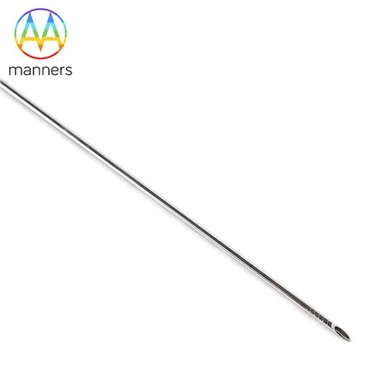
Classifying the hardware by service clarifies procurement. Gynecologic RF needles tend to be longer, with transabdominal or transvaginal options and marked depth rings. Thyroid needles are finer - 18G to 21G - with short exposed tips to stay within a small nodule. Tumor needles, 14G to 17G, often feature cooled tips or expandable arrays to cover larger volumes. Cardiac RF puncture devices are flexible-shaft catheter hybrids with handle-activated firing and distal electrode control. And across all of them runs the OEM thread: from raw medical tubing to swaged hubs, ground bevels, laser-cut side windows, electropolished finishes, and sterile single-use kits built to a department's drawing. A needle that serves the liver is not interchangeable with one meant for the cervix, even if both are "18G stainless."
Operationally, cross-department sharing demands rules rather than goodwill. Never share a non-sterile needle across services; match gauge to target organ; match exposed-tip length to lesion depth; match generator preset to tissue type; and train each team on its own complication tree. A thyroid algorithm that stops for nerve proximity is meaningless for a uterine case watching the serosa. A liver protocol that over-powers for heat-sink has no place in adenomyosis. The shared asset is the generator and the ultrasound skill; the unshared asset must be the clinical judgment.
Centers that have embraced "ablation platforms" rather than departmental fiefdoms report unexpected efficiencies: shared simulation training, harmonized consent templates, common post-procedure imaging protocols. They also learn hard boundaries quickly - pleura near a lung lesion, carotid near a thyroid nodule, rectosigmoid near a posterior fibroid - each demands its own buffer and its own "stop" rule. The cardiac septal experience adds a nuance others borrow: less pushing, more energy modulation, handle-controlled firing that keeps the operator's hand out of the force equation. The needle becomes an instrument of restraint as much as of heat.
Elevating the view, one physical principle now speaks many clinical languages. The RF puncture needle is less a specialty tool than a translator - converting electrical energy into tissue-specific outcomes, one organ's safety margin at a time. The danger of the multi-use era is not over-ambition; it is forgetting that anatomy, not wattage, writes the rules.
Looking ahead, hospitals should stand up an ablation committee spanning gynecology, radiology, endocrinology, and cardiology to govern shared devices. Standardize sterilization, UDI traceability, and generator compatibility matrices. Let departments share the platform but never blur the safety protocols. And in tenders, ask for clinical-use validation per organ, not just a generic "RF compatible" label. The next decade belongs not to the busiest generator but to the most disciplined shared-ablation program.