Why Does A 0.1mm Difference In The Material Selection And Structural Tolerance Of The Veress Needle Mean Two Lives?
Jun 18, 2026
https://en.wikipedia.org/wiki/Veress_needle
1. Reusable vs. Disposable: Two Engineering Trade-offs Under the Same Structural Logic
Dimension
Reusable Metal Veress Needle
Disposable Veress Needle
- Body Material: 316L Stainless Steel, Machined + Electrolytic Polishing; Medical-Grade PC/POM Injection Molded + Local Stainless Steel Inserts
- Spring: Removable for Inspection, Resistant to Repeated High-Pressure Sterilization; Encapsulated within Handle Body, Pre-Calibrated at Factory
- Flow Path: Gap between Inner and Outer Sheaths + Internal Lumen of Needle Core, Disassemblable for Cleaning; Fixed Flow Path, Non-Disassembleable
Cost Model: High Unit Price, Allocated Across Hundreds of Cycles; Low Unit Price, Single-Use Cost Included in Consumables Kit
Quality Control Focus: Spring Fatigue Life, Polishing Integrity, Seal Aging; Injection Molding Dimensional Consistency, Spring Assembly Preload, Sterile Barrier Packaging
For OEM manufacturers, the common chassis of both product types shares the same geometric constraint: an outer sheath outer diameter ≈2.0 mm and an inner core outer diameter ≈1.2–1.4 mm, leaving less than 0.3–0.4 mm of annular clearance for gas flow-within which the inner core must slide back and forth.
2. Three Deadly Dimension Chains
① Edge Chamfer and Polishing Surface Roughness
If the edge radius R of the beveled outer sheath blade exceeds the design value (due to insufficient grinding or excessive polishing), puncture resistance increases, requiring greater force from the physician's wrist-making inertia harder to control and increasing the risk of over-penetration. However, if the blade is overly sharp (R too small or burrs present), it may snag fascial fibers or cause micro-tears during removal.
The standard compliant machining process typically involves: CNC longitudinal turning (Swiss-type) + electrochemical deburring + multi-stage diamond polishing, achieving a final surface roughness of Ra ≤ 0.2 μm, ensuring the material is precisely "cut" rather than "torn" apart.
② Radial Clearance Between Inner Core and Outer Sheath
This is the most problematic area of the entire needle. If the clearance is too large, gas flow will be acceptable but the inner core may wobble, resulting in poor concentricity after the blunt tip pops out and incomplete blade coverage; if the clearance is too small, sliding resistance increases, the spring feels "stiff" or gritty, and the risk of jamming rises sharply.
In practice, mass production control involves 100% in-line inspection using pin gauges and pneumatic measuring instruments, while spring preload force is tested through sampled tensile/compressive force curve measurements. A difference of just 0.02 mm can alter the tactile feel-and the operating room is not a setting where "batch-to-batch tactile variation" is acceptable.
③ Side Hole Position and Chamfer
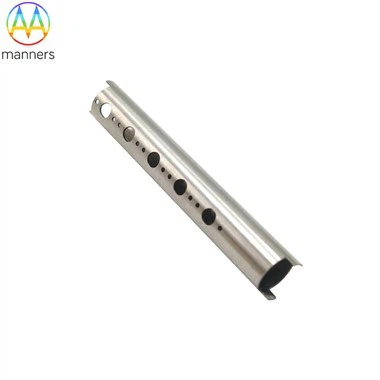
The lateral port (eye) is located at the distal end of the inner core, near the base of the blunt tip, with a diameter of approximately 0.4 mm. There is a frequently overlooked structural detail: if the edges of the port are not chamfered or deburred, the intestinal mucosa may be "scratched" by sharp edges when lifted by gas bubbles. Additionally, if the lateral port is positioned too close to the very tip of the blunt end, after deployment it may be partially obstructed by the outer sheath, effectively halving the flow cross-section. Conversely, if the port is placed too far back, gas may leak into the preperitoneal space through the rear position before the inner core has fully deployed-creating a false pre-inflation effect-just as the needle tip pierces the peritoneum.
3. Why Stainless Steel is the "Default Option," Yet Not the Only Choice
316L has become the mainstream not only because of its corrosion resistance, but also due to its stable elastic limit, which ensures that its mechanical properties do not significantly change after repeated bending (though bending is not permitted, lateral forces during transportation and handling are unavoidable) and high-temperature, high-pressure sterilization cycles. Some high-end lines use 17-4 PH precipitation-hardening stainless steel for spring components to achieve a better fatigue life curve.
Switching to a one-time-use version with an engineered plastic handle involves a trade-off between cost structure and infection control: while the plastic handle allows the valve body, indicator window, and snap-fit components to be molded in a single injection process, significantly reducing assembly time, it also permanently eliminates the possibility of removing and cleaning the spring during surgery if it becomes inconvenient-thus requiring stricter consistency standards at the point of manufacture.
4. What Manufacturers Should Truly Fear
The Veress needle is one of the few medical devices for which "the simpler the structure, the stricter the regulatory scrutiny." Since it is used in the first step of blind puncture, both the FDA and NMPA have never focused on whether it has multiple functions, but rather on whether its failure modes can be predicted and fully enumerated-spring failure, debris detachment, valve leakage, blade chipping... each with documented adverse event records traceable back to specific incidents.
For the supply chain, the key metric for doing well with a Veress needle can be condensed into one sentence: Sharp yet non-scratchy, smooth yet stable in the core, light yet powerful spring, sealed valve seat that opens instantly with a twist-only when all four contradictions are met simultaneously can it be considered qualified.