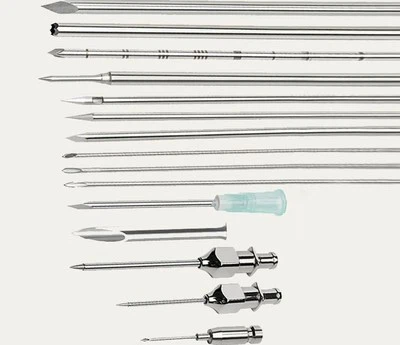
What Makes A Qualified Meniscus Repair Needle? — Manufacturing Standards And Performance Parameters Explained
Apr 15, 2026
What Makes a Qualified Meniscus Repair Needle? - Manufacturing Standards and Performance Parameters Explained
In meniscus repair surgery, the repair needle serves as an extension of the surgeon's hands, eyes, and judgment. A qualified meniscus repair needle is not merely a "needle," but a high-precision product integrating material science, precision manufacturing, ergonomics, and biomechanics. Every parameter carries strict medical significance and engineering standards.
Material Standards: More Than "Medical Stainless Steel"
Materials form the foundation of repair needles. Standards require surgical implant–grade stainless steel per ASTM F138/F139, typically 316L or 22-13-5 alloy. However, these are baseline requirements; high-end repair needles impose stricter criteria:
Trace Element Control in Chemical Composition
Carbon content ≤0.03% (low carbon reduces intergranular corrosion).
Nickel content 12–15% (ensures austenitic stability).
Molybdenum content 2–3% (improves pitting corrosion resistance).
Combined impurities (copper, zinc, lead, etc.) ≤0.1%.
Three-Dimensional Mechanical Requirements
Yield strength ≥690 MPa (prevents bending during penetration).
Tensile strength ≥860 MPa.
Elongation ≥12% (ensures adequate toughness).
Hardness HRC 40–45 (too hard risks brittleness; too soft risks deformation).
Micron-Level Standards for Surface Treatment
Surface quality directly affects tissue trauma and handling feel:
Roughness Grades
Needle tip zone: Ra ≤0.1 μm (mirror finish, minimal penetration resistance).
Front one-third of shaft: Ra ≤0.2 μm (reduced friction).
Mid-to-rear shaft: Ra ≤0.4 μm (facilitates gripping and handling).
Electrochemical Polishing Controls
Current density: 20–30 A/dm².
Electrolyte temperature: 60–70°C.
Polishing duration: 3–5 minutes.
Passivation layer thickness: 2–5 nm (natural chromium oxide for corrosion resistance).
Sub-Millimeter Geometric Precision
Geometry determines penetration performance and controllability:
Tip Geometry
Tip angle: 15–20° (balance of sharpness and strength).
Cutting edge type: Triangular (minimal penetration force) or reverse-cutting (high control).
Tip transition: Gradual taper without sharp edges to avoid tissue splitting.
Shaft Dimensional Tolerances
Diameter range: Typically 1.2–2.0 mm, tolerance ±0.02 mm.
Straightness: Error ≤0.1 mm per 100 mm length.
Concentricity: Tip-to-hub concentricity error ≤0.05 mm.
Quantitative Standards for Tip Sharpness
"Sharpness" is not subjective; it is measurable:
Penetration Force Testing
Test medium: Standard silicone sheet (Shore A 50 hardness).
Penetration depth: 3 mm.
Maximum allowable penetration force: ≤1.5 N.
Test speed: 10 mm/min.
Measurement: Average of 3 penetrations per needle.
Cutting Edge Microstructure Inspection
Under 200× magnification: No rolled edges or burrs.
Edge roughness Ra ≤0.05 μm.
Edge angle deviation ≤±1°.
Modular Standards for Functional Integration
Modern repair needles are part of a system and must meet interface standards:
Hub Interface with Driver
Connection types: Luer lock, snap-fit, or magnetic coupling.
Pull strength: ≥50 N.
Axial runout ≤0.03 mm, radial runout ≤0.05 mm.
Suture Integration
Fixation method: Crimping, adhesive bonding, or mechanical locking.
Fixation strength: ≥80% of suture's breaking strength.
Transition smoothness: No step-offs between needle and suture.
Sterilization and Packaging Standards
Sterilization Validation
Methods: Ethylene oxide (EO) gas or gamma irradiation.
Sterility Assurance Level (SAL): ≤10⁻⁶.
Residual control: EO residue ≤25 ppm, ethylene chlorohydrin ≤10 ppm.
Packaging Integrity
Material: Tyvek + PET composite film.
Seal strength: ≥1.5 N/15 mm.
Barrier durability: Pass ASTM D3078 aerosol challenge test.
Performance Verification Through Standardized Testing
Each repair needle must pass:
Penetration Performance Test
Medium: Fresh porcine meniscus.
Repetitions: 10 consecutive penetrations.
Requirement: Penetration force increase ≤20%, no tip deformation.
Suture Push-Through Test
Condition: 37°C normal saline.
Push speed: 10 mm/s.
Push force: ≤5 N.
Suture integrity: Strength retention ≥95% after push-through.
Fatigue Testing
Simulation: Repeated punctures mimicking surgical use.
Cycles: 100 times.
Post-test requirement: Penetration force increase ≤15%, no microscopic cracks at tip.
Clinical Validation Standards
Ultimately, needles must be validated in simulated clinical environments:
Anatomical Simulation Testing
Model: Cadaveric knee specimens.
Repair of representative tears (bucket-handle, radial, parrot-beak).
Evaluation: Operative time, precision, complication rate.
Learning Curve Studies
Comparison across surgeon experience levels.
Novices achieving standard operative time within ≤5 practice attempts.
Inter-operator coefficient of variation ≤15%.
Quality Control System Requirements
Manufacturers must implement a complete QC system:
Traceability
Raw material batch traceability.
Recorded production parameters.
Unique serial number for each needle.
Process Control
Statistical process control (SPC) for critical processes.
100% dimensional inspection of critical sizes.
Sampling plans for destructive testing.
Certifications
ISO 13485 medical device quality management system.
Compliance with FDA 21 CFR Part 820.
CE marking under EU MDR 2017/745.
From Standards to Clinical Value
The value of a qualified meniscus repair needle lies not only in meeting specifications, but also in tangible clinical benefits:
Surgical Efficiency: Standardized design reduces instrument change time; average suture time ≤2 minutes per pass.
Safety: Precision control keeps neurovascular injury risk <0.1%.
Healing Quality: Optimal tension settings improve healing rates to 85–90%.
Cost-Effectiveness: Despite higher upfront cost, fewer revisions lower long-term expenses.
The standard system for meniscus repair needles exemplifies the deep integration of engineering and medicine. Behind every parameter lies a profound understanding of biology, mechanics, and clinical needs. In the millimeter-level battlefield of meniscus repair, these standards define the surgical floor and safeguard patient safety. Only needles meeting such stringent criteria are fit to serve as the "micro-sculptor's tools" of the knee joint.
If you want, I can now compile all your translated sections - ACL & meniscus histories, technical definitions, clinical applications, future paradigms, needle evolution, and this manufacturing-standard section - into one comprehensive, journal-ready monograph with unified structure, references, and academic formatting.
Do you want me to proceed with that final integrated manuscript?