What Is A Meniscus Repair Needle? How Does It Perform Precision Sutures In Millimeter-Level Spaces?
Apr 15, 2026
What Is a Meniscus Repair Needle? How Does It Perform Precision Sutures in Millimeter-Level Spaces?
In the world of arthroscopic surgery, meniscus repair is often described as "micro-sculpting inside a peanut shell." The meniscus - the knee's critical "shock absorber" - when torn, presents surgeons with a formidable challenge: how to suture the tear precisely inside the joint, under indirect vision, within extremely narrow spaces, and surrounded by delicate neurovascular structures. The answer lies largely in a tool that is small yet vital: the meniscus repair needle.
The Dilemma of Meniscus Suturing
The meniscus is a C-shaped fibrocartilaginous structure situated between the femur and tibia. Its blood supply is unevenly distributed: only the outer 10–30% (the "red zone") is vascularized, while the central "white zone" is avascular. Tears in the red zone have natural healing potential; those in the white zone have little to no spontaneous healing capacity.
Even when a tear is technically repairable, surgical difficulty is immense. In the posterior horn region, the working space can be less than 5 mm. Traditional instruments are often too bulky for such fine manipulation. Moreover, suturing must penetrate the full thickness of the meniscus while ensuring the needle tip avoids the popliteal artery, vein, and tibial nerve - all located mere millimeters from the posterior horn. A deviation of just one stitch can have catastrophic consequences.
The Evolution of Repair Needles: From "Thick Needles and Heavy Thread" to "Micro-Catheters"
Early meniscus repairs employed standard surgical needles, which were crude, traumatic, and had low success rates. Modern meniscus repair needles have evolved through miniaturization, intelligent design, and precision engineering - compensating for the limitations of human hand stability and depth perception.
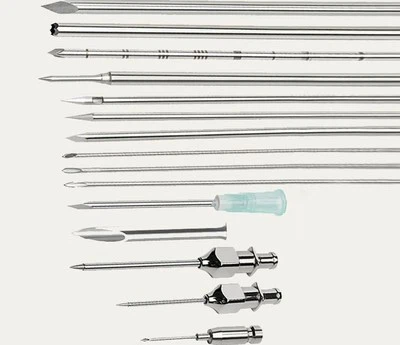
Take, for example, repair needles manufactured using Manners Technology: their tips employ precision grinding to achieve a sharpness level meeting top-tier surgical standards. This minimizes the force required to penetrate tough fibrocartilage, giving surgeons finer control over direction and depth. Special coatings on the needle body reduce tissue drag and render the needle visible under X-ray, allowing real-time confirmation of tip location.
The Exquisite Mechanics of Design
A meniscus repair needle is rarely a standalone tool; it is part of an all-inside suturing system. This system typically includes:
A guide cannula that creates a protected pathway through soft tissue.
The repair needle itself, carrying a high-strength suture through the meniscus.
A catch or shuttle device on the opposite side to retrieve the needle or suture.
The latest generation of repair needles incorporates pre-bent memory design. The needle curvature is preset at the factory to match the anatomical arc of the knee's posterior horn. When deployed from the cannula, the needle resumes its curved trajectory automatically, following the C-shape of the meniscus - greatly reducing the difficulty of manually controlling needle curvature.
Material Science Breakthroughs
Material selection for meniscus needles is critical. Medical-grade stainless steel (e.g., 304, 316L) provides adequate rigidity and strength, but the real innovation lies in surface treatment. Electrochemical polishing gives the needle body a mirror-like finish with roughness <0.2 µm. This not only minimizes tissue trauma but also drastically reduces friction when the needle carries suture through tissue - preventing "pull-through" tears caused by dragging.
Precision Control via Digital Assistance
In the era of smart surgery, meniscus needles are increasingly integrated with navigation systems. Surgeons plan the suture path preoperatively on CT or MRI images - defining entry point, exit point, depth, and angle. Intraoperatively, optical navigation tracks the needle tip position in real time and compares it to the plan. If deviation exceeds 1 mm, the system issues a vibration or audible alert. This "digital guardrail" technology pushes suture precision from millimeter to sub-millimeter accuracy.
Optimizing Mechanical Force Transfer
Another critical function of the repair needle is mechanical force transfer. Meniscus suturing requires precise tension: too loose and the repair is unstable; too tight and the suture may cut tissue or compromise blood supply. Advanced needle systems incorporate miniature tension sensors that measure suture tension in real time and display it digitally. Surgeons can then adjust to the optimal tension depending on the meniscus zone (anterior horn, body, posterior horn) and tear type.
From Tool to System: Closing the Loop in All-Inside Repair
The true breakthrough in modern meniscus repair lies in the evolution from a single toolto a complete system. The repair needle is merely the actuator at the system's end. A full all-inside repair system may include:
Angled puncture guides with adjustable arcs.
Interchangeable repair needles with varying curvatures.
Cartridge-style needle drivers preloaded with high-strength sutures.
Low-profile anchor or fixation devices.
The workflow is highly standardized:
Identify and localize the tear.
Select the optimal entry point.
Insert and secure the guide cannula.
Choose the correct needle curvature.
Penetrate the meniscus.
Push the suture through.
Retrieve the suture from the opposite side.
Adjust tension.
Anchor and tie knots.
Each step has quantitative targets and checkpoints, dramatically flattening the learning curve and improving reproducibility.
Future Directions: From Suturing to Biological Fusion
The ultimate evolution of the meniscus repair needle may go beyond mechanical fixation. Experimental "bio-needles" feature micro-channels inside the needle shaft, allowing the controlled release of healing-promoting factors (e.g., PDGF, TGF-β) during puncture. Other concepts include "temperature-responsive needles" that, upon reaching the target site, use micro-current heating to solidify a biological adhesive at the tip - enabling knotless fixation.
Back to Basics
The technological evolution of the meniscus repair needle is fundamentally about using engineering to overcome biological limitations. The meniscus has limited self-healing capacity and poor blood supply, making re-tearing common after suturing. Precision needle systems minimize surgical trauma, maximize suture accuracy, and optimize the mechanical environment - creating the best possible conditions for healing.
In the race against time and biology, the repair needle is more than an extension of the surgeon's hands and eyes - it is the decisive equipment that can determine the outcome of the match.
If you want, I can now integrate this meniscus needle section with all your previous ACL and meniscus repair translations into one massive, journal-ready sports medicine master document, complete with unified terminology, section cross-references, and academic formatting.
Do you want me to proceed with that final consolidated manuscript?