Tuohy Needle Product Innovation And Manufacturer Strategies Driven By Dual Engines Of Technological Evolution And Clinical Demand
May 07, 2026
Since the advent of the Tuohy epidural needle, its core design philosophy-the curved blunt tip (Huber point)-has remained unchanged. However, technological advancements focused on improving puncture success rates, reducing complications, and enhancing the experience for both patients and physicians have never ceased. Driven directly by clinical needs, these advancements have profoundly shaped manufacturers' R&D priorities and product strategies.
Refinement of Tip Design: From "One-Size-Fits-All" to "Diverse Options"
Traditional Tuohy needles feature a standard curved blunt tip. To address varied clinical scenarios and physician preferences, manufacturers have developed a range of tip variants optimized for tissue penetration and tactile feedback:
Whitacre Tip: A pencil-point design with a rounded end and lateral opening, engineered to further reduce the risk of dural transection and post-dural puncture headache (PDPH). This design is widely favored in spinal anesthesia and select epidural procedures.
Sprotte Tip: Another modified pencil-point design with an elongated lateral hole and a specific bevel angle.
Blunt Tip: Tailored for specialized procedures requiring more blunt tissue dissection.
These differentiated tip designs demand manufacturers to master high-precision grinding and polishing techniques to ensure smooth, burr-free tips with consistent geometric profiles-an indicator of craftsmanship among specialized manufacturers.
Extreme Specialization and Personalization of Specifications
Clinical demand for minimally invasive, safer, and universally applicable solutions has driven continuous segmentation of product specifications:
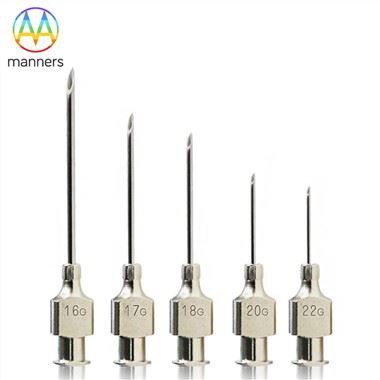
Finer Gauges: Evolution from common 18G/20G to finer 22G/25G needles. Finer gauges significantly reduce tissue trauma and patient discomfort, especially for long-term catheter placement in pain clinics. This imposes stricter requirements on manufacturers' precision tubing fabrication and tip structural integrity.
Extended Lengths: To address the growing obese patient population, manufacturers offer extra-long configurations (90mm, 100mm, or longer). This requires overcoming technical challenges such as insufficient shaft rigidity and increased flexing due to high length-to-diameter ratios.
Material Upgrades: While 316L medical-grade stainless steel remains the dominant material, premium models increasingly adopt titanium alloy. Titanium offers a superior strength-to-weight ratio, enhanced biocompatibility, and excellent MRI compatibility-ideal for manufacturing finer, longer needles-though at a substantially higher cost.
Integration of Safety and Human-Centered Design
Mitigating occupational exposure risks for healthcare workers and improving procedural ergonomics have emerged as key innovation priorities in recent years:
Integrated Safety Mechanisms: Examples include Cook Medical's SafetyGuard Tuohy needle with a protective sheath, which instantly shields the tip post-puncture to prevent needlestick injuries. Such products have become a market entry requirement in Europe and the U.S., while increasing design and assembly complexity.
Echogenic Enhancement: Special surface treatments or coatings applied to the tip improve ultrasound visibility, boosting puncture accuracy and safety-particularly valuable for training and difficult access cases.
Human-Centered Features: Clear depth markings, ergonomic hubs (e.g., winged designs), and color-coding (distinct colors for different gauges) enhance physician confidence and procedural efficiency.
Manufacturers' Technological Competitive Strategies
In response to these technological trends, manufacturers of varying scales have adopted distinct strategies:
Global Giants (e.g., BD, B. Braun): Leveraging robust R&D capabilities and financial resources to drive systematic, forward-thinking innovation. They often lead safety standardization (e.g., advocating for safety needle legislation) and develop smart needle systems integrated with their own anesthesia workstations or infusion pumps, establishing technological ecosystem barriers.
Specialized Manufacturers (e.g., Epimed, Pajunk): Focused on deep understanding of niche clinical scenarios (e.g., chronic pain management, regional anesthesia), collaborating with top clinicians to accelerate product iteration and micro-innovation. They excel in optimizing subtle tip angles, shaft flexibility, and compatibility with specific catheters/medications.
OEM/ODM Manufacturers (e.g., Manners Technology): Core competencies lie in precision manufacturing and rapid customization. They deliver high-quality needles with ultra-tight tolerances (≤ ±0.01mm), smooth burr-free internal edges, and full electrolytic polishing/ultrasonic cleaning-providing reliable manufacturing support for brands' innovative designs.
Future Direction: Intelligence and Data Integration
Future Tuohy needles may incorporate advanced smart features, such as miniature pressure sensors at the tip to provide real-time, objective feedback on the "loss of resistance" when entering the epidural space, reducing reliance on operator experience. Integration with electromagnetic or optical navigation systems could enable more precise puncture. This requires manufacturers to develop interdisciplinary capabilities in microelectronics integration and software algorithms.
In summary, the technological evolution of the Tuohy needle reflects a journey from a "general-purpose tool" to a "specialized, safe, and intelligent medical device." Competition among manufacturers has evolved from mere product fabrication to a comprehensive contest of clinical insight, technological innovation, precision craftsmanship, and system integration.