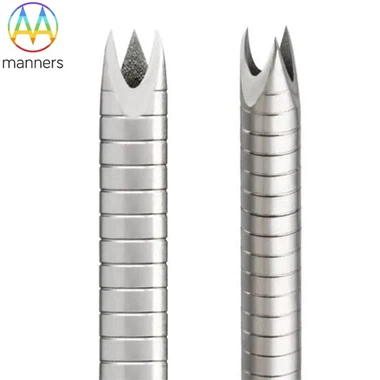
The Interface & Performance Matching Logic Of Laparoscopy Shaver Blade Manufacturers
Jul 09, 2026
A common clinical frustration: "Brand A shaver blades stall, lose suction, or cut poorly when mounted on Brand B consoles."The culprit is rarely the console itself but rather mismatches in the mechanical interface and cutting-suction synergy design of the Laparoscopy Shaver Blade. Professional manufacturers must execute targeted adaptation for the intended host system.
Drive Interface-The Most Overlooked Compatibility Point
The proximal end of the inner cutter features a drive engagement: square socket, hex socket, pin drive, or collet groove. Dimensions and depth tolerances must replicate the Original Equipment Manufacturer's (OEM) specifications within ±0.05mm. Excess clearance causes slippage (spinning without cutting); excessive tightness increases start-up torque and heat generation. Manufacturers must supply interface variants matching specific host brands (Stryker/ConMed/Smith+Nephew/Domestic systems) and validate plug-in fit plus torque transmission.
Outer Diameter / Window Position & Suction Dynamics
- Outer Cannula OD (commonly Φ3.5/4.0/5.0mm) must match the inner diameter of the introducing trocar sleeve.
- Window Length/Position dictates the effective suction range. The timing of window opening/closing during inner cutter rotation must align with the host console's logic (many systems cut on forward rotation, evacuate debris on reverse).
- Inner/Outer Clearance governs vacuum seal integrity. Excessive clearance leaks suction, preventing tissue ingestion; insufficient clearance increases drag and heat. Manufacturers must perform flow-leakage tests correlated to the host's specified negative pressure (-mmHg).
The Interplay: RPM – Tooth Geometry – Tissue Type
- Soft Adipose: Large positive rake straight or spiral teeth; cuts efficiently at moderate speeds; primary concern is preventing tissue wrapping.
- Fibrous Adhesions/Endometriosis: Smaller rake hook or serrated teeth; requires higher RPM + wear-resistant edges (coatings/hardened steel).
- Calcified Deposits: Avoid excessively brittle edges; recommend martensitic hardened substrates + DLC coating.
- Manufacturers should provide procedure-specific tooth profile recommendations and co-validate designs with clinician users. Simple "copying the shape" does not guarantee equivalent cutting feel or efficiency.
Compatibility Nuances: Disposable vs. Reusable Blades
Disposable blades are often designed for exclusive compatibility with one host system and may incorporate physical locks preventing accidental reuse. Reusable blades must account for interface wear, coating degradation, and edge dulling after multiple reprocessing cycles. Manufacturers of reusable types must clearly state Maximum Reprocessing Cycles and provide validated Reprocessing Instructions (cleaning, lubrication, visual inspection criteria).
During procurement, insist the manufacturer provides a Compatibility Statement + Interface Drawing Comparison Records + Host System Integrated Cutting Report. Avoid discovering "visually similar but functionally incompatible" only after delivery to the hospital.