The Full‑Chain Quality Philosophy Of EBUS‑TBNA Needle Manufacturers
May 23, 2026
In the field of interventional diagnosis and treatment, the journey of a puncture needle represents a micro‑scale migration from raw materials into the human body. For manufacturers of EBUS‑TBNA needles, every nanometre of this journey must be governed absolutely by quality. This is not merely mandatory compliance with regulations such as ISO 13485, but an ingrained full‑chain quality philosophy: quality is not inspected after production, but designed and manufactured within every atom, every process step, and every decision. This article reveals the quality ecosystem behind a "safe, effective and reliable" EBUS‑TBNA needle, extending far beyond the product itself.
Traceability and Commitment: Raw Material Control from Compliance to Exceeding Standards
Quality is rooted in materials. Manufacturers have evolved from passive verification by requesting certification documents to deep proactive engagement through full‑chain traceability and performance customisation. Taking medical‑grade 316L stainless steel or nitinol wire as examples, we require suppliers to provide certificates conforming to ASTM or ISO standards, while establishing joint quality control protocols:
- Micro‑composition locking: Spectroscopic analysis ensures key elements including chromium, molybdenum and nickel in each batch stay within optimal ranges, with impurity elements kept at extremely low levels.
- Full‑spectrum mechanical performance testing: Beyond meeting hardness requirements (HV 200–250), yield strength, tensile strength and elongation are fully tested to deliver optimal fatigue and bending resistance.
- Upfront biocompatibility screening: Extract‑based biocompatibility testing is conducted on raw materials to eliminate risks at the source.Such raw material control that surpasses standard requirements pushes quality barriers as far upstream as possible, laying an unshakable foundation for subsequent precision manufacturing.
Process Equals Product: Building Control Towers at Every Micrometre
Manufacturing EBUS‑TBNA needles is an art of micron‑level precision. We regard the production line as a quality‑generating system rather than a simple processing workflow. Real‑time monitoring control towers are deployed for key processes:
- Laser etching station: 5‑axis laser machines operate with ±0.01 mm precision. In‑line vision systems monitor the depth, width and consistency of etched patterns in real time, triggering automatic alarms and sorting for any minor deviations.
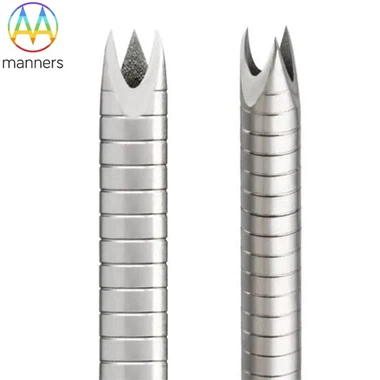
- Precision grinding station: The back‑cut geometry of the needle tip is central to puncture performance. Laser profilometers scan the three‑dimensional profile of every needle tip, comparing it with digital twin models to ensure cutting angles and edge sharpness fully match design specifications.
- Electropolishing and cleaning station: Electrochemical parameter monitoring and particulate counting of cleaning solutions guarantee consistent surface treatment and absolute cleanliness. Rather than final‑stage inspection, this applies Statistical Process Control (SPC) every second, ensuring stable process performance through data streams.
Traceability: Assigning a Unique Life Record to Every Needle
Within our quality philosophy, accountability must be traceable. Each EBUS‑TBNA needle is assigned a Unique Device Identification (UDI) linked to a complete digital record:
- Upstream traceability: Links to melting batch numbers of raw materials, incoming inspection reports and even environmental data from the workshop where materials were produced.
- Full‑process recording: Logs every machine used, processing parameters for each step, operators and all in‑line inspection data.
- Downstream tracking: Correlates to final sterilisation batches, finished‑product inspection reports, and ultimately hospitals and patients (subject to privacy regulations).This system enables precise root‑cause identification within minutes for any potential issue, even with extremely low incidence, supporting rapid and targeted recall or corrective actions to minimise patient risks and market impacts. Traceability stands as the most powerful technical demonstration of manufacturers' social responsibility.
System‑Level Quality Beyond Products: Packaging, Sterilisation and Change Control
Our quality philosophy covers the entire product lifecycle:
- Packaging validation: Packaging functions not only as a container but as a sterile barrier system. Rigorous transport simulation tests (vibration, drop impact, temperature‑humidity cycling) verify its ability to preserve product integrity and sterility throughout the supply chain.
- Sterilisation validation: Irradiation or ethylene oxide (EO) sterilisation undergoes complete Installation Qualification (IQ), Operational Qualification (OQ) and Performance Qualification (PQ). Beyond verifying sterilisation feasibility, bioburden monitoring and dose‑mapping studies ensure efficacy, safety and consistency for every sterilisation cycle.
- Strict change control: Any modification, no matter how minor (e.g., replacement of minor auxiliary supplier materials, fine‑tuning of parameters after equipment maintenance), triggers strict change‑control procedures including risk assessment, validation/qualification and notifications to customers and regulatory authorities. Our quality system rejects all uncontrolled "improvements".
As manufacturers of EBUS‑TBNA needles, we deliver far more than puncture devices - we provide trust credentials forged through rigorous quality principles. This trust stems from atomic‑level fidelity to materials, micron‑scale dedication to processes, and unwavering respect for data. In life‑critical fields, quality allows no compromise. It is our ultimate deliverable and the unshakable lifeline of our manufacturing enterprise.