The Core Role Of Digital Manufacturing In End-To-End Quality Control Of Biopsy Needles
May 31, 2026
As a Class III high-risk active medical device, vacuum-assisted breast biopsy needles directly impact diagnostic accuracy and patient safety. In large-scale production, final inspection alone cannot guarantee the absolute reliability of every needle. Leading manufacturers such as Manners are integrating the "zero-defect" philosophy into every stage-from raw materials to finished products-by building a digital intelligent manufacturing system centered on data, powered by automated equipment, and enabling full-process traceability. This approach fundamentally transforms quality control from post-production inspection to proactive prevention and in-process monitoring.
1. Digital Process Chain: Precise Mapping from Drawings to Physical Products
Every stage of the manufacturing process is digitally defined and monitored.
1. Authority of CNC Code
On the Citizen L12-1M7 sliding headstock lathe, complex operations such as 3D surface milling of needle tips and precision grooving of sleeves are driven by highly reliable CNC programs. These programs undergo rigorous simulation and trial-cut verification, serving as the "digital DNA" for machining accuracy. Any modifications must go through an approval process to ensure production consistency.
2. Digital Management of Laser Marking
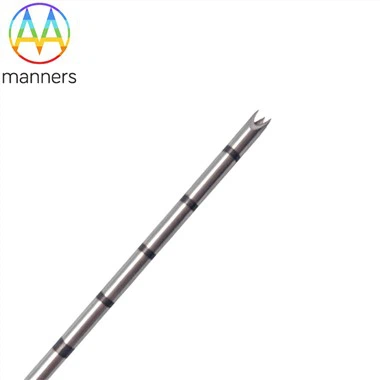
Information such as scale markings, batch numbers, and serial numbers on sampled groove sleeves is directly read from and executed by the laser marking machine via the MES system. Marking parameters-including power, speed, and frequency-are locked and recorded to ensure permanent consistency in mark depth and clarity, with 100% accuracy.
3. Parameterized Control of Surface Treatment Processes
Key process parameters-such as temperature, concentration, and duration of passivation solution; current-voltage curves for electrolytic polishing; and frequency, power, and time for ultrasonic cleaning-are all integrated into a central control system for automatic monitoring and alarm triggering. Any parameter drift automatically triggers intervention, preventing batch-wide quality issues.
2. Data Closed Loop for Online and Offline Detection
Quality data is generated and fed back in real time during the production process.
- Online inspection: During the lathe machining process, a contact probe or machine vision system may be integrated to perform real-time in-process measurements of critical dimensions (such as outer diameter and groove width), enabling automatic compensation of machining parameters and eliminating dimensional variations at an early stage.
- High-precision offline inspection: The profile projector mentioned in the document serves as the "eyes" of quality control. It magnifies the machined part by dozens to hundreds of times onto a screen, enabling precise measurement of microscopic features that cannot be detected with conventional calipers-such as the geometric angle of the needle tip, edge profiles of grooves, and shapes of cutting edges. All inspection data is automatically uploaded to a quality database.
- Comprehensive performance testing: In addition to dimensional checks, functional tests must also be conducted on finished needles, including cutting force testing, negative pressure sealing tests, and compatibility testing with host machines. These test results are also integral components of the product's digital twin.
3. Full Lifecycle Traceability System
This is the backbone of the digital manufacturing system.
1. Raw Material Traceability
Each batch of SUS 316 stainless steel rod is assigned a unique material certificate number, linked to subsequent production batches.
2. Manufacturing Process Traceability
Through the MES system, processing details for each needle's three main components (needle tip, sampling sleeve, cutting sleeve) are fully recorded, including processing time, operator, equipment status, process parameter version, and inspection results on each machine (lathe, laser marking machine, polishing tank).
3. Product Unique Identification
A unique serial number laser-marked on each needle enables full backward traceability of all production data, inspection reports, and even the raw material furnace number used. This meets medical device UDI requirements and satisfies the most stringent regulatory audit standards.
4. Continuous Improvement and Compliance Assurance Based on Data
Digital systems are used not only for control but also for optimization.
- Process Capability Analysis: Long-term accumulated dimensional inspection data can be used to calculate process capability indices, objectively evaluate manufacturing stability, and drive process optimization.
- Rapid Root Cause Analysis: When anomalies occur, the data chain enables quick identification of the problematic环节-whether it's raw material variation, equipment failure, or incorrect parameter settings-significantly shortening the problem resolution cycle.
- Compliance Automation: The system automatically generates production records, inspection reports, and equipment calibration logs that meet ISO 13485 and ISO 9001 requirements, ensuring efficient operation of the quality management system and facilitating audits by domestic and international regulatory authorities.
Conclusion
Thus, the manufacturing workshop for modern high-end vacuum-assisted breast biopsy needles is essentially a sophisticated digital ecosystem flowing with data and instructions. Citizen lathes, laser marking machines, and inspection instruments are no longer isolated equipment but intelligent nodes within this network. The core competitiveness of manufacturer Manners lies not only in possessing these high-precision devices, but more importantly in establishing seamless data pathways that integrate the equipment layer, control layer, and management layer-enabling digitalized management and collaboration across all elements: people, machines, materials, methods, environment, and measurement. This data-driven manufacturing model ensures that every biopsy needle leaving the factory is traceable, verifiable, and consistently performant, transforming "zero defects" from a quality goal into a quantifiable, monitorable, and achievable daily production reality. As a result, while delivering customized services, the company guarantees absolute product reliability and safety.