The Art Of Precision: Unveiling The Ultra-Precise Manufacturing System Behind The One-Time Insertion Devices
May 03, 2026
Key words: One-time piercing device, Precision manufacturing
In minimally invasive surgeries, a disposable puncture device that is only a few tens of centimeters long and several millimeters in diameter serves as an extension of the surgeon's arm and is the sole passage for light and instruments to enter the patient's body. Its reliability directly determines the success of the surgery and the safety of the patient. This reliability does not come from simple production methods, but stems from a rigorous manufacturing system that integrates ultra-precise mechanical processing, special material forming, and nanoscale surface treatment. For high-end manufacturers like Manners Technology, their core competitiveness lies in transforming the clinical requirements for "absolute precision, absolute cleanliness, and absolute reliability" through a series of almost obsessive processes into the consistent quality of each manufactured product.
Foundation: Thoughtful Mechanism and Micrometer-Scale Dimension Control
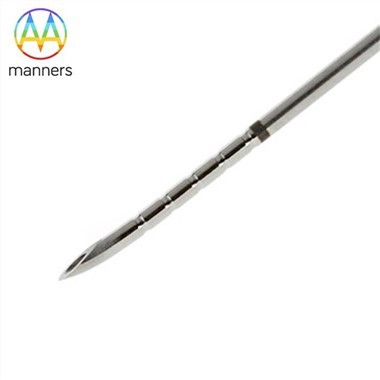
The core structure of the puncturing device - the stainless steel tube - begins with a medical-grade stainless steel pipe. To meet the tolerance requirement of ±0.01mm specified in the product specifications and ensure a smooth inner wall without any microscopic defects, it is necessary to rely on a CNC centering automatic lathe. Equipment such as the Citizen Cincom L12-1M7 from Seiko Ishikawa in Japan is a powerful tool for accomplishing this task.
* Synchronous processing and deburring: The core advantage of the L12 series machine is "one setup, complete processing". It can simultaneously process the complex hole patterns at both ends of the tube while using the integrated high-precision rotating tool or special fixtures to immediately deburr and chamfer the edge of the hole opening. This "processing and deburring simultaneously" synchronous process avoids the errors caused by secondary setup and ensures that there are no burrs larger than 0.01 inches (approximately 0.254mm) remaining. If these burrs fall off during surgery, they may become foreign objects that cause infection or embolism.
* Ultra-high rigidity and thermal stability: The main body of the machine adopts a high-rigidity design, combined with a liquid cooling system, to ensure that the thermal deformation caused by cutting heat and the heat generated by the spindle is minimized when operating at high speeds (spindle speed can reach over 10,000 revolutions per minute), thus guaranteeing the dimensional stability of each part in batch production.
* Complex contour shaping: Besides simple drilling, the centering machine can also, through multi-axis linkage, machine out the threads used for connecting the sealing cover and the inverted spines structure used for fixation to the abdominal wall from the tube. All dimensions are completed with micrometer-level accuracy.
Soul: Electrolytic Polishing and Surface Integrity Engineering
The surface of the stainless steel after mechanical processing is still "rough" at the microscopic level, covered with cutting lines and micro-cracks. For puncture device sleeves that need to come into prolonged contact with human tissues and blood and be repeatedly passed through by instruments, this is not only a potential starting point for corrosion, but also may increase the risk of tissue damage and thrombosis. Electrolytic polishing is the decisive step to improve the surface quality.
This is an electrochemical process where the workpiece acts as the anode and is subjected to an electric current in a specific acidic electrolyte solution. The current will preferentially dissolve the microscopic protrusions on the metal surface, thereby smoothing the surface. For the piercing device, the goal of this process is extremely precise:
1. Achieve ultra-smooth surface: By precisely controlling the current density, voltage, time, and electrolyte temperature, a thin layer of material (typically ranging from a few micrometers to several tens of micrometers) can be uniformly removed, significantly reducing the surface roughness Ra value. The "high polish, no spots, contaminants, or scratches" required in the product information is achieved through this process. The smooth surface reduces the adhesion of bacterial biofilms and tissue adhesion.
2. Eliminate micro-defects and internal stress: Electrolytic polishing can effectively remove surface and sub-surface micro-cracks generated during mechanical processing, smooth out sharp edges, and eliminate some processing residual stress, thereby improving the fatigue resistance and corrosion resistance of the parts.
3. Form a stable passivation film: This process will form a thicker, more uniform, and denser chromium oxide passivation film on the surface of stainless steel. This film has extremely stable chemical properties and is the key to the excellent biocompatibility and corrosion resistance of medical stainless steel.
Guarantee: Ultrasonic Cleaning and Absolute Cleanliness
Even after electrolytic polishing, the surface of the part and the internal lumen may still be contaminated with electrolyte residues, grease or particles. Ultrasonic cleaning utilizes high-frequency sound waves (such as 40kHz) to generate a "cavitation effect" in the cleaning solution - countless tiny bubbles form and violently implode, generating a powerful impact force that can penetrate deep into the complex cavities and threaded gaps inside the piercing sleeve, effectively removing the adhered substances. This cleaning method is non-contact and non-abrasive, and is an indispensable step for achieving "absolute cleanliness" in medical devices.
Integration: Plastic Injection Molding Combined with Multi-materials
The puncture device is a composite of metal and plastic. The transparent puncture cone head, multi-valve seal, and lateral intake valve, among others, are all manufactured from plastic through injection molding process.
* Optical-grade transparent materials: such as Makrolon 2458 (polycarbonate), require extremely high purity and transparency, without any wrinkles, bubbles or impurities, to ensure that the surgeon can obtain a clear and undistorted view in the visual puncture device.
* Highly elastic sealing materials: such as medical silicone or thermoplastic elastomers, need to have excellent elasticity recovery ability and wear resistance to withstand thousands of punctures by the instrument while maintaining sealing.
* Precision molds and process control: The accuracy of injection molds directly determines the size and appearance of plastic components. Precise control of the melt temperature, injection pressure, holding time and cooling rate is required to prevent problems such as flash, material shortage, and stress cracking in the product. The combination of metal and plastic components is usually achieved through interference fit, ultrasonic welding or medical adhesives to ensure a secure and biocompatible connection.
Closed-loop: Full-process quality inspection system
The final step in precision manufacturing is even more precise testing. The six or more testing procedures mentioned by Manners Technology form a quality loop:
* Dimensional inspection: Use calipers, two-dimensional imaging measuring instruments, etc. to conduct 100% or sample inspections on key dimensions.
* Appearance inspection: Under strong light, manually or with the aid of machine vision, check the surface smoothness, presence of scratches, stains, transparency of plastic parts, etc.
* Function testing: Test the sealing performance of seals, the smoothness of valve opening and closing, the sharpness of puncture cones, etc.
* Special inspection: Such as conducting endoscopy on the inner cavity of stainless steel tubes to ensure there are no any residual debris - this is crucial for preventing foreign objects from being left behind during the operation.
Conclusion
A qualified disposable puncture device is the result of the integration of precision mechanical engineering, electrochemistry, polymer materials science, and strict quality management. From the micron-level cutting of the Citizen precision machine to the nanometer-level smooth surface brought by electrolytic polishing, and then to the optical transparent components produced through injection molding, every step embodies the ultimate pursuit of "precision" and "cleanliness". Through these highly specialized processes, the manufacturer transforms the surgeons' trust in the "reliable channel" into a mass-produced industrial product with consistent performance. In this field, manufacturing precision is the physical foundation of surgical safety.