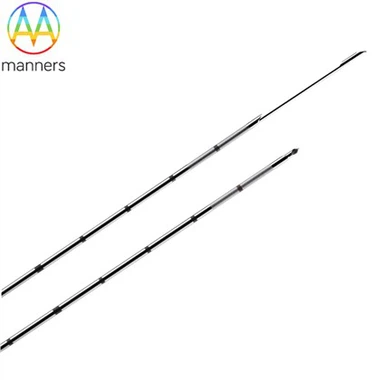
The Portal Revolution In Minimally Invasive Surgery: How Disposable Trocars Are Reshaping The Paradigm Of Surgical Practice
May 03, 2026
Keywords: Disposable Trocar; Minimally Invasive Surgery
In the history of surgical development, the shift from traditional open surgery to minimally invasive surgery undoubtedly represents a profound revolution. At the heart of this revolution lies the trocar-the essential "portal" connecting the external environment to the internal surgical field. The evolution from reusable metal trocars to today's mainstream disposable trocars is seemingly simple, yet it reflects a comprehensive advancement in surgical philosophy, infection control, operational efficiency, and even healthcare economics. Manufacturers like Manners Technology are driving this "portal" toward ever greater safety, convenience, and intelligence by deeply integrating precision engineering with clinical needs.
From "Reusable" to "Disposable": A Dual Leap in Infection Control and Surgical Efficiency
Early laparoscopic procedures relied heavily on reusable metal trocars. While durable, they required complex cleaning, disinfection, and sterilization workflows, carrying risks of cross‑contamination and instrument damage. More importantly, repeated use dulled the trocar tip and aged the seals, impairing puncture smoothness and pneumoperitoneum maintenance. The widespread adoption of disposable trocars fundamentally resolved these issues:
Eliminating cross‑infection: Discarded after single use, they completely remove the risk of pathogen transmission between patients due to inadequate cleaning, meeting the highest standards of infection control.
Guaranteed consistent performance: Each new disposable trocar features a sharp puncture tip, resilient seals, and smooth inner and outer surfaces, ensuring precise, effortless insertion, stable pneumoperitoneum, and predictable, standardized performance for every procedure.
Enhanced workflow efficiency: No pre‑operative sterilization or post‑operative reprocessing is required, simplifying hospital sterile supply workflows and enabling faster operating room turnover.
Design Evolution: The Safety Philosophy from "Sharp Dissection" to "Blunt Separation"
The core function of a trocar is to establish access into a body cavity, and its insertion design directly impacts patient safety. Early trocars typically featured sharp pyramidal tips that cut through tissue with a blade. Though direct, this method risked accidental injury to intra‑abdominal organs or major blood vessels-especially in patients with adhesions or low body weight.
This challenge drove critical design innovations:
Blunt‑tip trocars: Designed with a conical blunt tip, they use sustained, controlled pressure to bluntly separate muscle and fascial fibers rather than cutting them, significantly reducing the risk of accidental injury to underlying organs.
Visual trocars: One of the most important innovations in recent years. The puncture cone is made of optical‑grade transparent plastic (e.g., Makrolon 2458) with an integrated micro‑camera. Surgeons can observe the real‑time separation of abdominal wall layers during insertion, enabling truly "direct vision" puncture and minimizing blind‑insertion risks. Manufacturers like Manners Technology enforce strict requirements for tip clarity and flawlessness to ensure an unobstructed critical view.
Trocars with safety protective sheaths: Once the trocar tip penetrates the abdominal wall, a spring‑loaded protective sheath instantly deploys to cover the sharp tip, preventing accidental injury during subsequent maneuvers.
Manufacturing Precision: How Micron‑Level Tolerances Ensure Millimeter‑Scale Safety
Small as they are, trocars represent a sophisticated precision system. Manufacturing at Manners Technology exemplifies how safety and performance are built on extreme accuracy:
Cannula fabrication: Stainless steel cannulas (typically medical‑grade 304 or 316L) are machined on high‑precision CNC machines such as the Citizen Cincom L12‑1M7. Diameter tolerances are held within ±0.01 mm, with mirror‑smooth inner bores to ensure seamless passage of instruments (e.g., 5 mm graspers, 12 mm staplers) without gas leakage. Both ends are deburred synchronously to eliminate any burr larger than 0.01 inches that could damage tissue or expensive laparoscopic instruments.
Sealing system: Critical for maintaining pneumoperitoneum. Multi‑flap seals made of elastic materials like silicone must preserve airtightness despite repeated instrument passage, preventing CO₂ leaks that could collapse the surgical field. Their design involves complex fluid dynamics and materials engineering.
Surface treatment: Electropolishing not only gives the stainless steel cannula a bright finish but also removes micro‑burrs and cracks, forming a denser, more corrosion‑resistant passive layer that improves biocompatibility and reduces tissue adhesion.
Expanding Clinical Applications: From Laparoscopy to Multidisciplinary Minimally Invasive Fields
Disposable trocars have become standard equipment in laparoscopic surgery for cholecystectomy, appendectomy, gastrointestinal cancer resection, and gynecological procedures. But their utility extends far beyond:
Thoracoscopic surgery: Used as instrument ports in video‑assisted thoracoscopic surgery for lobectomy and mediastinal tumor resection.
Arthroscopic surgery: Smaller‑diameter trocars enable minimally invasive examination and treatment in the knee, shoulder, and other joints.
Spine minimally invasive surgery: Used to establish working channels in procedures such as vertebroplasty.
Single‑port laparoscopic surgery: Specialized multi‑channel single‑port trocars accommodate multiple instruments through one incision, further enhancing cosmetic outcomes and minimal invasiveness.
Conclusion
A disposable trocar is far more than a simple "hole‑making tool"-it is a foundational component of modern minimally invasive surgery. The shift from reusable to disposable reflects a patient‑centered infection control philosophy. The evolution from sharp to blunt, and from blind to visual insertion, embodies a surgical ethos of proactive risk prevention. Behind it all, micron‑level manufacturing precision delivers the engineering assurance needed to translate clinical safety demands into reliable industrial products. As robotic surgery, NOTES, and other advanced techniques evolve, trocar requirements will grow even more stringent. In the future, disposable trocars integrated with advanced sensing (e.g., pressure detection, hemorrhage alarms) and smarter sealing mechanisms will continue advancing minimally invasive surgery toward greater precision, safety, and intelligence.