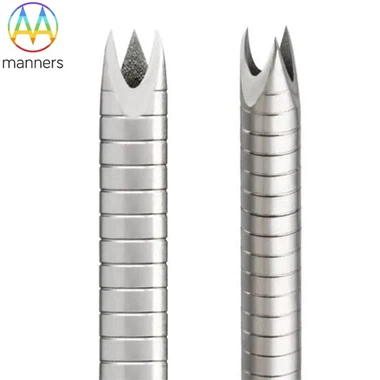
An In-Depth Analysis Of The QC Process Flow For Professional Meniscus Repair Needle Manufacturers
Jun 20, 2026
The meniscus repair needle is a critical component classified as a Class III medical device, typically falling under the category of implantable or invasive surgical instruments. Professional manufacturers must be certified to ISO 13485 (Medical Device Quality Management Systems) and often comply with FDA QSR 820 and MDSAP requirements, establishing full lifecycle traceability from raw materials to finished product shipment.
I. Incoming Quality Control (IQC)
Medical-grade stainless steel or Nitinol alloy bars are subject to rigorous verification upon receipt, including validation of the melt lot number, chemical composition, mechanical properties, and biocompatibility declarations. Only batches accompanied by a full Certificate of Analysis (COA) are released to the production line, managed under strict First-In-First-Out (FIFO) and quarantine protocols.
II. In-Process Quality Control (IPQC) & Statistical Process Control (SPC)
Control plans are established for critical processes: Precision Grinding, WEDM (Wire Electrical Discharge Machining), Needle Bending, and Electropolishing.
- Grinding Inspection: Post-grinding, optical imaging systems measure tip angle and cutting edge symmetry.
- WEDM Inspection: Tool microscopes are used to sample and verify profile accuracy.
- Bending Inspection: Profile projectors confirm bend angle and radius.
- Polishing Inspection: Surface Roughness Testers (Ra) verify the finish post-electropolishing.
- SPC Implementation: For critical dimensions (needle ID/OD, groove position, concentricity), Statistical Process Control (SPC) monitors Cpk indices to ensure process stability and capability.
III. Finished Product Performance Testing
A comprehensive battery of tests is conducted:
- Puncture Force Test: Measuring peak penetration force using simulated meniscal equivalent material.
- Fracture Strength / Bending Fatigue Test: Verifying no plastic deformation or fracture occurs under specified loads.
- Inner Core Sliding Resistance Test: Confirming smooth delivery of sutures/anchors without hang-up.
- Visual Inspection: Magnified inspection for cracks, burrs, or corrosion.
- Laser Marking Verification: If marked (Model, Lot #, Orientation Arrow), verifying that the marking depth does not compromise corrosion resistance.
IV. Cleaning, Sterilization Coordination, and Final Release
- Post-electropolishing, needles undergo multi-stage ultrasonic cleaning, rinsing, and drying. Manufacturers coordinate Ethylene Oxide (EO) sterilization or provide clean, non-sterile packaging per client requirements.
- Batch Record Retention: Positive/Negative control samples are retained for each lot.
- Final Release Audit: The Release Authority audits the entire Device Master Record (DMR):
Raw Material Traceability Chain
In-Process Inspection Records
Finished Product Performance Reports
Cleaning Validation / Sterilization Coordination Files
Packaging Integrity Checks
Only upon full compliance is the batch released.
V. UDI and Traceability
Manufacturers assign Unique Device Identifiers (UDIs)-barcodes or 2D codes-in accordance with FDA, EU MDR, and NMPA requirements. Production date, line number, operator ID, and key process parameters are recorded. This ensures any market feedback can be traced back to the specific raw material batch and processing equipment.
Conclusion
This robust traceability system is exactly what brand owners scrutinize when selecting a meniscus repair needle manufacturer. A manufacturer lacking a comprehensive traceability infrastructure cannot support the global registration and post-market surveillance obligations of a Class III medical device.