Technical Evolution: The Radiofrequency Transseptal Needle – Defining The New Standard For Safety And Efficiency in Cardiac Interventional Access
Apr 09, 2026
Technical Evolution: The Radiofrequency Transseptal Needle – Defining the New Standard for Safety and Efficiency in Cardiac Interventional Access
In the fields of cardiac electrophysiology and structural heart disease intervention, safely and accurately establishing left atrial access is the cornerstone of successful procedures. The emergence of the radiofrequency (RF) transseptal needle marks the transition of transseptal puncture (TSP) technology from an "art of experience" reliant on tactile feel and mechanics to a controllable, visible, and quantifiable era of "precision engineering."
I. A Generational Leap in Technology: From Mechanical "Push-Through" to Radiofrequency "Melt-Through"
Traditional mechanical puncture needles rely on the operator applying axial force, using the mechanical shear force of a sharp tip to "pierce" the fossa ovalis. This model carries inherent risks:
The Uncontrollable "Pop": At the moment of penetration, a sudden drop in resistance can easily cause the needle tip to "jump forward," increasing the risk of cardiac perforation and cardiac tamponade.
Ineffectiveness Against Complex Anatomy: Faced with a thickened, fibrotic, aneurysmal, or previously scarred septum, mechanical puncture has a high failure rate, and repeated attempts increase complication risks.
The RF puncture needle employs a fundamentally different physical principle: through high-frequency alternating current, it generates controllable Joule heat at the contact point between the needle tip and tissue, causing instantaneous vaporization of water within tissue cells, thereby achieving "melting" and "cutting" of the tissue. This energy-based puncture model brings about transformative change:
Zero "Jump-Forward" Risk: Energy release is synchronized with tissue ablation; needle advancement is actively controlled by the operator, eliminating uncontrolled forward motion.
"Overcoming Hardness with Softness" Penetration Force: RF energy can effectively ablate tough fibrotic tissue, offering significantly superior success rates and efficiency in penetrating complex anatomies compared to mechanical force.
II. The Essence of Product Design: The Integration of Safety, Precision, and Visibility Engineering
An exceptional RF puncture needle is a highly integrated assembly of multiple engineering wisdoms:
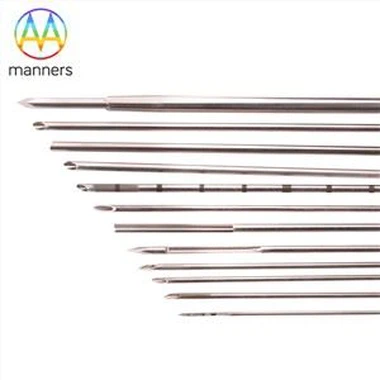
Blunt, Atraumatic Tip: Unlike the sharp design of mechanical needles, the RF needle tip features a smooth spherical or ellipsoidal blunt head. This design ensures that when moving within the heart, even if it contacts the atrial wall, it is more likely to "push aside" rather than "puncture" the tissue, greatly enhancing operational tolerance and safety.
Precise Energy Control System: The needle body acts as a monopolar electrode, forming a circuit with a return electrode plate on the body surface. Modern systems can monitor tissue impedance in real-time, automatically adjusting energy output (power/time) to achieve personalized, adaptive ablation, preventing perforation or insufficient energy delivery.
Enhanced Imaging Compatibility: The needle body incorporates a radiopaque marker band, making it clearly visible under X-ray fluoroscopy. Combined with real-time guidance from intracardiac echocardiography (ICE), it enables millimeter-level precise positioning and adjustment of the puncture target, needle tip location, and angle, transforming "blind puncture" into "visualized puncture."
Prevention of Particulate Embolism: As mechanical needles pass through sheaths and dilators, their sharp edges can scrape plastic, generating microscopic particulate debris, posing an embolization risk. The blunt tip design and smoother surface finish of the RF needle fundamentally eliminate this hazard.
III. Clinical Application Scenarios and Value Redefinition
The RF puncture needle is evolving from a "lifesaver" for complex cases to a "power tool" for enhancing overall surgical quality.
|
Clinical Scenario |
Limitations of Traditional Mechanical Needle |
Core Value Proposition of RF Needle |
|---|---|---|
|
Standard Cases |
Reliant on experience, carries unpredictable breakthrough risk. |
Provides a standardized, predictable puncture process, shortens the learning curve, and improves procedural workflow stability. |
|
Complex Anatomy (Thickened, Fibrotic, Aneurysmal) |
Difficult puncture, high failure rate, high complication risk. |
Significantly increases first-pass success rate; becomes the preferred or even essential tool for managing such cases. |
|
High-Volume EP Centers |
Procedural efficiency limited by the unpredictability of puncture. |
Reduces puncture time and fluoroscopy time, increases operating room turnover and overall operational efficiency. |
|
Training New Operators |
Steep learning curve, high safety risk. |
The controllable energy release lowers the difficulty of operation, making it an ideal tool for safe and efficient training of new operators. |
Conclusion
The radiofrequency transseptal needle is more than just a new tool; it represents a new paradigm. It transforms TSP, a high-risk step, into a highly controllable, standardized procedure. Its core value lies in using technological empowerment to extend the safety margin from "reliance on operator experience" to "embedded within the instrument's design." With the increasing prevalence of procedures like left atrial appendage closure and mitral valve intervention, and the rising demands for procedural efficiency and safety, RF puncture technology is rapidly evolving from a "premium option" to a "fundamental configuration" in modern cardiac interventional centers, redefining the standard for establishing cardiac interventional access.