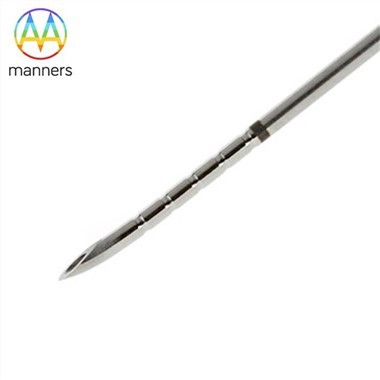
Structural Design Advantages Of Screw-Type Intraosseous Needles
Sep 28, 2026
1. Structural Defect Pain Points of Traditional Puncture Needles
Traditional ordinary puncture needles have prominent structural defects in intraosseous infusion scenarios, restricting clinical rescue effect. Ordinary straight needles rely on simple extrusion and penetration to enter the bone marrow cavity, which requires excessive operating force, easily causes needle body deviation and bone surface slipping, and leads to puncture failure. After entering the bone cavity, the needle body is poorly fixed and easy to shift and fall off during patient movement and rescue operation, resulting in infusion interruption. The simple tubular structure cannot form a closed stable infusion channel, and fluid exudation often occurs at the puncture site, causing local tissue swelling and pain. In addition, traditional needles have no precise positioning structure, operators cannot accurately judge the penetration depth, and excessive puncture easily damages deep bone tissue, bringing additional trauma and hidden dangers to patients, especially children.
2. Screw-Type Structural Working Principle
The core innovation of medical intraosseous needles lies in the integrated structural design of internal screw tube and handheld handle, which realizes stable puncture and fixed infusion through mechanical structure optimization. The spiral tube structure can produce uniform rotary cutting force during penetration, smoothly cutting through cortical bone without excessive axial pressure, avoiding bone surface slipping and needle body deviation. After entering the bone marrow cavity, the spiral structure forms a mechanical occlusion with the bone tissue, realizing stable self-fixation of the needle body, effectively preventing displacement and falling off during rescue and patient movement. The integrated handle design improves the operation controllability, enabling operators to stably control the puncture speed and depth. The closed screw tube channel ensures the tightness of infusion, avoids fluid exudation, and maintains the stability of continuous drug and fluid infusion.
3. Structural Type Classification of Intraosseous Needles
According to structural design differences, intraosseous needles are divided into three mainstream structural types. Integrated screw fixed needles adopt an integrated molding process of screw tube and needle body, with high overall structural stability, firm fixation after puncture, suitable for long-time emergency infusion and severe critical rescue. Detachable handle screw needles are designed with separable handles and needle bodies, which are convenient for storage, transportation and postoperative needle body removal, suitable for pre-hospital emergency and mobile rescue scenarios. Customized structural needles adjust the screw pitch, tube body length and handle structure according to customer drawings and sample requirements, adapting to special bone structures and personalized operation habits, covering special clinical rescue needs that standard structures cannot meet. All structural products are made of medical stainless steel, with high biocompatibility and pressure resistance.
4. Structural Standard Operation Guide
Different structural intraosseous needles have targeted standardized operation specifications to give full play to structural advantages. For integrated screw fixed needles, hold the handle steadily during operation, rotate clockwise at a uniform speed for penetration, stop immediately when the resistance disappears, and use the spiral structure to self-lock and fix the needle body to ensure stable infusion. For detachable structural needles, complete bone puncture and positioning through handle rotation, then detach the handle for subsequent infusion operation to avoid handle interference with rescue work. For customized special structural needles, pre-check the structural parameters before operation, adjust the rotation speed and penetration force according to screw pitch and tube body characteristics, and strictly control the puncture depth. During the whole process, maintain vertical puncture to avoid oblique damage to cortical bone and surrounding tissues.
5. Structural Application Practical Experience
Clinical structural application verification shows that screw-type intraosseous needles completely solve the fixation and sealing pain points of traditional straight needles. The spiral self-fixation structure makes the needle body displacement rate drop to zero during rescue infusion, ensuring uninterrupted continuous drug delivery and fluid resuscitation. The rotary cutting structure reduces the puncture force by more than 50%, significantly reducing bone and soft tissue trauma, and the postoperative local pain and swelling degree are greatly reduced. The integrated handle structure improves the one-time puncture success rate, shortens the channel establishment time, and provides more sufficient rescue time for critical patients. Customized structural products can adapt to complex and special anatomical structures, effectively solving the problem of difficult puncture and fixation in special patient groups, with high clinical practical value.
6. Summary and Refinement
The innovative screw-type structural design is the core competitive advantage of modern medical intraosseous needles and the fundamental reason for its superior clinical performance over traditional puncture equipment. The spiral cutting and self-fixation structure solves the three major clinical pain points of difficult penetration, unstable fixation and easy exudation of traditional needles. Combined with high-quality stainless steel materials and precision processing technology, it realizes the integration of low trauma, high stability and high efficiency of emergency vascular access. Structural optimization is the key support for intraosseous needles to become the preferred equipment for emergency difficult vascular access.
7. Structural Optimization Future Suggestions
Manufacturers should continue to iterate and optimize the screw structure of intraosseous needles, adjust the scientific screw pitch and tube body radian, further reduce puncture trauma and improve fixation stability. Strengthen the research and development of lightweight and portable structural designs to adapt to pre-hospital emergency and field rescue scenarios. Optimize the detachable structure process to improve the convenience of assembly and disassembly while ensuring structural stability. Industry institutions can formulate structural design standards for intraosseous needles to standardize screw parameters and handle specifications, further improve product consistency and clinical adaptability, and promote the structural upgrading of the industry.