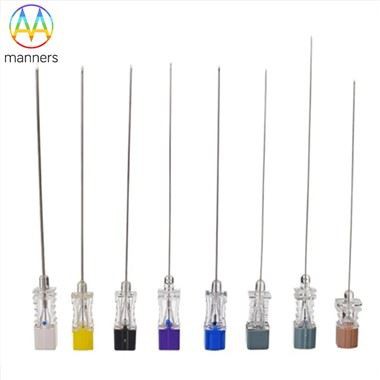
Strict Supervision, Precise Manufacturing And Supply Chain Management: Building A High Barrier For The Industry Of Close-range Treatment Needle
May 07, 2026
Close-range treatment needles, as one of the three types (high-risk) of medical devices for implanting radioactive substances into the human body, have core barriers for industry entry and operation that are far beyond those of ordinary medical consumables. These barriers are jointly constructed by an extremely strict global regulatory system, extremely precise manufacturing processes, and highly specialized supply chain management, keeping many potential competitors out.
The "red line" of regulation: Global major market access
Due to the direct involvement of radioactive sources and invasive procedures, brachytherapy needles are subject to the most stringent regulatory scrutiny in major markets worldwide.
* United States (FDA): Approval through pre-market authorization (PMA) or 510(k) process is required. If the needle is combined with a radiation source or treatment planning software with specific statements, it may be regarded as a "combined product" or "software device", and the approval process is more complex. The production process must comply with the FDA Quality System Regulations (QSR 820) and undergo strict factory inspections.
* Europe (EU MDR): Under the EU Medical Device Regulation (MDR), close-range treatment needles are usually classified as Class III devices. They need to undergo a comprehensive technical document review, clinical evaluation, and approval of a post-market surveillance plan by the notified body. The MDR has raised unprecedented requirements for clinical evidence and long-term safety follow-up.
* China (NMPA): As a Class III medical device, registration requires submission of a large amount of technical, production, and clinical data, and the approval process is long. The production process must comply with the "Medical Device Production Quality Management Specifications".
* Radiation safety supervision: In addition to medical device regulation, the product also needs to comply with the requirements of radiation safety agencies in various countries (such as the NRC in the United States and the Ministry of Ecology and Environment in China) for the transportation, storage, and use of radiation sources. Manufacturers often need to prove the compatibility and safety of their products with specific radiation sources.
Any changes in design, materials or manufacturing processes may trigger a re-registration, which is time-consuming and costly. This gives the early entrants a powerful regulatory moat.
Precision Manufacturing: Art at the Micron Level
The manufacturing of close-range treatment needles is a prime example of precision engineering, directly influencing the accuracy and safety of the treatment.
1. The material requirements are extremely strict: The mainstream materials used are 316L medical stainless steel or titanium alloy (Gr.5, Gr.23). Titanium alloy is increasingly being used in high-end products due to its excellent MRI compatibility, high strength, and biocompatibility. The material must provide complete biocompatibility (ISO 10993) and material certification.
2. Ultra-high precision processing:
* Tube processing: The inner and outer diameters of the tube need to be highly consistent and have a straightness. The smoothness of the inner wall is crucial to ensure that the radiation source (such as iridium-192 wire) can pass through smoothly without any obstruction. The tolerance is often required to be at the micrometer level (such as ±0.01mm).
* Needle tip shaping: The bevel angle and sharpness of the needle tip need to be precisely controlled. It is necessary to ensure smooth insertion and reduce tissue damage and bleeding. For particle implantation needles, the needle tip design also needs to facilitate the release of particles.
* Marking: The depth markings on the needle body must be clear, permanent, and precise. This is usually achieved through laser marking.
3. Advanced surface treatment: Electrolytic polishing is the standard process, used to remove burrs, improve surface smoothness, and enhance corrosion resistance. A smooth surface can also reduce bacterial adhesion and tissue friction.
4. Cleaning and sterilization: Thorough cleaning (such as ultrasonic cleaning) must be carried out to remove all processing residues. Finally, ethylene oxide (EO) or irradiation sterilization is used, and strict verification is conducted to ensure sterility and absence of pyrogens.
Supply Chain Management: Specialization and Stability
The supply chain for close-range treatment needles is short and specialized:
* Upstream: Highly dependent on a few suppliers that can provide medical-grade titanium alloy pipes, special stainless steel, and high-end medical polymers. These raw material suppliers themselves also need to undergo strict qualification certifications.
* Midstream (Manufacturing): Requires investment in expensive five-axis CNC machines, precision grinders, laser marking machines, electrolytic polishing equipment, and clean workshops. Production personnel need specialized training. Due to the wide variety of products and potentially small batch sizes, flexible manufacturing capabilities are crucial.
* Downstream: Customers are large hospitals or cancer centers' radiotherapy departments. The purchasing decisions are professional and the cycle is long. Sales not only rely on the products themselves, but also on strong clinical support, technical training, and dosimetry services. The products need to be compatible with post-treatment equipment, treatment planning systems, and even imaging equipment. Therefore, partnerships with major radiotherapy equipment manufacturers are of vital importance.
The key to building core competitiveness
For manufacturers, the core competitiveness lies in:
1. The culture of "Compliance is Life": Establish a quality management system that exceeds standards, enabling us to handle regulatory audits from all over the world with ease.
2. Accumulation of process know-how: Processing of titanium alloys, laser marking with precise scales, seamless assembly, etc., require long-term exploration and experience accumulation.
3. Systematic verification capability: Not only verify the product itself, but also verify its compatibility and safety with various radiation sources, applicators, and treatment plans, generating a large number of verification documents.
4. Clinical collaborative innovation: Cooperate with top radiation therapy centers, convert clinical needs into engineering parameters, and accumulate evidence through clinical trials.
Therefore, the interstitial therapy needle industry is a typical "high barrier, high value, high stickiness" market. New entrants need to overcome huge barriers in terms of regulation, technology and clinical trust. The current leadership positions are built upon decades of accumulated process precision, vast clinical data, and an expert network spread across the globe.