Stereotactic Breast Biopsy: The Technical Logic And Instrument Selection Behind Precise Localization
Jul 17, 2026
https://www.mayoclinic.org/tests-procedures/breast-biopsy/about/pac-20384812
Stereotactic breast biopsy is currently one of the important methods for diagnosing non-palpable small breast lesions, especially suitable for microcalcifications and structurally distorted lesions detected by mammography. Its core advantages lie in its "visibility, accuracy, and minimal trauma," which relies heavily on the coordinated use of a high-precision imaging system and a specialized biopsy needle.
I. Imaging Basis of Stereotactic Technology
Stereotactic systems typically use digital mammography (DBT) or traditional mammography equipment to acquire images from two different angles (usually ±15°) to construct the three-dimensional coordinates of the lesion. The computer automatically calculates the skin entry point, puncture depth, and angle, guiding the biopsy needle precisely to the target area. Compared to ultrasound-guided biopsy, stereotactic technology is more suitable for dense breasts and early lesions that only present as calcifications.
II. Structure and Key Parameters of Biopsy Needles
In this process, the breast biopsy needle is not only a sampling tool but also a crucial consumable determining the accuracy of diagnosis.
- Length: Depending on breast thickness and patient position, the commonly used length is 5–10 cm. Too short a needle may fail to reach deep lesions, while too long an needle increases the risk of tissue damage.
- Diameter (Gauge): Clinically, 14G, 16G, and 18G are commonly used. Among them, 14G is the preferred specification for stereotactic biopsy due to its sufficient tissue volume and controllable complications. It is worth noting that the smaller the Gauge value, the larger the outer diameter of the needle, and the higher the sampling efficiency, but the risk of damage to mammary ducts and blood vessels also increases.
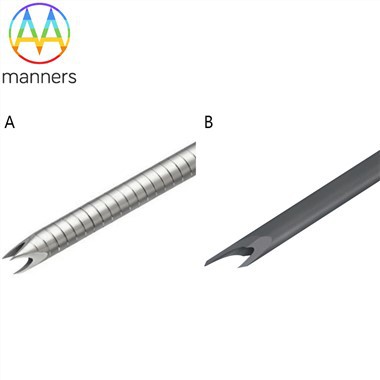
- Needle Tip Design: A beveled or triangular needle tip helps reduce puncture resistance and improve patient comfort.
III. Comparison of Mainstream Material Characteristics
Material | Characteristics | Applicable Scenarios
Stainless Steel | High strength, corrosion resistance, moderate cost | Reusable biopsy gun needle
Titanium Alloy | Low density, lightweight, good biocompatibility | High-end disposable biopsy needle
Medical Polymer Materials | No metal artifacts, completely disposable | Research use or special imaging examinations
In stereotactic biopsy, stainless steel remains the mainstream choice, but titanium alloy needles are gradually being promoted in precision positioning scenarios due to their lightweight and good handling feel.
IV. Instrument Coordination During Operation
A successful stereotactic puncture requires a high degree of coordination between the biopsy needle, positioning grid, compression plate, and imaging system. After locking the coordinates, the doctor advances the biopsy needle along the guide groove, using the core needle cutting principle to obtain a columnar tissue sample. The entire process is usually completed under local anesthesia and takes about 20–30 minutes.
V. Technical Limitations and Development Trends
Although stereotactic biopsy has high accuracy, it is still limited by factors such as the diffuse distribution of calcifications and the patient's inability to tolerate prolonged prone position. In recent years, the introduction of vacuum-assisted biopsy (VAB) systems has significantly increased the amount of tissue obtained per needle and reduced the false negative rate. In the future, with the application of AI-assisted positioning algorithms and novel composite material needles, stereotactic breast biopsy will achieve further breakthroughs in accuracy and safety.