Stainless Steel Vs. Titanium Vs. Medical Polymers: The Performance Game And Selection Logic in Laparoscopic Cannula Materials
Apr 18, 2026
Stainless Steel vs. Titanium vs. Medical Polymers: The Performance Game and Selection Logic in Laparoscopic Cannula Materials
Core Product Terms: Stainless Steel Cannula, Titanium Trocar, Medical Polymer, Biocompatibility
Representative Manufacturers: B. Braun, Stryker, KARL STORZ, Hangzhou Kangji Medical
The performance, safety profile, and cost structure of laparoscopic cannulas are inextricably linked to the choice of manufacturing materials. Currently, the market presents three primary material pathways: traditional stainless steel, premium titanium alloys, and dominant medical-grade polymers. Each material represents a distinct design philosophy, clinical positioning, and manufacturing approach, creating a complex landscape where engineers and surgeons must balance competing priorities.
I. Stainless Steel: The Benchmark of Classic Reliability
As the cornerstone of surgical instrumentation, 316L stainless steel has been the default choice for reusable cannulas for decades. Its enduring presence is rooted in a set of well-understood mechanical properties.
Advantages: Mechanical Robustness and Cost-Effectiveness
Stainless steel offers exceptional mechanical strength and hardness, allowing it to withstand the rigors of repeated use and harsh sterilization cycles, including autoclaving. Its corrosion resistance within the human biological environment is well-documented and reliable. Furthermore, the metallurgical processes for stainless steel are mature and cost-effective, making it an economically attractive option for foundational surgical tools.
Limitations: The Barriers to Modern Innovation
Despite its robustness, stainless steel presents significant drawbacks in contemporary minimally invasive surgery. Its opaque nature prevents direct visualization during puncture, a critical limitation that has largely excluded it from modern disposable trocar designs. The high density of steel also contributes to a heavier instrument, potentially increasing the physical burden on the abdominal wall and hindering the ergonomic flexibility required by surgeons. Additionally, steel's electrical conductivity poses inherent risks when used alongside high-frequency electrosurgical units, creating potential hazards for thermal injury or current diversion. Finally, integrating complex features like multi-functional sealing valves is mechanically challenging with metal construction.
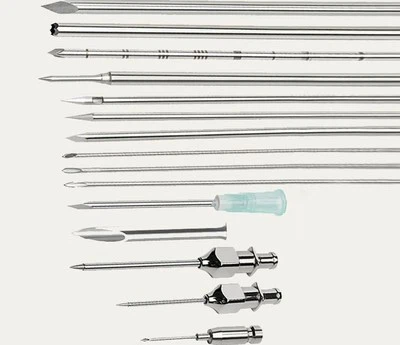
Today, stainless steel's role is largely confined to the obturator components of reusable systems or specific metal parts in robotic surgery platforms. German manufacturers like B. Braun continue to offer stainless steel options in their classic reusable instrumentation lines, catering to specific clinical preferences.
II. Titanium Alloys: The Pinnacle of High-End Performance
Titanium and its alloys, particularly Ti-6Al-4V, represent the apex of metallic performance in medical applications. They are chosen when performance trumps cost.
Core Advantages: Strength-to-Weight Ratio and Biocompatibility
Titanium offers a superior strength-to-weight ratio comparable to stainless steel but at roughly 40% lighter weight. This significant weight reduction translates to less surgeon fatigue and reduced tension on the patient's abdomen. Its biocompatibility is arguably unmatched, exhibiting near-zero sensitization and making it the material of choice for long-term implants. Furthermore, titanium is largely "invisible" to CT and MRI scanners, producing minimal artifacts. This is critically important for surgeries requiring intensive intraoperative imaging or postoperative follow-up scans.
Application Scenarios and Challenges
The use of titanium cannulas is predominantly reserved for the high-end, reusable market segment or for specialized fields like neurosurgery and spinal minimally invasive access, where image clarity is paramount. Companies like Stryker and KARL STORZ offer titanium variants in their premium product portfolios. However, the barriers to entry are high; raw material costs are significantly higher than steel, and the metal's reactivity requires specialized machining equipment and protocols, complicating the manufacturing process.
III. Medical Polymers: The Undisputed Champion of the Mainstream
Engineering plastics-primarily Polycarbonate (PC), Polyether Ether Ketone (PEEK), and Acrylonitrile Butadiene Styrene (ABS)-have become the absolute dominant material for disposable laparoscopic cannulas.
Disruptive Advantages: Visualization, Safety, and Design Freedom
The most revolutionary advantage of polymers is their transparency, which enables direct visualization during the critical puncture step, dramatically enhancing patient safety. Their lightweight nature drastically reduces the physical load on the abdominal wall. Being excellent electrical insulators, they completely eliminate the risks associated with electrosurgery. Moreover, polymer processing via precision injection molding allows for the cost-effective, single-step creation of complex, integrated structures. Features like multi-port valves, side ports, and snap-fit connectors can be molded directly into the cannula body-a feat impossible with metals.
Performance Challenges and Mitigation
While polymers cannot match metals in sheer strength or heat resistance, advancements in material science have closed the gap sufficiently for single-use applications. Through strategic structural design (e.g., reinforcing ribs) and material compounding, modern polymers meet and exceed clinical requirements. PEEK stands out for its superior heat resistance and mechanical strength, though at a higher cost. For single-use devices, long-term stability is not a concern, making polymers the ideal balance of performance and economy. Leading domestic manufacturers like Hangzhou Kangji Medical have fully embraced high-performance polymers, optimizing mold design and injection parameters to deliver high-quality, cost-competitive products.
IV. The Logic of Material Selection: Balancing Performance, Cost, and Clinical Needs
The selection of cannula material is ultimately a strategic decision balancing performance, cost, and clinical context:
High Volume, Single-Use, Safety-Cost Focus: Medical polymers are the unequivocal and optimal choice.
Reusable, Imaging-Intensive, Ergonomic Priority: Titanium alloys serve the high-end niche.
Specific Components, Economic Durability: Stainless steel retains value for reusable obturators and foundational parts.
Looking forward, the trend is moving toward hybridization. Future innovations may see polymer cannulas reinforced with metallic cores in high-stress areas or the development of novel surface coatings to enhance lubricity and impart antimicrobial properties, further pushing the boundaries of what is possible in minimally invasive access.