Revolution At The Tip Of The Needle: Innovation Application Atlas Of Medical Puncture Needles in Minimally Invasive Intervention
May 11, 2026
In medicine's evolution from "open surgery" toward "minimally invasive" and even "non‑invasive" procedures, the puncture needle has evolved from a simple injection and sampling tool into a core "weapon" of interventional medicine. Guided by imaging technologies, it acts as a precise probe and scalpel capable of reaching any corner of the human body, pioneering a new paradigm for disease diagnosis and treatment. This article systematically reviews the cutting‑edge applications of puncture needles in modern minimally invasive interventional medicine.
I. Diagnostic Pioneer: The Gold Standard for Accurate Pathological Sampling
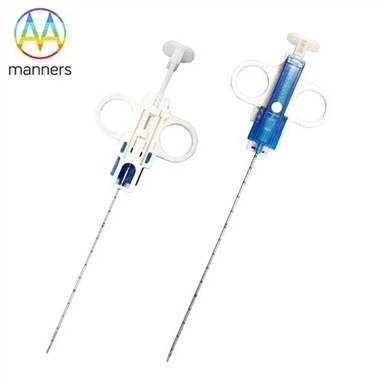
1. Percutaneous Puncture Biopsy: The cornerstone of interventional diagnosis. Under ultrasound, CT, or MRI guidance, different types of biopsy needles safely retrieve lesional tissue from most regions of the body.
- Core‑Needle Biopsy: Devices such as Tru‑Cut needles retrieve strip‑shaped tissue samples via an inner stylet notch, yielding high‑quality specimens ideal for diagnosing solid‑organ tumors of the breast, prostate, liver, and more.
- Vacuum‑Assisted Rotational Biopsy: Typically using larger‑gauge needles (8–14 G), built‑in rotary cutters harvest multiple continuous tissue samples in a single puncture under negative‑pressure suction. This improves diagnostic accuracy and can even achieve complete resection of benign small breast nodules.
- Fine‑Needle Aspiration Biopsy: Ultra‑fine 22–25 G needles aspirate cells for cytological examination. Minimally invasive, this technique is widely used for initial evaluation of thyroid nodules, superficial lymph nodes, and pancreatic masses.
II. Therapeutic Workhorse: Non‑Surgical Tumor Ablation
Percutaneous ablation offers curative options for early‑stage solid tumors in patients unsuitable or unwilling to undergo open surgery. The core principle is the precise placement of a specialized ablation needle into the tumor center.
- Radiofrequency Ablation Needle: The tip deploys umbrella‑shaped electrodes that generate high‑frequency thermal energy within the tumor, inducing coagulative necrosis of cancer cells. Widely adopted for liver, lung, and renal cancer.
- Microwave Ablation Needle: Microwaves emitted from the tip antenna polarize intracellular water molecules to generate frictional heat. Faster heating, more controllable ablation zones, and reduced susceptibility to blood perfusion cooling make it ideal for large tumors or lesions adjacent to major vessels.
- Cryoablation Needle: Argon gas delivered through a hollow probe rapidly freezes tissue into an "ice ball" that encapsulates the tumor. Repeated freeze‑thaw cycles destroy malignant cells. The ice ball is clearly visualized on CT (hypodense), and the procedure triggers anti‑tumor immune responses. Indicated for renal, lung, and bone tumors.
- Irreversible Electroporation (IRE) Needle: A non‑thermal ablation modality. Multiple electrode needles are precisely positioned around the tumor to deliver high‑voltage microsecond pulses, creating irreversible nanoscale pores in cell membranes to induce apoptosis while preserving blood vessels and bile ducts. This offers new hope for treating perihilar liver and pancreatic tumors adjacent to large ducts and vessels.
III. Pain Terminator: Precision Neuromodulation
In pain medicine, puncture needles serve as both a gauge and scalpel for diagnostic nerve blocks and therapeutic neuromodulation.
- Selective Nerve Root Block & Pulsed/Radiofrequency Therapy: Under C‑arm fluoroscopy or CT guidance, the exposed tip of a radiofrequency needle is placed adjacent to symptomatic spinal nerve roots or facet joints. A small dose of local anesthetic confirms the pain source via diagnostic block, followed by pulsed radiofrequency (neuromodulation) or conventional radiofrequency thermocoagulation (long‑term pain blockade) to treat discogenic pain, trigeminal neuralgia, and more.
- Minimally Invasive Interventional Disc Therapy: A fine puncture needle accesses a herniated disc via the posterolateral approach for discography‑guided diagnosis. A working channel then delivers plasma wands, laser fibers, or rotary cutters for nucleus pulposus vaporization, ablation, or partial discectomy, reducing intradiscal pressure to relieve discogenic low back pain.
IV. Structural Reconstruction: Support and Repair
- Percutaneous Vertebroplasty (PVP) / Kyphoplasty (PKP): For osteoporotic vertebral compression fractures, a large‑bore bone needle is inserted percutaneously through the pedicle into the collapsed vertebral body under imaging guidance. High‑viscosity bone cement is injected directly (PVP), or a balloon expands the vertebra before cement delivery (PKP). Cement solidification rapidly stabilizes the vertebra, alleviates severe pain, and restores mobility.
V. The Future Is Now: Integrated Diagnosis‑Treatment and Intelligence
1. Optical Biopsy Needles: Miniaturized optical coherence tomography (OCT) or confocal laser microscopy probes are integrated at the needle tip. Real‑time cellular‑level in‑vivo imaging enables "in‑situ pathological diagnosis" without tissue extraction, drastically shortening diagnostic turnaround times.
2. Smart Sensing Needles: Embedded miniature temperature, pressure, and impedance sensors provide real‑time feedback during ablation, enabling closed‑loop control of energy delivery for precise conformal ablation margins and preventing over‑ or under‑treatment.
3. Robot‑Assisted Puncture Systems: Puncture needles mounted on robotic arms execute procedures with stability and precision beyond human hands, eliminating hand tremor and respiratory motion artifacts. Particularly valuable for high‑difficulty punctures targeting prostate lesions, small lung nodules, and other deep‑seated structures.
Conclusion
The evolving role of medical puncture needles in minimally invasive intervention epitomizes the progress of modern medical technology. From a passive delivery tube, it has matured into an active intelligent platform integrating precision navigation, real‑time diagnosis, and high‑efficiency therapy. Every precise needle placement embodies the modern medical principle of maximizing therapeutic benefit while minimizing trauma. With further convergence of imaging, materials science, and artificial intelligence, these fine instruments will continue leading minimally invasive therapy toward greater precision, intelligence, and personalization.