The Symphony Of Design And Ergonomics: Analyzing The Engineering Wisdom Of Medical Needle Insertion Devices
May 11, 2026
The Symphony of Design and Ergonomics: Analyzing the Engineering Wisdom of Medical Needle Insertion Devices
Medical puncture needles are not merely "a thin tube with a tip". Every variation in their size, angle and curvature involves profound engineering principles and considerations of human tissue mechanics. An excellent design aims to complete diagnostic or therapeutic tasks with the least tissue damage, the least patient pain, and the highest level of precision. This article will, from the perspective of engineering design, deeply analyze how each key part of the puncture needle works together.
I. Needle Point Geometry: Deciphering the Code of the "First Contact"
The tip of the needle is the first point of contact between the instrument and the tissue. Its geometric shape directly determines the accuracy of the puncture, the degree of tissue damage, and the "feel" of the doctor.
1. Inclined Plane Point and Its Evolution: * Traditional Single Inclined Plane Point: Simple to manufacture, but during puncture, due to the asymmetrical force, a "deflection force" that causes the needle tip to deviate from the predetermined path will be generated, especially when passing through tissues of different densities. * Inverted Inclined Plane Point: An additional smaller auxiliary inclined plane is added on the back of the main cutting inclined plane, effectively balancing the lateral force and significantly reducing the needle tip deflection, improving the puncture accuracy, and is a common design for modern injection needles and puncture needles. * Three Inclined Plane Point/Five Inclined Plane Point: By increasing the number of ground inclined planes, the needle tip is made closer to a "pyramid" shape of a sharp vertex. This not only makes the puncture more effortless (reducing puncture force) and less painful, but also due to the more symmetrical tip, further improves the directional stability. Ultra-fine insulin pen needles mostly adopt the five inclined plane design to achieve an almost painless injection experience.
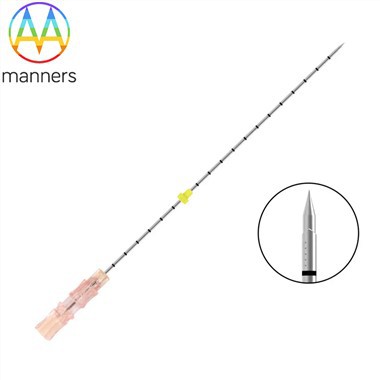
2. Non-cutting Needle Points: * Pencil Point/Rhombus Point: Without cutting edges, it is in a gradually converging conical shape. Its working principle is to separate tissue fibers without cutting. It can push aside blood vessels and nerve fibers, thereby significantly reducing the risks of headache, hematoma, and nerve damage after dural puncture, and is the standard design for spinal anesthesia needles and epidural needles. * Trocar Point (Percutaneous Needle Point): Composed of a sharp triangular or conical inner core (trocar) and a blunt-tipped cannula. The trocar is responsible for puncturing the tissue to establish a channel, and then being withdrawn, leaving the blunt-tipped cannula as the working channel, which can minimize cutting damage to blood vessels and organs, and is widely used in the first puncture of laparoscopy and thoracic drainage.
II. Needle Tube Design: A Balance of Strength, Flexibility and Function
The syringe serves as a conduit for force, and its design requires achieving the optimal balance within contradictions.
* Trade-off between wall thickness and inner diameter: This is the core contradiction in design. Thin-walled syringes have low rigidity and are prone to bending, but have a large inner diameter, which is beneficial for passing through thicker samples (such as biopsies) or for rapid drug infusion. Thick-walled syringes have strong rigidity and precise directional control, but have a small inner diameter. Designers need to optimize the ratio of wall thickness to tube diameter based on specific purposes (such as the need for high rigidity in spinal puncture to break through ligaments, and a large inner cavity for blood sampling).
* Length and "needle track" stability: When the puncture needle moves through tissue, the stability of its path is called the "needle track". Longer syringes are more likely to bend and deviate due to the non-uniformity of soft tissue when passing through. Therefore, while ensuring reaching the depth, it is advisable to choose a shorter needle or adopt a more rigid material and structural design to increase stability.
* Ultrasound-enhanced design: To be clearly visible under ultrasound guidance, the needle tip of many puncture needles is processed with small pits or engraved with threads, or embedded with materials with different acoustic properties such as ceramics at the needle tip, so that it generates strong echo points on the ultrasound image, facilitating the operator to track the needle tip position in real time, which is the key to the safety of interventional operations.
III. Needle Holder and Connector: The Hub of Human-Machine Interaction
The needle holder is the part that the doctor holds and operates with. Its design directly affects the comfort of operation, stability and the reliability of connection.
* Ergonomic design: The excellent needle holder features a concave groove that conforms to the curvature of the fingertip, anti-slip texture and an appropriate diameter, ensuring a stable grip even when blood or synovial fluid is present. For puncture needles that require fine rotational operations (such as lumbar puncture needles), the needle holder is usually designed with flat wings or knurled surfaces that facilitate the thumb and index finger to hold it.
* Ruhr connection standard: The connection between the needle tip and the syringe, extension tube or pressure sensor typically uses Ruhr taper connectors. This 6% taper standard design achieves a leak-free connection through friction fitting. For high-risk scenarios such as high-pressure injection (e.g., CT angiography) or arterial access, Ruhr lock connectors are used. On the basis of the taper fit, a threaded locking ring is added to provide dual safety guarantees, preventing accidental detachment and serious consequences.
IV. Special Function Integration: From Tools to Intelligent Platform
Modern puncture needles are evolving from passive tools to active diagnostic platforms.
* Manipulable/Turnable Needle: By pre-bending, using tension lines, or employing shape memory alloys, the needle tip can actively deflect within the body. Doctors can rotate or push the needle handle to make the needle tip "avoid" important blood vessels or organs, and travel along a curved path to reach the target, significantly enhancing the safety and success rate of complex punctures.
* Multi-channel Integrated Needle: One needle incorporates two or more independent channels. For example, a coaxial biopsy needle, with an inner core needle for sampling and an outer sheath for hemostasis or injecting anesthetic; or integrating injection channels, optical fiber channels, and even miniature endoscope channels into one, achieving "one needle for multiple uses".
* Energy Delivery Needle: The needle body itself acts as an electrode (radiofrequency ablation needle), a microwave antenna (microwave ablation needle), or a cryogenic delivery tube (cryoablation needle). After precise puncture to the tumor under imaging guidance, energy treatment is directly delivered through the needle body to achieve minimally invasive tumor inactivation.
Conclusion
The design of medical puncture needles is a highly sophisticated science that integrates biomechanics, material mechanics, ergonomics, and clinical requirements. From the nanoscale sharp needle tip edge, to the micrometer-level tolerance of the tube wall, and to the millimeter-level tactile handle, every detail has undergone meticulous optimization. The ultimate goal is to achieve an almost perfect engineering solution in the most precise "system" of the human body, minimizing trauma, maximizing precision, and optimizing operation. This is the best embodiment of the "people-oriented, technology-driven" philosophy in medical device design.