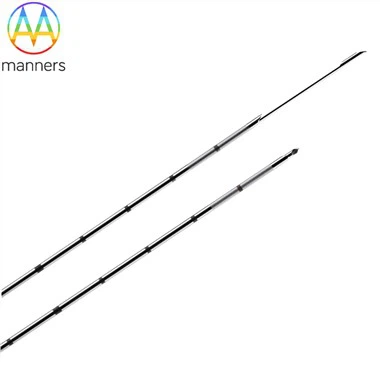
Reusable Pencil Point Needles And The Cleaning Question
Nov 18, 2026
Meta description: Pencil Point Needles demand flow-based reprocessing; ISO13485 reusable needles with validated cleaning, extraction evidence and cycle limits.
Pain Points: A Closed Tip Is Hard to Clean
Reusable needles are attractive for cost and for continuity, and a pencil point is the least forgiving geometry to reprocess. The lumen is closed at one end, so fluid can only enter and leave through the side ports, and the taper creates a crevice where the wall is thickest and the flow is slowest. A cleaning protocol developed for an open needle will pass visual inspection and leave residue in exactly the place that matters.
The second problem is that the residue is invisible. Dried protein, salt from a buffer or cured paste all sit inside the taper and the port entrance, and none of them can be seen through a 0.4 mm hole. Validation that relies on visual examination therefore confirms cleanliness where cleanliness cannot be observed, which is the most common weakness in a reprocessing file.
The third is that reuse changes the geometry. Every cleaning cycle is a wetting and drying cycle, and repeated cycles promote pitting at the weld-free but stressed taper, and erosion at the port edges. A device that was validated for twenty cycles may be dimensionally acceptable at fifty and functionally different, with a larger port and a thinner wall.
Working Principle: How Fluid Reaches a Closed Tip
Cleaning a closed tip depends on flow through the ports rather than on immersion. Immersion wets the outer surface and the port entrance, but the interior of the taper and the length of the lumen beyond the ports see only what diffuses in. In a narrow passage, diffusion is slow and the displacement per cycle is small, so an immersion-only protocol cleans the part of the device that is least likely to harbour residue.
Pressure-driven flow through the ports is the mechanism that works. Connecting the hub to a flushing line and forcing fluid out through the ports produces a velocity at the tip that scours the taper and carries residue out. The effectiveness depends on the flow rate, the temperature and the number of exchanges rather than on the duration of the soak.
The taper adds a specific challenge. Between the ports and the closed end there is a small volume with almost no exchange, and residue collects there because the flow turns before it reaches the end. A protocol that flushes in one direction fills that pocket and leaves it; alternating the direction, or pulling a vacuum at the hub between flushes, is what empties it.
Materials matter as much as mechanics. Passivated 316 stainless resists repeated cleaning better than 304, and the difference appears as pitting at the taper after many cycles rather than as an immediate failure. Selecting the grade for the number of intended cycles is a design decision that reprocessing cannot compensate for.
Classification: Reuse Models and Their Burdens
Single-use devices avoid the cleaning question entirely and move the burden to manufacturing cleanliness and to packaging. This is the appropriate model where the residue is difficult to remove, where the device is used in a critical application, or where the number of cycles cannot be controlled.
Reusable devices with a validated reprocessing instruction place the burden on the cleaning protocol and on the user's adherence to it. The design must make that protocol feasible: ports large enough to be flushed, a hub that accepts a flushing connector, and a taper that can be inspected or tested.
Reusable devices with a defined cycle limit, tracked by marking, are a middle position. They acknowledge that geometry degrades and cap the exposure, and they require a marking method that survives cleaning, which is a specification in its own right.
Hybrid arrangements exist where the needle body is reusable and the tip assembly is replaced. They reduce the cleaning burden and introduce an interface that must be sterile at the point of connection, which is its own validation problem.
Practical Operation: Building a Reprocessing Validation
Start from the worst case, not the typical one. The soil that is hardest to remove, the longest dwell before cleaning and the lowest flow rate the protocol allows define the validation. A protocol validated on a light soil with immediate cleaning will fail in practice, and the failure will be attributed to user error rather than to the validation design.
Prove removal by extraction, not by inspection. Flushing a defined volume through the ports and analysing it for the marker gives a number that can be compared with a limit. Doing this at the taper, by sectioning a cleaned part, gives evidence for the pocket that a flush cannot reach uniformly.
Define the flow path and the connector. A protocol that says flush with a syringe is ambiguous; one that specifies the connector, the volume, the temperature, the direction sequence and the number of exchanges is reproducible. Ambiguity in a reprocessing instruction is transferred directly to the user.
Qualify the cycle count. Run the intended number of cleaning cycles on a sample and measure port area, taper geometry and surface condition at intervals. The number at which any of those leaves its window is the true limit, and it is usually lower than the number assumed at design.
Control drying. Residual moisture in a closed taper is a corrosion cell, and it is also a growth medium. A defined drying step, with an air flush through the ports, is part of the cleaning validation rather than a housekeeping detail.
Qualify the cycle count with geometry, not with appearance. Run the intended number of cycles on a sample and measure port area, taper angle and surface condition at intervals; the point at which any of them leaves its window is the true limit, and it is usually lower than the figure assumed at design. Setting the replacement interval below that limit gives the process a margin.
Field Experience: Where Reprocessing Goes Wrong
The most frequent finding in a reprocessing audit is a soak-only protocol. The device is submerged, the residue is softened and partly removed, and the interior beyond the ports is untouched. Because the outside looks clean, the protocol is accepted until an extraction test is performed.
The second is a connector mismatch. The user attaches a syringe that does not seal at the hub, the flush leaks around the connection rather than through the ports, and the tip receives almost no flow. Specifying the connector, and supplying it with the device, removes a failure that the user cannot see.
The third is cycle drift. Devices are used beyond the validated count because the marking has faded, and the port area has grown enough to change the delivered volume. A durable mark, plus a replacement interval shorter than the validated limit, is the practical control.
Summary
A reusable pencil point is cleanable only through its ports, so the cleaning protocol has to be a flow protocol rather than an immersion one. Residue collects at the taper and behind the ports, where visual inspection cannot reach, and the only defensible evidence is extraction combined with sectioned examination.
The practical requirements are a flow-based protocol with a specified connector and direction sequence, extraction-based validation from a worst-case soil, a qualified cycle limit, and a defined drying step. Those four elements turn a reprocessing instruction into something a user can actually follow and an auditor can actually verify.
Outlook
Design for reprocessing is becoming an explicit requirement rather than an afterthought. Devices are increasingly assessed on whether their geometry can be flushed, inspected and dried, and a closed taper with undersized ports will fail that assessment regardless of its clinical performance.
Verification is becoming quantitative. Extraction-based acceptance, per-cycle geometry tracking and in-line flow checks give a reprocessing file the numbers it currently lacks, and they allow a cycle limit to be set from evidence rather than from convention.