The Rotary Forge Behind Pencil Point Needles
Nov 18, 2026
Meta description: Pencil Point Needles are cold formed by rotary forging, closing the tip without a weld for concentric, leak-free side-port geometry.
Pain Points: A Closed Tip Cannot Be Cut from a Straight Tube
A pencil point is a closed, tapered end with side ports, and that shape cannot be produced by grinding a tube. Cutting a taper leaves the tip open, so a second operation is needed to close it, and every closure method brings its own problem. Welding a cap onto a 0.5 mm tube creates a heat-affected zone, a possible leak path and a step that catches on the septum. Bonding a cap introduces an adhesive at the exact place where cleanliness matters most.
Machining the taper from solid stock solves the closure problem and creates a different one. On small diameters the tool deflection is comparable with the wall thickness, so concentricity between the outer taper and the inner lumen is difficult to hold, and the tool has to enter a bore that is often below half a millimetre. The result is a tip that looks correct and meters incorrectly.
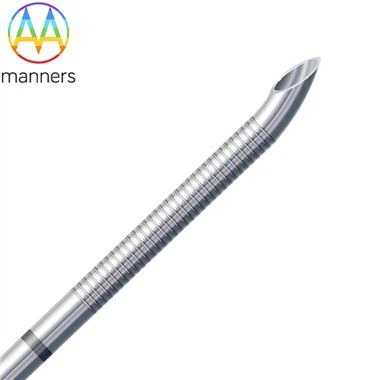
The third option, and the one that most pencil points actually use, is cold forming. Rotary forging reduces both the outer and the inner diameter of a tube in a single continuous operation, closing the end as it goes. The shape is produced by material flow rather than by removal, which is what makes a concentric, leak-free, weld-free tip possible at all.
Working Principle: Diameter Reduction by Material Flow
Rotary forging, also called rotary swaging, works by passing a tube through a set of dies that rotate around it and strike it rapidly. Each strike reduces the diameter slightly, and the repeated action moves the wall inward and forward. Because the reduction is incremental, the material is displaced rather than torn, and the grain structure follows the new shape instead of being cut across.
The inner diameter closes with the outer diameter at a controlled ratio. That ratio is the central process variable, because it decides the wall thickness at the taper and therefore the strength of the tip, the size of the internal passage and the amount of material available for the side ports. A taper that closes too quickly produces a heavy wall and a pinched lumen; one that closes too slowly leaves a thin wall that deforms on insertion.
Cold working raises hardness and reduces ductility, so the amount of reduction that can be taken in one pass is limited. Larger reductions require intermediate annealing, and the annealing schedule becomes part of the geometry, because it determines how much recrystallisation occurs and therefore how the next pass flows. In practice a pencil point is a sequence of passes and anneals rather than a single forming step.
The taper angle emerges from the die profile. Most pencil points sit in the range of twelve to fifteen degrees from the axis, which balances piercing force against tip strength and against the length of the sealing zone. A shallower angle pierces more easily and seals over a longer distance; a steeper angle produces a stronger tip and a shorter seal.
Classification: Four Ways to Make a Closed Taper
Rotary forging from tube is the production standard for this geometry. It gives a seamless tip, preserves concentricity and suits 304 and 316 stainless tubing as well as other workable alloys. The limitation is that it needs dedicated dies per size and a pass schedule per material.
Welded or brazed caps are used where quantities are low or where an existing tube must be closed without new tooling. The tip can be dimensionally acceptable, but the joint is a potential leak and a crevice for residue, and the process is difficult to validate for reusable devices.
Machined tips from solid bar are appropriate for larger diameters and for shapes that forging cannot produce, such as internal steps or non-circular passages. They are expensive per part and demand a lathe that can hold concentricity on thin stock.
A fourth route, additive manufacturing, is appearing for prototypes and for low-volume industrial nozzles. It can produce internal channels that forging cannot, and it currently lacks the surface finish and the repeatability that a sealing taper requires, so it is used to prove a design rather than to supply production.
Practical Operation: Setting a Pass Schedule
Start from tube geometry rather than from the finished tip. The wall thickness of the incoming tube, its concentricity and its hardness determine how much reduction each pass can take. A tube with an eccentric bore will produce an eccentric tip no matter how well the dies are set, so incoming inspection on wall concentricity is the first control rather than an optional one.
Specify the reduction per pass and stick to it. A typical schedule reduces the diameter by a fraction of a millimetre per pass with an anneal when the accumulated cold work reaches the material limit. Operators who take a larger reduction to save a pass produce a taper with surface cracks that only appear after polishing.
Control the mandrel or core if one is used. Where the inner diameter must remain open to a defined depth, a core pin sets the final bore and its wear is the main source of drift. Measuring the bore at the taper on the first part of each shift catches that drift before it becomes a batch.
Lubricate consistently and clean between passes. Forging lubricant that is not removed traps particles that later appear as inclusions at the taper, and a dry pass raises both friction and the risk of galling. A defined wash between passes is cheaper than a rework loop.
Verify the taper by profile rather than by diameter alone. A profile projector gives the angle, the tip radius and the transition point to the full diameter in one view, and the transition is where most functional problems originate.
Field Experience: What Forged Tips Fail On
The most common failure is a crack at the transition between the taper and the full diameter. It comes from taking too much reduction in the final pass, from a missed anneal or from a die with a worn entry radius. Because the crack is at the surface and usually closed, it appears as a leak in a pressure test rather than as a visible defect.
The second is a drifting internal passage. As dies wear, the bore at the taper closes slightly, and the effect is invisible until a flow or dispensing test fails. Tracking bore size at the tip on a schedule, rather than only at the tube, converts this into a trend that can be corrected by die replacement.
The third is material specific. Austenitic grades work harden quickly, so a schedule validated on one heat of 304 may crack on another with slightly higher carbon. Certifying incoming material for hardness and for inclusion content, and adjusting the anneal rather than the reduction, keeps the process stable across heats.
Summary
A pencil point is made by moving material rather than by removing it. Rotary forging reduces the outer and inner diameter together, closes the end without a weld and produces a concentric taper whose angle comes from the die profile. The pass schedule, the intermediate anneals, the die condition and the incoming tube together decide whether the tip is sound.
The practical controls are few and specific: concentric tube in, defined reduction per pass, anneal at the cold-work limit, consistent lubrication and cleaning, and profile verification at the transition. Those controls are what separate a tip that meters reliably for thousands of cycles from one that leaks at the first pressure test.
Outlook
Forming equipment is becoming more controllable. Servo-driven rotary forgers can reproduce a feed curve pass by pass, which turns a schedule that was previously a matter of operator feel into a program. That is the step that allows small-diameter tips to be produced on more than one machine with the same result.
Near-net-shape thinking will spread. Where a forged tip can replace a machined assembly, the savings are not only in cycle time but in the elimination of a joint that had to be inspected and validated. The likely direction is more forging, earlier in the design, with the tube and the tip specified together rather than sequentially.