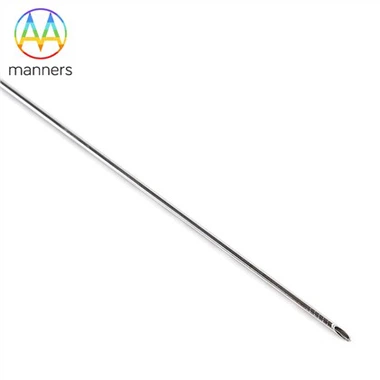
Side Ports In Pencil Point Needles: Flow Without Plugging
Nov 18, 2026
Meta description: Pencil Point Needles rely on coaxial side ports for flow; port area, edge quality and patency control dispensing and irrigation performance.
Pain Points: A Closed Tip Has Only Two Holes
A pencil point is closed at the end, which is what makes it non-coring, and it is closed at the end, which is what makes it fragile in service. All flow passes through one or two small circular ports near the tip, and those ports are the smallest features in the device. Any particle, dried paste or polishing residue that reaches them reduces the flow, and in a metering application a partial blockage is worse than a complete one because it changes the dose silently.
The geometry compounds the problem. The ports sit where the wall is thinnest and where the flow must turn, so the local velocity is highest and the erosion is greatest. A port that is too small produces a jet that damages the membrane being pierced; a port that is too large removes too much wall and weakens the tip. The working range is narrow and it moves with the taper angle.
Manufacture adds its own risks. Drilling a sub-millimetre hole in a curved, hardened wall produces a burr on the inner edge that is difficult to remove and that both restricts flow and sheds particles. Laser drilling avoids the burr and leaves a recast layer. EDM gives a clean edge at a slower rate. Each method leaves a different signature, and the signature is what determines whether the port stays open.
Working Principle: Where the Flow Goes and Why It Matters
The ports are usually arranged coaxially, on the same side of the tip, so that the two holes share a common axis through the cannula. That arrangement gives a short, straight flow path from the lumen into the port and reduces the chance of a dead pocket between them. It also means the device has a preferred orientation relative to the membrane, because both ports discharge in the same direction.
Flow rate through the pair is governed by the combined area and by the pressure drop across the tip. Because the ports are short and the flow must turn sharply, the entrance and exit losses dominate over friction, so doubling the number of ports increases flow by less than doubling the area suggests. The practical consequence is that port area has to be sized from a measured flow requirement rather than from an assumed relationship.
The turn at the tip is where particles collect. A particle large enough to bridge a port will lodge at the entrance, and the swirl behind it will trap smaller particles until the passage closes. This is why a device that passes a clean-water flow test can still block on a paste: the fluid carries the evidence, but only the paste reveals the pocket.
Jet behaviour matters for membrane piercing. A port discharging at high velocity against a septum can cut it, which defeats the non-coring intent of a closed tip. Keeping the discharge velocity moderate, by using adequate port area and a controlled insertion depth, preserves the self-sealing property that the closed tip was designed to provide.
Classification: Port Layouts and Their Uses
A single port is the simplest layout and gives the most wall thickness at the tip. It suits low-flow metering, gas delivery and applications where the port can be oriented deliberately towards a target surface.
Two coaxial ports are the common configuration for dispensing and irrigation, because they double the flow area without removing material from two sides of the tip. They discharge in one direction, which is useful when the flow must be aimed.
Opposed ports, on opposite sides of the tip, balance radial reaction forces and suit applications where the device must stay centred, such as irrigation of a cavity. They reduce the wall thickness on two sides and are therefore limited to larger diameters.
Angled or tangential ports impart a swirl and are used for mixing and for nozzle applications in industrial dispensing. They are the most difficult to drill consistently and the most sensitive to burr, so they are normally specified with a defined drilling method rather than with a hole size alone.
Practical Operation: Drilling, Cleaning and Proving Patency
Specify the drilling method, not only the hole size. A laser-drilled port and a mechanically drilled port of the same diameter behave differently because of the recast layer and the burr, and a specification that leaves the method open will produce two populations of device under one part number.
Control the entry and exit edges. A burr on the inner edge restricts flow and sheds particles; a lip on the outer edge catches on the membrane and can tear it. Deburring by abrasive flow or by electrochemical means reaches the inner edge, while a wire brush does not. Verify by microscopy on a sectioned tip rather than by looking at the outside.
Prove patency with the medium that matters. A water flow test at a single pressure confirms that the port exists; a test with the intended fluid, at the intended pressure and over the intended number of cycles, confirms that it stays open. Where the application involves pastes or suspensions, the test should use a representative formulation, because viscosity changes the deposition pattern at the turn.
Clean before and after drilling. Debris generated by the operation is the most common cause of a blocked port in a new device, and it is also the most common cause of a failed cleaning validation on a reusable one. A defined flush through the ports, in both directions, with an extraction check, is the minimum evidence.
Check the port area as a dimension. The diameter of a small hole is difficult to measure directly, so the practical approach is to measure the flow at a reference pressure and convert it to an effective area, then trend that value. It is an indirect measurement, and it is the one that correlates with behaviour.
Field Experience: Patterns of Blockage and Damage
The most common field failure is partial blockage by dried material, usually in a device that was cleaned and stored rather than in one that was used continuously. The residue collects at the port entrance where the flow turns, and the first symptom is a slightly lower dispensed volume rather than an obvious stoppage. Devices that are flushed with a defined volume after use rarely show the pattern.
The second is burr-induced restriction. A port that is 10 percent small in effective area produces a change in flow that is inside most flow tolerances but outside the tolerance of a metering application. The defect is invisible from outside and requires a section to confirm, which is why first-article inspection should include one.
The third is erosion of the port edge on high-cycle devices. Gas and abrasive slurries enlarge the port progressively, which raises flow and changes the jet. Tracking flow at a reference pressure across the life of a reusable device detects the change before it affects the process.
Summary
Side ports are the only path through a pencil point, and they are the smallest, most exposed features of the device. Their area, their arrangement and the quality of their edges decide flow, jet behaviour, blockage resistance and the integrity of the membrane seal. The taper angle and the port layout compete for the same envelope, so they must be designed together.
The practical route is to specify the drilling method and the edge condition, to verify patency with the real medium, to clean in both directions with an extraction check, and to trend effective area rather than to rely on a single diameter. Those four practices are what keep a closed tip from becoming a blocked one.
Outlook
Drilling is becoming more precise and more instrumented. Femtosecond laser drilling produces edges with minimal recast and can be monitored in process, which addresses the two failure modes that currently require sectioning to detect.
Flow verification will move in-line. A pressure-decay or flow-signature test performed on every unit, recorded against the part, turns port patency from a sampled check into a per-device measurement, and it gives metering applications the evidence they need to guarantee a dose.