Research On Precision Manufacturing Technology Of 14 ML Therapeutic Phlebotomy Needles
Jun 05, 2026
https://pmc.ncbi.nlm.nih.gov/articles/PMC11507497/
Amid the medical device industry where tradition intersects with innovation, the fabrication of 14 mL therapeutic phlebotomy needles epitomizes the seamless integration of targeted volumetric therapeutic requirements and state-of-the-art precision machining. Rather than a straightforward upsizing of standard needle dimensions, its production constitutes a systematic engineering project incorporating material science, fluid mechanics, ergonomics and rigorous quality control protocols.
The fixed 14 mL blood volume corresponds to dedicated therapeutic venesection scenarios, principally quantitative intervention for patients afflicted with polycythemia disorders or hereditary hemochromatosis. Accordingly, the cannula is engineered to deliver comparatively high flow rates under safe and controllable operating conditions, with production commencing from core raw material screening. Premium-grade stainless steel, specifically 316L medical stainless steel, stands as the optimal substrate owing to its outstanding biocompatibility, corrosion resistance and mechanical robustness. This material safeguards biological safety during contact with blood and bodily tissues, while striking a balanced mix of rigidity and ductility for the typically several-inch-long cannula, eliminating risks of bending or fracture during clinical puncture procedures.
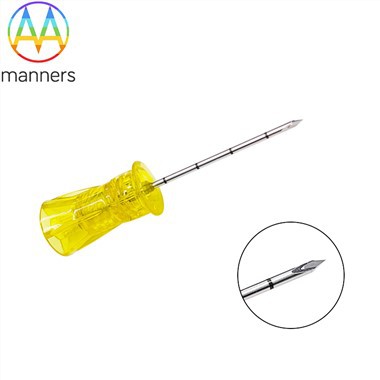
Inner bore diameter and overall cannula length constitute core physical parameters governing flow velocity and puncture penetration depth. To sustain stable 14 mL blood extraction, the inner lumen dimension is calculated with high precision: it must be sufficiently wide to lower fluid shear stress and avert hemolysis during blood transit, yet restrained from excessive enlargement that would exacerbate vascular trauma upon venipuncture. Such cannulas generally feature marginally larger bore sizes than routine diagnostic blood collection needles. Outer diameter design strikes a compromise between minimizing patient puncture pain and preserving structural mechanical integrity. Tip geometric configuration bears critical functional importance; contemporary production leverages laser cutting coupled with electrolytic grinding to fabricate multi-bevel ultra-thin-wall puncture facets, enabling smooth penetration through skin and vascular walls with minimized insertion force and improved patient comfort.
Production initiates with precision stainless steel tubing blanks, which are cut and dimensionally formed via automated CNC machine tools to guarantee uniform cannula length across all units. This is followed by the pivotal tip grinding process to produce sharply honed, geometrically symmetrical needle points. Internal lumen polishing is refined to a mirror finish, an indispensable procedure to curb adhesion and activation of blood components (notably platelets) and sustain consistent fluid flow. Given the relatively large 14 mL collection volume, blood dwell time within the cannula is moderately prolonged, making superior inner surface smoothness vital to preserve native blood properties and inhibit microthrombus formation.
Surface finishing forms another critical protective barrier. Manufactured within an ISO 13485-certified quality management system environment, finished cannulas undergo sequential multi-stage cleaning prior to deposition of medical-grade lubricious coating. The coating reduces frictional resistance between the needle and soft tissue for seamless venipuncture, while retaining compatibility with subsequent ethylene oxide (EtO) or irradiation sterilization workflows. Every production batch is subjected to comprehensive performance verification covering puncture force testing, volumetric flow validation (confirming steady discharge of 14 mL simulated fluid within specified duration), hub pull-out strength testing, alongside bioburden inspections for sterility and pyrogen-free compliance.
In conclusion, specialized cannulas engineered for 14 mL therapeutic phlebotomy emerge from deep synergy between advanced precision manufacturing and tailored clinical specifications. Every production stage, from raw material procurement to finished product release, adheres to stringent standards of dimensional accuracy, clinical safety and functional efficiency, serving as a vital technical bridge linking the ancient therapeutic philosophy of bloodletting to modern standardized patient care safety benchmarks.