Transformations Of Instruments And Medical Concepts
Jun 05, 2026
https://pmc.ncbi.nlm.nih.gov/articles/PMC11507497/
Abstract
Against the broad backdrop of medical history and therapeutic advancement, this paper investigates venesection bloodletting needles. By tracing the fluctuating history of bloodletting: from a dominant ancient medical practice, through criticism and elimination in early modern times, to scientifically defined niche applications in contemporary medicine, the study focuses on how the evolution of therapeutic instruments (bloodletting needles) reflected and fueled fundamental shifts in medical ideology spanning from humoral pathology to evidence-based medicine.
Introduction
Far from an isolated piece of hardware, the bloodletting needle serves as the physical carrier of the ancient medical practice of bloodletting. Changes to its shape, clinical application and medical standing act as a mirror reflecting revolutionary advances in human understanding of human physiology and disease pathogenesis, as well as the arduous transition of medical practice from empirical tradition toward scientific verification.
1. Antiquity to Early Modern Era: Universal Remedy Dominated by Humoral Theory and Diversified Instrumentation
For nearly two millennia, bloodletting was grounded in the humoral theory pioneered by Hippocrates of ancient Greece and Galen of ancient Rome. The doctrine posited that illnesses stemmed from imbalance among four bodily humors: blood, phlegm, black bile and yellow bile; draining surplus or corrupted blood was deemed the core intervention to restore humoral equilibrium. Supported by this theoretical framework, bloodletting ranked among Western medicine's mainstream therapies and was prescribed for nearly all ailments.
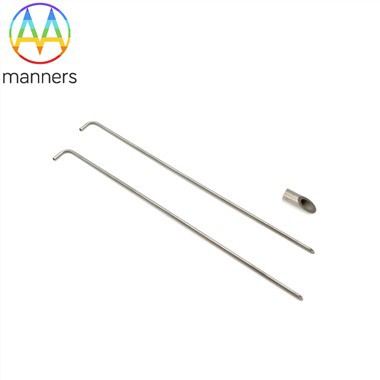
Instruments and techniques: The therapeutic toolkit extended well beyond slender puncture needles. Blood fleams were used to incise superficial veins; cupping therapy generated negative pressure via preheated glass cups to extract blood; medicinal leeches facilitated slow localized blood withdrawal. Metallic bloodletting needles were reserved for pricking superficial veins in varied configurations: some spear-tipped, others engineered with blood grooves, featuring inconsistent lengths and gauges. Disinfection remained primitive, limited to boiling or open-flame sterilization, leading to extremely high postoperative infection risks. Instrument selection depended on physicians' personal practice habits, target anatomical sites and targeted blood withdrawal volume.
2. The 19th-Century Turning Point: Scientific Skepticism and Specialization of Instruments
Progress in anatomy, physiology and especially pathology gradually undermined the validity of humoral theory. The introduction of statistical analysis in the mid-19th century delivered a groundbreaking critical re-evaluation. For instance, French clinician Pierre Louis deployed clinical statistical research to prove bloodletting offered no therapeutic benefit and could prove harmful for illnesses such as pneumonia. Medical consensus shifted toward the localization theory centered on organic lesions and the emerging germ theory of disease.
Instrument evolution: Unrestrained, systemic over-phlebotomy rapidly fell out of favor. Nevertheless, therapeutic venesection was retained with drastically restricted indications for select acute emergencies including acute congestive heart failure and polycythemia vera. Corresponding instruments grew more specialized and refined with optimized sharpness and volumetric controllability, laying the technical groundwork for modern venipuncture devices.
3. Modern Medical Positioning: From Independent Therapy to Specialized Clinical Technique
From the 20th century onward, advances in pharmacology and evidence-based medicine phased out bloodletting as a standalone formal therapy, yet its core procedural skill - venipuncture - was comprehensively restructured and incorporated into contemporary clinical systems.
- Diagnostic blood sampling: Traditional bloodletting needles have evolved into single-use vacuum blood collection needles and safety lancets engineered exclusively to harvest blood specimens for laboratory testing rather than disease treatment, prioritizing minimal invasiveness, pain reduction, rapid quantitative collection and cross-contamination prevention.
- Therapeutic blood depletion: For a narrow set of confirmed clinical indications, regulated therapeutic venesection (for polycythemia vera or hereditary hemochromatosis) and therapeutic plasmapheresis remain valid clinical interventions. Unlike historic blind bloodletting, these modern procedures adopt closed sterile collection equipment under continuous vital sign monitoring to withdraw precisely calculated volumes of whole blood or blood components with defined therapeutic endpoints and full procedural control.
- Collateral pricking therapy in Traditional Chinese Medicine (TCM): As a characteristic external TCM treatment, controlled micro-volume blood pricking on designated acupoints is applied for localized ailments such as skin abscesses and acute soft tissue sprains, based on TCM meridian and qi-blood theories, which differs fundamentally from classical Western bloodletting doctrines.
4. Embodiment of Conceptual Reform: Safety, Precision and Evidence-Based Practice
The shift from crude hand-forged metal implements to single-use sterile disposable needles encapsulates three landmark ideological revolutions in clinical medicine:
Aseptic philosophy: from disregard for infectious hazards to recognition of sterile protocols as the clinical lifeline.
Precision philosophy: from vague empirical "draining bad blood" to rigorous milliliter-level volumetric control of blood collection.
Evidence-based philosophy: from millennia of dogmatic medical conventions to the requirement of verifiable scientific evidence for every clinical intervention.
Conclusion
The developmental history of venesection bloodletting needles traces a complete transformation: from revered sacred medical implements to obsolete hazardous tools, then to standardized specialized clinical devices. It chronicles medicine's paradigm shift from speculative philosophical reasoning to experimental science, from holistic conjectural pathology to localized empirical verification, and from physician-centric authoritarian practice to patient-safety-oriented care. When modern clinicians employ a sterile single-use blood collection needle today, they utilize not only a masterpiece of contemporary industrial manufacturing but also a medical symbol thoroughly refined and remolded by scientific rationality. Its enduring existence serves as a reminder that medical advancement is inherently an iterative collaborative evolution: clinical theories and therapeutic instruments continuously promote and reshape one another amid ongoing critical review and empirical validation.