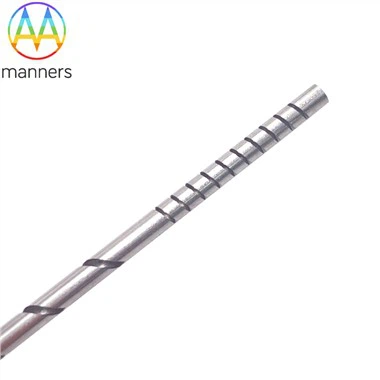
Quincke Spinal Needle 22G 90mm In The GLP-1 Weight-Loss Era
Nov 26, 2026
Primary keyword: Quincke Spinal Needle 22G 90mm | Secondary: neuraxial access in obesity, longer spinal needle, ultrasound landmarking | Intent: commercial investigation | Meta: GLP-1 drugs and rising BMI are changing neuraxial access. Read how the Quincke spinal needle 22G 90mm performs in deeper tissue.
The New Patient Body: Deeper Tissue, Different Landmarks
Anaesthetists have been describing a change in the patient population for several years, and the change has a name in every ward round: the patient is larger, the landmarks are softer, and the space is further away. Weight-loss medication has altered the trajectory rather than the direction, because patients on GLP-1 receptor agonists may lose weight steadily while retaining the anatomical features that make neuraxial access difficult, including a thick subcutaneous layer and a deeply placed spine.
The practical effect is that the ninety-millimetre needle, once comfortably long for almost every adult, is now the minimum rather than the maximum. A skin-to-subarachnoid distance that was five centimetres in a textbook patient can be eight or more, and the depth is not reliably predictable from the surface, because the tissue over a rotated spine can be thicker on one side than the other.
Why Depth Changes the Needle Equation
Needle length is not merely a reach problem. A longer cannula is more flexible, more easily deflected by ligament, and harder to keep on a straight trajectory, so the thirty extra millimetres that make a deep space reachable also make the needle more likely to drift. That is why a 90mm needle has to be straight within tolerance and stiff enough not to bow, and why the introducer becomes more important as depth increases: it establishes a track that the longer needle can follow instead of finding its own.
Depth also changes the consequences of error. A needle that is too short in a thin patient produces a subcutaneous infiltration that is noticed within minutes. A needle that is too short in a patient with eight centimetres of tissue produces a hub that sits in fat, a tip that may or may not be in the space, and a dressing that cannot stabilise either. The failure is quieter and later, which is why depth should be estimated before puncture rather than discovered during it.
Ultrasound also changes what counts as an adequate depth estimate. Measuring from skin to the posterior dura through a probe placed in the position of the puncture gives a number that can be planned against, while palpation gives an impression. In a patient with a soft tissue envelope of ten centimetres, the difference between an impression and a number is the difference between a needle that reaches the space and one that does not.
Gauge Choices in a Heavier Cohort
Gauge selection in obese patients is a compromise between flow and tracking. A 22G cutting needle offers enough flow to confirm placement in a deep space where the fluid column has to travel further, and it offers a tip that stays where it is aimed. A 25G or 27G atraumatic needle reduces the dural defect, but in a patient where the space is far away and the landmarks are poor, the number of passes required often erases the theoretical benefit.
There is also a procedural dimension. Higher body mass is associated with higher rates of obstructive sleep apnoea, and some of these patients are candidates for neuraxial techniques chosen specifically to avoid airway manipulation. In that context, a spinal that works on the first attempt is worth more than a dural defect that is a fraction of a millimetre smaller, provided the patient is positioned and monitored appropriately for the sedative and analgesic plan.
Technique Adjustments That Matter
Three adjustments are worth standardising. First, mark the level with ultrasound rather than relying on palpated landmarks, and measure the depth to the ligamentum flavum if the machine and the operator allow it. Second, use the sitting position when the lateral position cannot achieve adequate flexion, because a rounded back in a seated patient is often easier to maintain than a flexed spine in a lateral one. Third, choose the introducer deliberately: a short introducer that barely reaches subcutaneous tissue is useless at depth, while one that reaches the ligamentum flavum consumes the length advantage of the spinal needle.
Positioning deserves more time than it usually receives. A patient with a thick soft-tissue envelope can appear to be in a good lateral position while the spine is rotated, and a rotated spine turns a midline approach into a search. Confirming that the shoulders and pelvis are square, that the hips are flexed enough to open the interlaminar spaces, and that the patient can maintain the position for the duration of the procedure is time well spent before the first puncture.
Equipment planning follows the same logic. Long needles need long introducers, and a department that stocks ninety-millimetre needles with twenty-five-millimetre introducers has effectively shortened its reach. The pairing should be specified as a set: introducer length matched to the depth range, needle length matched to the deepest case in the unit, and a dressing large enough to secure a hub that sits above soft tissue.
Field Notes from High-Volume Units
Units that see a high proportion of patients with raised BMI report two consistent findings. The first is that the depth recorded at one procedure is useful at the next, so documenting the distance from skin to space changes the second procedure from an estimate into a plan. The second is that longer needles reduce conversions, but only when they are stocked in quantity; a single box of thirty-two or thirty-eight millimetre needles is not a policy.
The problems they describe are also consistent. Needles that bend at the hub when a patient moves during a long procedure. Dressings that cannot hold a needle whose hub sits above a deep soft-tissue envelope. And headaches in younger patients with obesity, where the choice of a large cutting needle was made for reach and never reconsidered for risk. All three are design and stocking issues as much as they are technique issues.
Summary: A Longer Needle Is Not a Strategy
The requirements for this population are: a needle long enough for measured depth rather than assumed depth, a cannula straight and stiff enough to track over that length, an introducer that establishes a track without consuming the length advantage, and a dressing plan that stabilises the hub above soft tissue.
Alongside the product, the requirements are ultrasound, documented depth and a gauge policy that is written down rather than improvised. The needle is the instrument; the protocol is what makes it work in a patient whose anatomy has changed.
Training is the third variable. A department that adopts longer needles without teaching depth estimation, ultrasound marking and paramedian rescue will report more failed taps than before, because the needle now reaches places the technique is not prepared for. The product and the training have to be introduced together, and the second is usually the slower of the two.
Outlook: GLP-1 Era, Home Care and Longer Configurations
The weight-loss drug market is expected to keep expanding, and its anaesthetic consequences will keep arriving in operating theatres: patients with lower weight but persistent central adiposity, patients with delayed gastric emptying, and patients whose co-morbidities are improving faster than their anatomy. Neuraxial techniques will be used more, not less, in this group, because they avoid airway instrumentation in patients who are still at risk.
On the product side, the movement is towards longer standard lengths and better depth instrumentation. Needles with visible centimetre markings, introducers sized to the depth rather than to the skin, and packaging that pairs a needle with an appropriately long introducer are all small changes that address the same problem. For buyers, the practical question is whether the supplier offers a coherent depth system rather than an isolated long needle.
Frequently Asked Questions
Is 90mm enough for patients with obesity?
For many, yes; for some, no. Depth should be estimated by ultrasound or measured at a previous procedure, and longer lengths should be available as catalogue items rather than special orders.
Do GLP-1 receptor agonists affect lumbar puncture?
They do not change the needle, but they change peri-procedural risk through delayed gastric emptying and comorbidity. Follow institutional and society guidance on holding and fasting.
Should a cutting needle be avoided in this group?
Not automatically. Younger patients with obesity remain at risk of post-dural puncture headache, so tip choice should follow age and history rather than body mass alone.