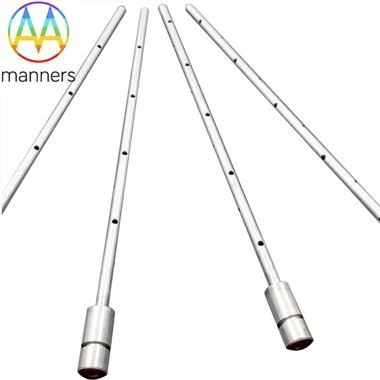
Quincke Spinal Needle 22G 90mm In An Ultrasound-First Neuraxial Service
Nov 26, 2026
Primary keyword: Quincke Spinal Needle 22G 90mm | Secondary: ultrasound-guided lumbar puncture, pre-procedure scanning, needle tip visibility | Intent: informational and commercial | Meta: Ultrasound-guided lumbar puncture is becoming routine. Learn where the Quincke spinal needle 22G 90mm fits in a scanning-first workflow.
Blind Landmarks Are No Longer the Default
Palpating a spine and counting interspaces was once the whole of neuraxial assessment. It is now the first step of a process that increasingly includes scanning: identifying the level, measuring depth, confirming midline, and occasionally guiding the needle in real time. The change has been driven less by technology than by caseload, because the patients who most need a spinal are the ones whose landmarks are hardest to feel.
Ultrasound does not make a needle better, but it changes which needle is appropriate. When the depth is known and the midline is marked, a longer needle becomes a planned instrument rather than a speculative reach, and the value of a clear tactile end point rises, because the operator can interpret it against a known depth instead of guessing. That combination is where the 22G 90mm cutting needle fits naturally.
What Ultrasound Changes About the Needle
Three needle properties become visible under scanning. The first is tip echogenicity: a needle whose tip returns a strong signal is easier to follow in plane, and a tip that disappears into tissue forces the operator to infer position from the shaft. The second is stiffness: a flexible needle bows away from the plane of the probe, which is manageable at shallow depth and increasingly difficult at eight centimetres. The third is length, because a needle that is barely long enough leaves no margin for the angle of an in-plane approach.
Real-time guidance also changes the cost of failure. An out-of-plane approach that loses the tip can usually be rescued by re-scanning, while an in-plane approach that loses the tip often requires withdrawing to the skin and starting again. In both cases the penalty for a short or wandering needle is higher than it is in a blind technique, which is why departments that scan tend to standardise on a 90mm needle with a stiff cannula rather than on the shortest needle that might reach.
Echogenicity is a design property, not a universal one. Some needles have a tip that returns a strong signal, others have a shaft that reflects well but a tip that disappears; the difference is in the grind, the surface finish and the geometry of the bevel. A department that intends to use real-time guidance should evaluate the specific product it plans to buy under its own machine, because a generic claim about visibility is untestable at the bedside.
Which Needle for Which Spine
A workable matrix has three columns. Easy spines, defined as palpable landmarks and a shallow depth, can be served by a 25G atraumatic needle in experienced hands, or by a 22G cutting needle when flow and speed matter. Intermediate spines with poor landmarks but a normal depth are the natural territory of the 22G 90mm needle placed under pre-procedure scanning. Difficult spines with depth beyond eight centimetres, previous surgery or scoliosis need the longest available needle, real-time guidance, and a plan for abandoning the midline approach in favour of a paramedian one.
The matrix is not a rule about needles; it is a rule about matching instrument to information. When information is scarce, the instrument should be one that provides feedback. The cutting bevel provides that feedback in the form of a discrete give, and the 90mm length provides the margin to act on it.
A Practical Scanning-to-Puncture Workflow
Scan the patient in the position in which the puncture will be performed, because depth and midline both change between sitting and lateral. Identify the level, mark the midline and the level on the skin, and measure the distance from skin to the ligamentum flavum and, where visible, to the posterior dura. Record the measurement, then prepare and drape without erasing the marks.
Perform the puncture with the bevel in a constant orientation and advance in measured increments. The depth measurement sets the expectation: resistance should change near the predicted depth, and the absence of a change at that depth is information rather than a reason to push. If real-time guidance is used, keep the probe stationary and move the needle, rather than moving both, so that the relationship between the tip and the target stays interpretable.
Depth measurement also changes the failure plan. If the scan shows eight centimetres to the ligamentum flavum and the needle is ninety millimetres, there is little margin for an in-plane angle that consumes length. That is a reason to choose a paramedian approach with a steeper trajectory, or to use a longer needle, before the puncture begins rather than after two failed attempts.
Where Ultrasound Still Fails
Ultrasound fails in three situations that are worth naming. The first is the patient whose bone windows are poor because of obesity or ossification, where the depth can be estimated only approximately and the midline only roughly. The second is the patient who cannot hold position, where a scan obtained in one posture is invalid by the time the needle is inserted. The third is the operator who scans well but does not translate the image into a puncture plan, treating the scan as reassurance rather than as measurement.
The common thread is that scanning reduces uncertainty but does not remove it. Departments that treat a scan as a guarantee tend to puncture more confidently at the wrong level, while departments that treat it as a measurement tend to puncture less often and more accurately.
Summary: Information First, Then Instrument
The scanning-first service needs a needle that is long enough for measured depth, stiff enough to follow a planned trajectory, echogenic enough to be seen if real-time guidance is used, and sharp enough to give a clear end point when the dura is crossed. The 22G 90mm cutting needle meets those requirements for the intermediate and difficult spine, and remains appropriate for the easy spine when flow and pressure measurement are required.
The companion requirements are equally concrete: a probe, a marking pen that survives skin preparation, a documented depth, and a protocol that states when to switch from midline to paramedian rather than repeating a failing approach.
A second failure mode is over-reliance on a single scan. Depth and midline change with posture, and a patient who sat for the scan and lies for the puncture has a different anatomy. Scanning in the position of the procedure, and re-checking the mark after positioning, removes most of that error and costs less than a repeat puncture.
Outlook: AI Landmark Detection and Smarter Probes
The next step in this area is automated interpretation. Machine-learning models trained on neuraxial ultrasound can already identify the level, the midline and the depth of the ligamentum flavum in research settings, and the commercial versions will arrive as software features on existing machines rather than as new devices. When that happens, the needle becomes the last manual component in a largely measured process.
For consumables, that means the interesting specifications shift towards consistency: a tip whose force signature is repeatable, a cannula whose straightness is verified, and a hub that connects to instrumentation without introducing dead space. Those properties matter more to an automated workflow than to a skilled pair of hands, and they are the properties a buyer should start asking for now.
Frequently Asked Questions
Does ultrasound guidance require a different needle?
Not a different type, but a longer and stiffer needle is more useful, because in-plane approaches consume length and flexible cannulas bow away from the imaging plane.
Can the 22G 90mm be used for real-time guided puncture?
Yes. Tip echogenicity varies by design, so trial the specific product under scanning before standardising on it.
Is pre-procedure scanning enough without real-time guidance?
For most intermediate spines, measurement of level and depth plus a marked midline is sufficient and faster than real-time guidance.