Micron-level Precision: Unveiling The Manufacturing Process Of The Tip Of The V3 Infusion Needle
Jun 01, 2026
The outstanding performance of the V3 Infusion Needle (manufactured by Manners Technology) is rooted in a manufacturing process system that integrates high-precision mechanical processing, advanced material handling, and strict quality control. From a single stainless steel bar to a reliable and precise needle, the production process is a manufacturing art on the micron scale.
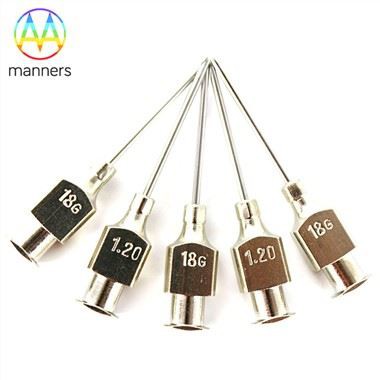
The manufacturing journey begins with high-precision bar materials. The selected stainless steel 304 bar has diameter tolerance, straightness and grain size that must be carefully selected to ensure the stability of subsequent processing. One of the core forming processes is the sliding headstock lathe (Sliding Headstock Lathe) processing, which specifically uses the Japanese Citizen Cincom L12-1M7 model. This type of machine is also known as a "Swiss-type lathe", characterized by the fact that the spindle box can slide longitudinally (Z-axis movement), while the tool is fixed. It is particularly suitable for processing slender shaft parts. When processing the hexagonal base of the V3 pin, the bar material is rotated at high speed and pushed forward. Multiple tools perform simultaneous operations such as turning the outer circle, milling the hexagon, and tapping threads under the control of the numerical control program. The Citizen Cincom L12-1M7 can achieve a size accuracy of ±0.01mm and an angle tolerance of ±0.1°, with a surface roughness of Ra < 0.4μm. This level of smoothness reduces friction during thread engagement, ensuring a smooth installation and reliable sealing with the injection robot interface.
The shaping of the needle tip part relies on the swaging technology. Swaging is a chipless forming process that uses two or four molds to perform high-frequency, small-amplitude radial forging on the ends of rotating or stationary tubes or rods, reducing their diameters and changing their shapes. The two-mold rotary swaging machine used by Manners Technology gradually forges the end of the stainless steel tube into a needle tip with a specific taper and double-hole structure through the reciprocating radial movement of the molds. Compared with traditional machining drilling, swaging is a cold forming process that allows metal fibers to flow continuously along the shape, not only increasing the density and strength of the material, but also avoiding the burrs and micro-cracks that may be produced during machining. By precisely controlling the forging frequency, feed rate, and mold profile, consistent needle tips with smooth inner holes and uniform wall thickness can be produced.
To connect the high-precision hexagonal base with the spun-forged needle tip, a welding technique is needed that can ensure strength without damaging the material properties. Laser welding demonstrates significant advantages in this regard. The laser beam is focused to a very small spot (up to the 0.1mm scale), with an extremely high energy density. It can instantly (in milliseconds) melt the local metal and form a molten pool. Compared to traditional arc welding, laser welding has a very low heat input and a very narrow heat affected zone. This means that very little heat is transferred to the base and the needle tip during the welding process, effectively preventing problems such as grain growth, deformation or corrosion reduction (sensitization) of stainless steel due to overheating. The weld seam formed by laser welding has a large depth-to-width ratio, high strength, and a smooth appearance, and almost no subsequent grinding is required, maintaining the integrity and aesthetics of the product.
After welding, the needle body enters the surface finishing stage. Electro-polishing (Electropolishing) is the finishing touch. The workpiece is placed as the anode in a specific electrolyte solution and then electrified. After that, the current density at the microscopic protrusions on the surface is higher, and the metal dissolution rate is faster, achieving a leveling effect. Electro-polishing conducted in accordance with the ASTM B912 standard can remove approximately 2-3 micrometers of the surface material, completely eliminating the microscopic scratches, burrs, and embedded impurities left by turning or spinning forging. The result is a mirror-like smooth surface with extremely low surface energy. This not only enhances corrosion resistance, but more importantly, the ultra-smooth surface significantly reduces liquid residue, which means more thorough cleaning and lower cross-contamination risks for the food industry that needs to frequently switch the injected materials.
Following closely is chemical passivation (Passivation). The workpiece is immersed in nitric acid or citric acid solution, where through chemical reactions, the free iron particles exposed on the surface due to mechanical processing are dissolved, allowing more of the chromium-rich alloy surface to be exposed. In the air, chromium quickly combines with oxygen to form a thin but extremely dense and stable chromium oxide passivation film. This film is the fundamental source of the corrosion resistance of 304 stainless steel. After a systematic passivation treatment, the V3 injection needle can remain shiny and new even when exposed to acidic juices, salts, or various food additives for a long time, without rusting.
Finally, after multi-slot ultrasonic cleaning to remove all residues from processing and chemical treatment, each needle must undergo functional tests such as magnifying glass inspection, size inspection, and air tightness testing before being placed in dust-proof and moisture-proof packaging. The entire manufacturing process, from CNC code programming to final quality inspection, is under the framework of the ISO 13485 medical device quality management system, ensuring the controllability of the process and the traceability of the results. It is precisely this series of interlocking, pursuit-of-perfection precision processes that jointly establish the stable and reliable performance foundation of V3 infusion needles in the demanding industrial environment.